Schools Don't Buy AI. They Buy More Teaching Time.
Whenever I meet a school principal, I never begin by talking about Artificial Intelligence.
Instead, I ask one simple question.
"How much classroom time is spent taking attendance every day?"
The answer is usually between three and ten minutes per class.
It may not sound like much.
But when you multiply those few minutes by hundreds of classrooms over an entire academic year, the amount of teaching time lost is significant.
That is why schools are exploring AI-powered classroom attendance—not because AI is the latest technology trend, but because they want teachers to spend more time teaching and less time on routine administrative work.
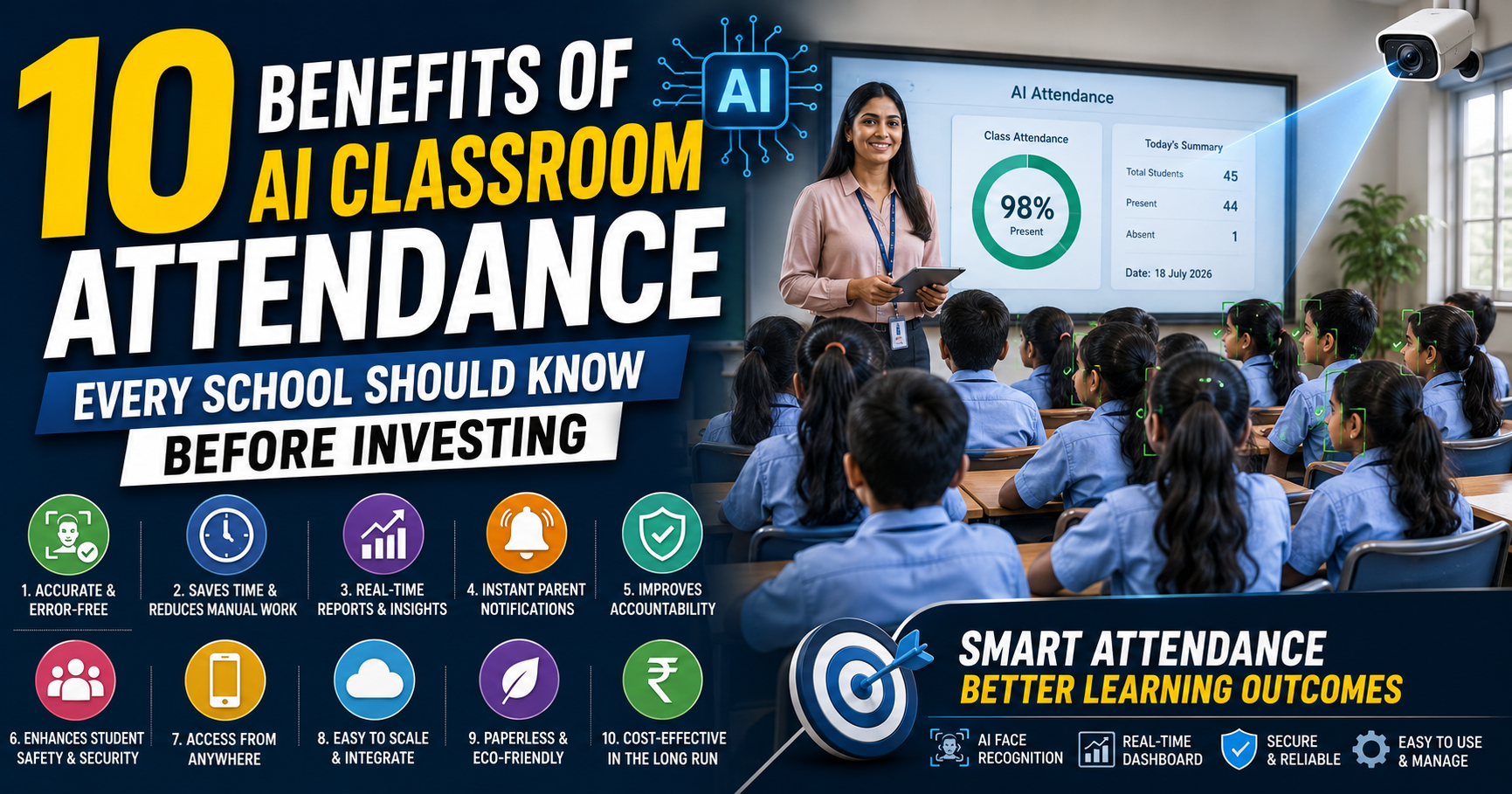
If your institution is evaluating an AI Classroom Attendance System, here are the ten benefits that matter most.
1. Teachers Spend More Time Teaching
This is the biggest advantage, yet many people overlook it.
Attendance is necessary, but it should never consume valuable classroom time.
With AI classroom attendance, teachers can capture attendance in seconds using a group photo instead of calling every student's name.
The result is simple:
More teaching.
Less administration.
2. Students Stay Focused
Every teacher has experienced it.
The lesson begins.
Attendance starts.
The classroom becomes noisy.
Students answer for absent friends.
Some are distracted before the lesson has even started.
AI attendance allows teachers to complete attendance quickly so learning begins almost immediately.
3. No Expensive Classroom Hardware
One of the biggest misconceptions is that AI attendance requires special cameras in every classroom.
It doesn't.
Modern AI attendance systems can work using ordinary Android phones or tablets already available in schools.
That means institutions can modernize attendance without replacing classroom infrastructure.
4. Better Accuracy Than Manual Registers
Manual attendance depends entirely on human concentration.
Names can be skipped.
Entries can be made incorrectly.
Attendance may be updated later from memory.
AI assists teachers by identifying registered students and preparing attendance automatically.
Teachers remain in control because they review the attendance before final submission.
Technology supports teachers instead of replacing them.
5. Eliminates Proxy Attendance
Traditional attendance methods have limitations.
Students may answer during roll call for absent classmates.
Cards can be exchanged.
Registers can contain mistakes.
AI attendance verifies the identity of registered students rather than simply recording a manual response.
This makes attendance records significantly more reliable.
6. Seamless Integration with School ERP
Attendance should never exist in isolation.
Schools already use ERP systems to manage admissions, academics, examinations, and communication.
A modern attendance solution should integrate directly with the existing ERP so that attendance data flows automatically instead of being entered multiple times.
This saves administrative effort and reduces errors.
7. Real-Time Visibility for School Management
School management should not have to wait until the end of the day to know attendance trends.
AI-powered attendance systems can provide real-time information such as:
- Students present today
- Class-wise attendance
- Faculty attendance
- Daily absentee reports
- Attendance trends
Better information helps administrators make faster decisions.
8. Easy to Scale Across Multiple Campuses
Many institutions now operate multiple campuses.
Managing attendance separately at each location creates inconsistency.
A centralized AI attendance platform allows management to monitor attendance across all campuses using a single system while maintaining campus-specific reports and controls.
As institutions grow, the technology grows with them.
9. Better Experience for Teachers
Technology succeeds only when people enjoy using it.
One lesson we have learned while demonstrating MemoFaceAI is that teachers appreciate solutions that simplify their daily routine.
If a teacher can complete attendance by opening an app, capturing one classroom photo, reviewing the result, and starting the lesson within moments, adoption becomes much easier.
The best technology is the technology people actually use.
10. A Foundation for Smarter Schools
Attendance is only the beginning.
Once schools have accurate attendance data, they can begin to answer important questions:
- Which classes have the highest absenteeism?
- Are attendance patterns changing before examinations?
- Which students may need additional academic support?
- Which classrooms consistently experience attendance issues?
Attendance becomes more than a record.
It becomes a source of insight that supports better academic planning and student engagement.
Is AI Classroom Attendance Right for Every School?
Not necessarily.
Every institution has different needs.
A small school with a few hundred students may have different priorities than a university with thousands of students across multiple campuses.
Before selecting any solution, I recommend asking these questions:
- Will teachers find it easy to use?
- Does it integrate with our existing ERP?
- Can it grow as our institution grows?
- Does it improve accuracy without adding complexity?
- Does it reduce administrative work?
The answers to these questions are often more important than the feature list in a brochure.
Final Thoughts
Artificial Intelligence is transforming many aspects of education, but schools should adopt technology for the right reasons.
The real value of an AI Classroom Attendance System is not that it uses artificial intelligence.
The real value is that it gives teachers more time to teach, helps administrators make better decisions, improves attendance accuracy, and creates a smoother experience for everyone involved.
When implemented thoughtfully, attendance becomes a process that works quietly in the background, allowing schools to focus on what matters most—education.
About the Author
Loveneesh Bansal is the Founder & CEO of Metaguard Mobitech Pvt. Ltd. With more than two decades of experience in attendance systems, access control, smart campus solutions, and enterprise software, he works with schools, universities, hospitals, and enterprises to simplify attendance through AI-powered solutions.
Must Read