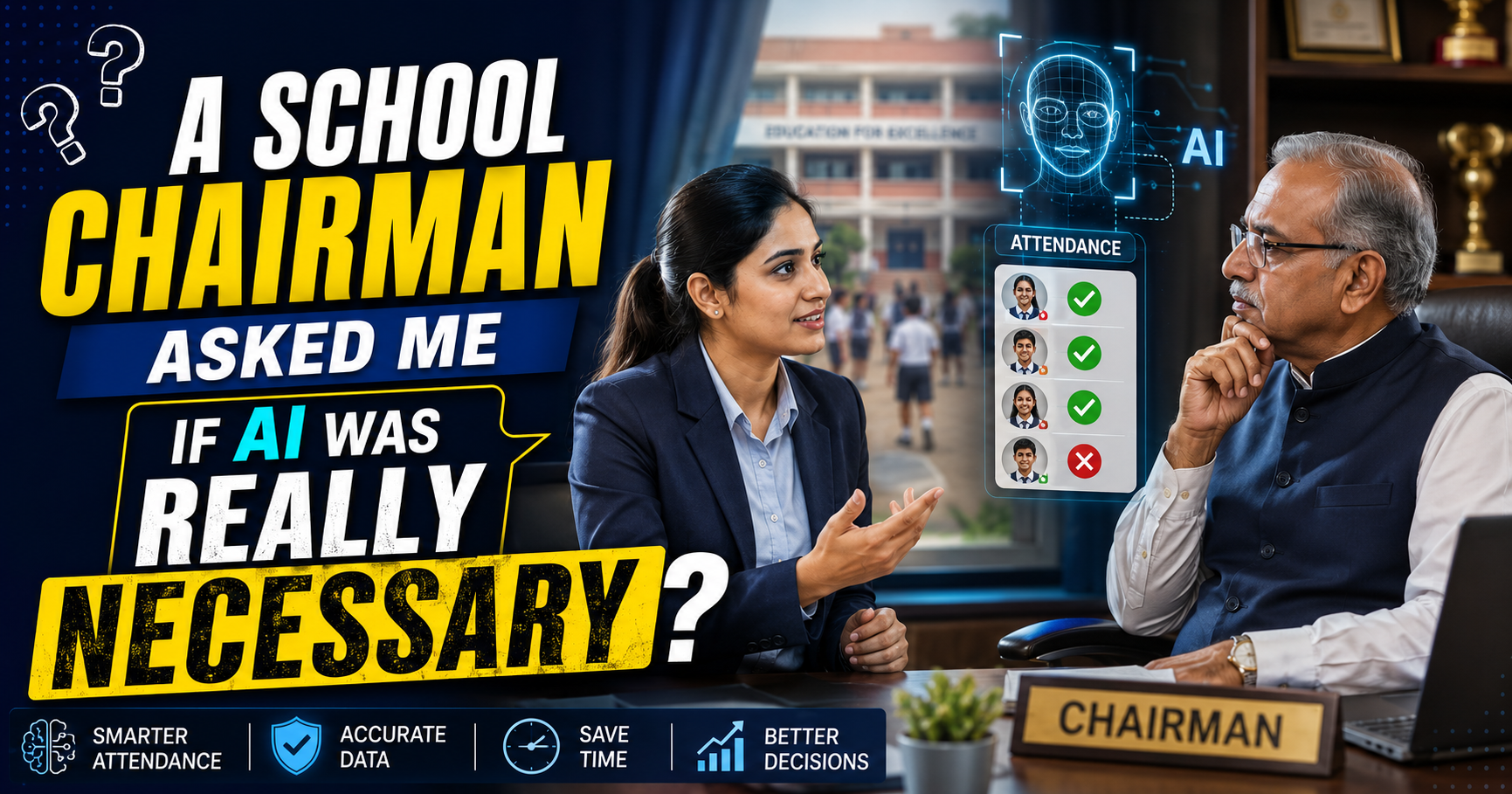
Artificial Intelligence has become one of the most discussed technologies in education. Almost every week, I meet school leaders who want to understand whether AI can improve attendance, classroom management, student safety, or administrative efficiency.
Interestingly, very few of these meetings begin with a discussion about their actual problem.
Most begin with a question about technology.
One such meeting has stayed with me for a long time because it reminded me of an important lesson that every school leader—and every technology provider—should remember.
The Question That Started the Conversation
A few years ago, I was meeting the chairman of a well-established school.
After discussing various attendance solutions, he looked at me and asked,
"Loveneesh ji, everyone is talking about AI. If I don't implement it this year, will my school fall behind?"
It was a genuine question.
A question many school owners are asking today.
But I didn't answer it.
Because whenever someone asks,
"Should I buy this technology?"
I believe the first responsibility of a consultant is not to recommend a product.
The first responsibility is to understand the problem.
I often compare it to visiting a doctor.
If you ask a doctor,
"Should I take this medicine?"
A good doctor doesn't immediately prescribe it.
The first question is always,
"Where does it hurt?"
Technology should work exactly the same way.
The First Question I Asked
Instead of discussing Artificial Intelligence, facial recognition, or pricing, I asked him one simple question.
"Sir, forget AI for one minute. In the last twelve months, what is the biggest attendance-related complaint that has actually reached your table? A complaint from a teacher, a parent, or your management team."
For a few seconds, the room became completely silent.
Then he smiled.
He admitted something that surprised me.
Every company before us had demonstrated features.
Some talked about Artificial Intelligence.
Others spoke about automation.
A few even discussed analytics.
But nobody had asked him where the real problem existed.
That one question completely changed the direction of our discussion.
We Discovered That Attendance Wasn't the Real Problem
As we started talking, I realised something important.
The school didn't have fake attendance.
Teachers were honestly maintaining attendance registers.
Students weren't misusing the system.
The attendance records themselves were accurate.
So where was the problem?
The problem was time.
Every teacher spent nearly five minutes taking attendance at the beginning of every class.
Five minutes may not sound significant.
But multiply that across dozens of classrooms and several periods every day, and the school was losing hours of valuable teaching time.
Then another issue emerged.
Parents often came to know about their child's absence much later—sometimes only after periodic reports were generated.
Attendance wasn't inaccurate.
It was simply too slow.
And communication was delayed.
I looked at the chairman and said,
"Sir, your attendance system isn't broken. It is honest. What is broken is that it is slow, and it is silent."
That sentence changed the conversation.
Attendance was only the visible symptom.
The real challenges were lost instructional time and delayed communication.
Why Schools Should Focus on Outcomes, Not Technology
Once we understood the actual problem, the solution became much clearer.
The chairman didn't need Artificial Intelligence because other schools were adopting it.
He needed to solve four operational challenges.
- Give teachers more teaching time.
- Reduce manual attendance effort.
- Inform parents immediately.
- Generate reports automatically without additional administrative work.
Notice something interesting.
None of these objectives mention AI.
They describe business outcomes.
Technology is simply the tool that helps achieve those outcomes.
That distinction is extremely important.
Many schools start their technology journey by asking,
"Which system should we buy?"
I believe the better question is,
"What problem are we trying to solve?"
Why I Recommended AI-Based Classroom Attendance
Once the objectives became clear, I recommended a classroom attendance solution that uses AI-powered group photo recognition.
Instead of calling every student's name individually, the teacher simply captures one classroom photograph using a mobile phone.
Within seconds, attendance is processed automatically.
Parents receive attendance notifications immediately.
Reports are generated automatically.
Teachers recover valuable classroom time.
Administrators spend less time preparing monthly reports.
Most importantly, the solution worked with the school's daily routine instead of forcing teachers to follow a completely new process.
Technology should adapt to people.
People should not constantly adapt to technology.
Why I Didn't Recommend RFID Cards
One of the chairman's next questions was very practical.
"Could RFID cards solve the same problem?"
My answer was balanced.
RFID is a proven and reliable technology.
Many schools successfully use RFID-based attendance.
However, every technology has its ideal environment.
In schools, students sometimes forget their cards.
Cards may remain inside yesterday's school bag.
Occasionally, students even exchange cards with friends.
An RFID reader confirms the presence of a card.
It cannot always confirm whether the correct student is carrying it.
That doesn't make RFID a bad technology.
It simply means that every solution has limitations that schools should understand before investing.
Why Fingerprint Attendance Wasn't the Right Choice
Fingerprint attendance has also served educational institutions for many years.
It is reliable.
It is widely accepted.
But in this particular school, fingerprint attendance introduced another operational challenge.
Imagine more than a thousand students entering through one or two gates every morning.
Every student must stop.
Place a finger on the scanner.
Wait for verification.
Then move ahead.
Instead of reducing waiting time, the school simply moved the queue from the classroom to the entrance gate.
The technology worked.
The process didn't.
Whenever I recommend a solution, I don't evaluate only the technology.
I evaluate the complete experience.
The Bigger Lesson I Learned
That meeting reminded me of something I now tell almost every customer.
Never sell technology. Sell the outcome.
The chairman never wanted Artificial Intelligence.
He wanted teachers to spend more time teaching.
He wanted parents to trust the school's communication.
He wanted administrators to stop preparing attendance reports manually.
Artificial Intelligence happened to be the most suitable way of achieving those objectives.
It was never the destination.
It was only the vehicle.
The day we begin selling technology instead of solving business problems is the day customers stop listening.
Five Questions Every School Should Ask Before Buying an Attendance System
Before investing in any attendance solution, I encourage school leaders to ask these five questions.
- What attendance-related problem are we actually trying to solve?
- How much teaching time is currently being lost every day?
- How quickly do parents receive attendance information?
- Will this technology simplify teachers' work or increase it?
- Will this solution still meet our needs five years from now?
These questions often lead to better decisions than comparing feature lists.
Key Takeaways
- Don't adopt AI simply because it is popular.
- Identify the business problem before evaluating technology.
- Lost teaching time is often a bigger issue than inaccurate attendance.
- The best attendance solution is the one that integrates naturally into the school's workflow.
- Technology should improve communication, save time, and reduce administrative effort—not create additional work.
Final Thoughts
Looking back at that meeting, I don't remember the presentation.
I remember the question.
"If I don't implement AI this year, will my school fall behind?"
Today, my answer remains the same.
A school never falls behind because it doesn't buy the latest technology.
A school falls behind when it solves the wrong problem.
Before choosing AI, RFID, biometrics, or any other attendance solution, take a step back and ask one simple question:
"What challenge are we really trying to solve?"
The answer to that question will almost always lead you to the right technology.
About the Author
Loveneesh Bansal is the Founder & CEO of MemoFaceAI. For over two decades, he has worked with schools, universities, hospitals, manufacturing companies, and enterprises, helping them design attendance and workforce management solutions that solve real operational problems rather than simply introducing new technology.
If you want to discuss about your organization call me at 9312289566