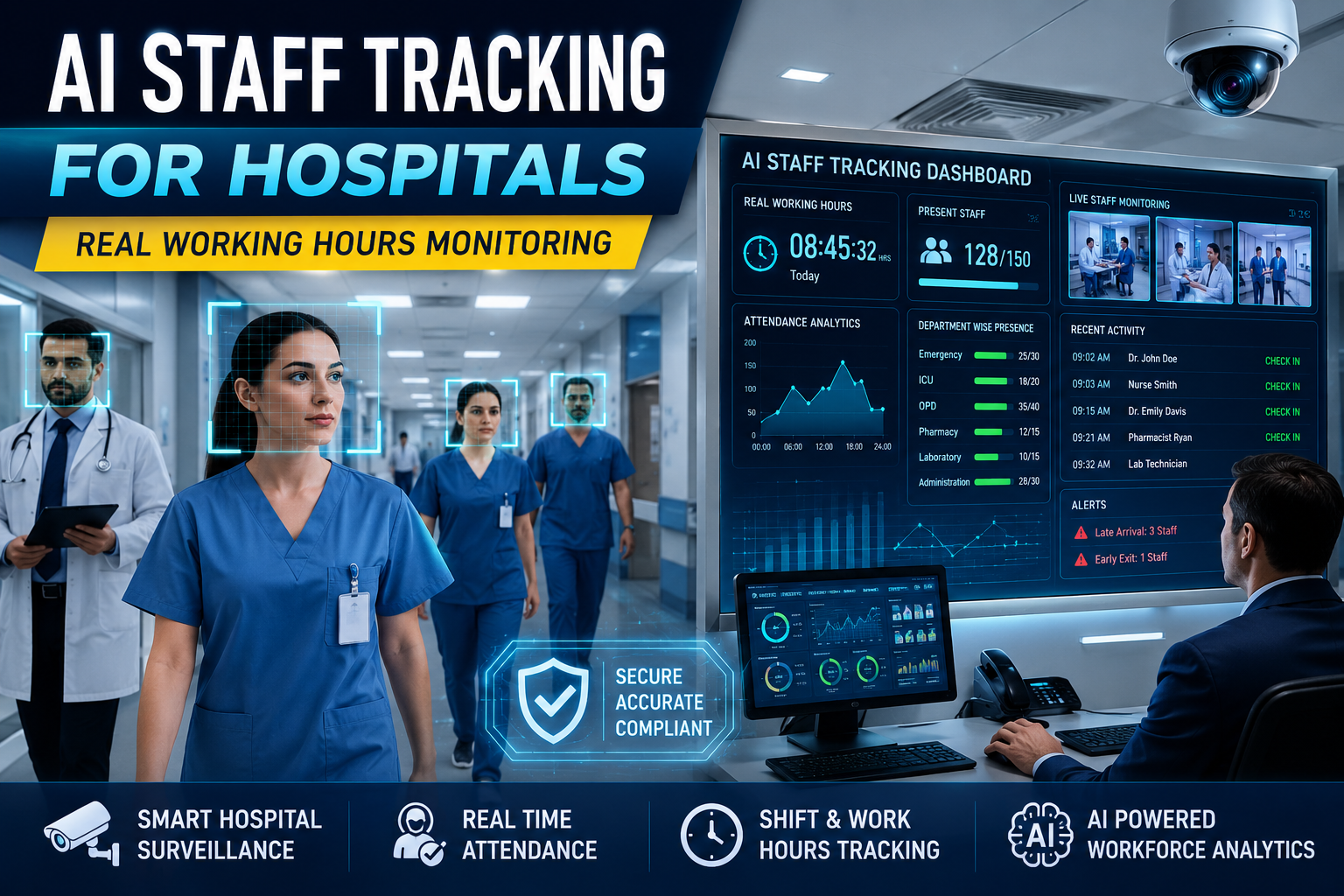
tracking actual staff working hours vs logged attendance hours.
Traditional attendance systems only record:
- login time
- logout time
- shift duration
But they do not measure:
- actual staff presence

- nurse availability

- ward movement

- time spent outside assigned zones

- real operational activity
This is why modern hospitals are adopting AI-powered CCTV staff tracking systems using:
These systems help hospitals compare:
Logged Hours vs Actual Working Hours
and improve workforce accountability, patient care, and operational visibility.
In this article, we’ll explain:
- how AI hospital staff tracking works
- CCTV employee monitoring in hospitals
- nurse and doctor movement analytics
- productivity tracking
- real-time workforce visibility
- operational efficiency benefits
- privacy and compliance considerations
The Workforce Challenge in Hospitals
Hospitals are complex operational environments.
Management must coordinate:
- doctors
- nurses
- ward staff
- housekeeping
- technicians
- security teams
- administrative employees
Traditional attendance systems only show:
- who checked in
- who checked out
But they do NOT show:
- actual availability
- active working hours
- movement between departments
- unauthorized absence from duty areas
Why Logged Attendance Hours Are Not Enough
Example:
A hospital employee:
- checks in at 8:00 AM
- checks out at 5:00 PM
System shows:
9 working hours
But management still does not know:
- how much time was spent inside assigned departments
- how often staff left work areas
- whether nurses remained available in wards
- whether support staff stayed active throughout the shift
This creates a major gap between:
Attendance Hours vs Actual Productive Hours
What is AI Hospital Staff Tracking?
AI hospital staff tracking is a workforce intelligence system that uses:
- CCTV cameras
- AI face recognition
- movement analytics
- real-time monitoring
- zone-based tracking
to analyze employee presence and movement across hospital premises.
The system automatically identifies:
- staff location
- department movement
- active shift duration
- time spent outside work areas
- workforce availability
How AI CCTV Staff Tracking Works
Step 1 — CCTV Camera Detection
Existing hospital CCTV cameras monitor:
- wards
- corridors
- entrances
- departments
- nurse stations
Step 2 — AI Face Recognition
The system identifies:
- doctors
- nurses
- support staff
- technicians
using AI facial recognition.
Step 3 — Movement Tracking
AI analyzes:
- movement patterns
- department transitions
- workstation presence
- idle duration
- unauthorized exits
Step 4 — Working Hour Calculation
The software compares:
- total logged attendance hours
- actual active work duration
- department presence time
Step 5 — Real-Time Dashboard & Analytics
Hospital management receives:
- workforce dashboards
- shift reports
- department analytics
- availability insights
- productivity reports
Why Hospitals Need Real-Time Staff Visibility
Hospitals require continuous workforce availability because patient care depends heavily on operational responsiveness.
Management needs visibility into:
- nurse availability
- emergency response readiness
- shift efficiency
- ward staffing
- workforce movement
Common Hospital Workforce Challenges
Staff Leaving Assigned Zones
Employees may spend excessive time:
- outside wards
- in cafeterias
- in non-assigned areas
without management visibility.
Shift Monitoring Difficulties
Large hospitals struggle to monitor:
- multiple departments
- rotating shifts
- support teams
manually.
Nurse Availability Concerns
Ward response time directly affects patient experience.
Unauthorized Movement
Sensitive hospital areas require controlled access.
AI Staff Tracking Use Cases in Hospitals
Nurse Availability Tracking
AI systems help monitor:
- nurse station presence
- ward movement
- patient care availability
Doctor Movement Analytics
Track movement between:
- OPD
- ICU
- emergency departments
- operation theatres
Shift Productivity Monitoring
Analyze:
- active shift duration
- department engagement
- idle time patterns
Housekeeping Staff Monitoring
Ensure operational staff remain active in assigned zones.
Emergency Department Workforce Visibility
Track emergency staff availability in real time.
AI Workforce Analytics Dashboard for Hospitals
Modern AI dashboards provide:
- active hour reports
- movement heatmaps
- department occupancy
- zone-based analytics
- workforce utilization
- shift performance reports
- attendance insights
Logged Hours vs Actual Working Hours
This is one of the biggest benefits of AI hospital workforce tracking.
Logged Hours
Measured from:
- shift check-in
- shift check-out
Actual Working Hours
AI calculates:
- active zone presence
- movement analytics
- ward availability
- operational engagement time
This provides a much more accurate picture of workforce productivity.
Benefits of AI CCTV Staff Tracking in Hospitals
Improved Workforce Accountability
Management gains visibility into real workforce activity.
Better Patient Care
Improved staff availability increases operational responsiveness.
Optimized Shift Management
Analyze staffing patterns more accurately.
Better Operational Efficiency
Reduce idle time and workforce gaps.
Real-Time Workforce Monitoring
Monitor departments live from centralized dashboards.
Enhanced Security
Track unauthorized movement in sensitive zones.
AI Attendance vs Traditional Hospital Attendance Systems
Traditional attendance systems only record:
- entry
- exit
AI systems provide:
- continuous workforce visibility
- department analytics
- movement tracking
- productivity insights
CCTV AI Tracking vs Biometric Attendance
| Feature | Traditional Attendance | AI CCTV Staff Tracking |
|---|---|---|
| Entry/Exit Tracking | Yes | Yes |
| Department Presence Tracking | No | Yes |
| Real-Time Workforce Visibility | Limited | Advanced |
| Nurse Availability Monitoring | No | Yes |
| Actual Working Hour Analysis | No | Yes |
| Zone-Based Tracking | No | Yes |
| Productivity Analytics | No | Yes |
Privacy & Compliance Considerations
Hospitals must ensure:
- secure data handling
- role-based access
- compliance with healthcare regulations
- employee privacy policies
AI systems should:
- use encrypted databases
- provide controlled access
- maintain audit logs
Transparency with employees is important for successful implementation.
Can Existing Hospital CCTV Cameras Be Used?
Yes.
Modern AI workforce tracking platforms can integrate with:
- existing CCTV infrastructure
- IP cameras
- AI surveillance systems
This reduces implementation cost significantly.
Payroll & HR Integration
AI workforce analytics can integrate with:
- attendance systems
- HR software
- payroll platforms
This helps compare:
- attendance hours
- actual productive hours
- overtime
- shift efficiency
before payroll processing.
Future of AI Workforce Tracking in Hospitals
Hospitals are moving toward:
- AI workforce intelligence
- predictive staffing analytics
- smart hospital automation
- operational efficiency analytics
- automated compliance reporting
AI staff tracking systems are becoming part of the broader digital hospital ecosystem.
Features Hospitals Want in AI Staff Tracking Systems
AI Face Recognition
Automatically identify staff.
Real-Time Movement Tracking
Monitor workforce activity live.
Zone-Based Analytics
Track department presence accurately.
CCTV Integration
Use existing surveillance infrastructure.
Productivity Analytics
Measure actual active work duration.
Shift Monitoring
Track workforce availability continuously.
Dashboard & Reporting
Generate operational analytics automatically.
Frequently Asked Questions (FAQs)
What is AI hospital staff tracking?
It is a system that uses CCTV cameras and AI face recognition to monitor staff movement and working hours.
What is the difference between logged hours and actual working hours?
Logged hours measure attendance duration, while actual working hours analyze active workforce presence and operational activity.
Can CCTV cameras track hospital staff?
Yes. AI video analytics can monitor staff movement across hospital departments and zones.
Why do hospitals need workforce analytics?
Hospitals need real-time visibility to improve operational efficiency, staff accountability, and patient care.
Can existing hospital CCTV systems be used?
Yes. Modern AI software can integrate with existing CCTV infrastructure.
Is AI staff tracking secure?
Yes. Advanced systems use encrypted databases, controlled access, and secure analytics platforms.
Final Thoughts
Traditional hospital attendance systems only answer:
“Who came to work?”
Modern AI workforce tracking systems answer:
“Who was actively available, where, and for how long?”
By combining:
- CCTV cameras
- AI face recognition
- movement analytics
- workforce intelligence
- productivity monitoring
hospitals gain real operational visibility.
As healthcare organizations continue adopting digital transformation, AI-powered hospital staff tracking systems are becoming essential for:
- workforce optimization
- patient care improvement
- operational efficiency
- real-time workforce intelligence.