- corporate offices,
- hospitals,
- educational campuses,
- manufacturing plants,
- warehouses,
- and smart buildings.
But as biometric adoption grows, so does a critical question:
How do organizations ensure the face in front of the camera is actually real?
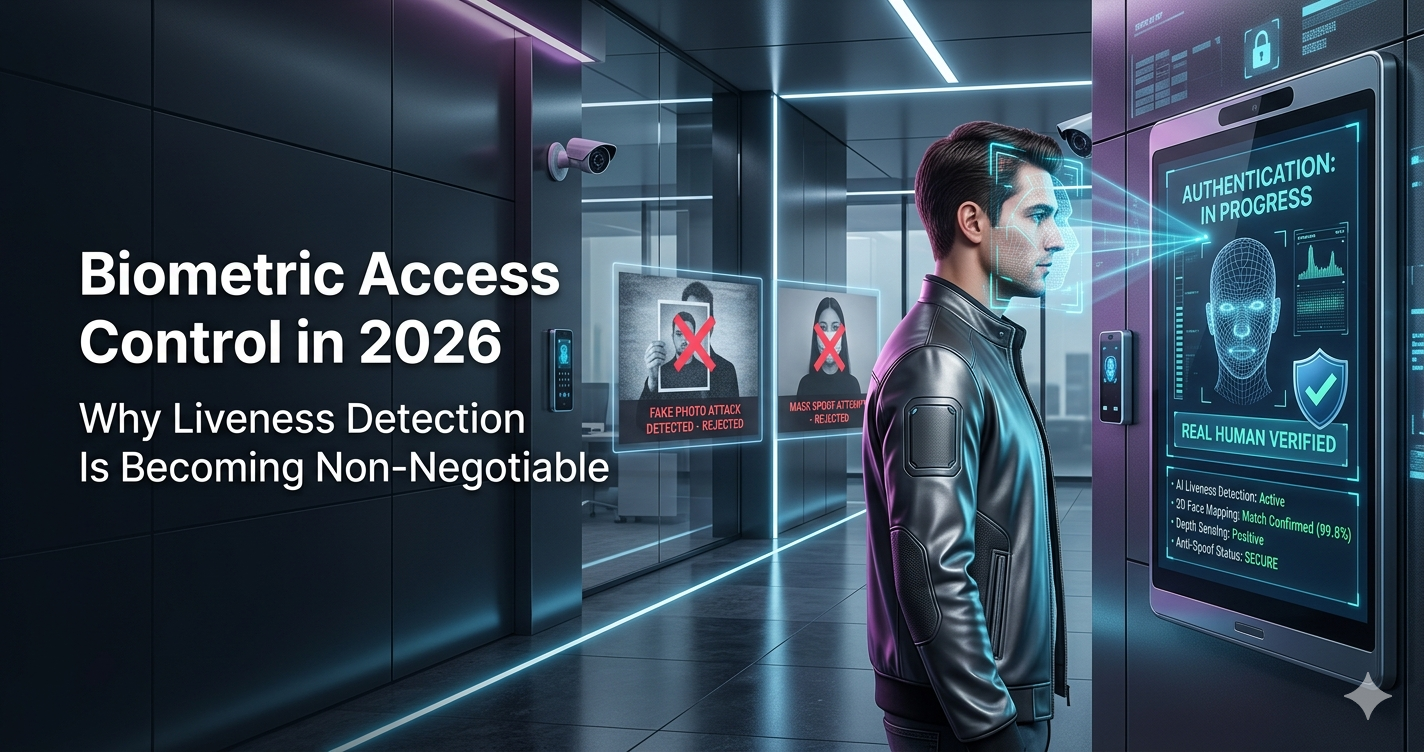
This is where liveness detection becomes one of the most important technologies in modern biometric security.
At MemoFaceAI, we strongly believe:
“Face recognition without liveliness validation is incomplete security.”
Biometric Access Control Has Gone Mainstream
According to recent industry analysis, biometric access systems have shifted from “premium niche technology” to expected infrastructure for modern enterprises.
Several factors are driving this transformation:
- AI accuracy improvements
- Affordable biometric hardware
- Demand for contactless access
- Rising credential theft
- Workforce automation
- Smart building adoption
- Familiarity with Face ID and mobile biometrics
Organizations increasingly prefer systems where users:
- walk naturally,
- authenticate automatically,
- and avoid physical access cards or PINs.
The Hidden Risk in Face Recognition Systems
Most traditional biometric systems only ask:
“Does this face match the stored identity?”
But modern attackers are using:
- printed photographs,
- replay videos,
- deepfakes,
- virtual camera injections,
- and synthetic identities
to fool facial authentication systems.
This creates a major vulnerability for:
- attendance systems,
- access control,
- visitor management,
- and workforce verification platforms.
Without liveness detection, even highly accurate face recognition engines can still be bypassed.
What Is Liveness Detection?
Liveness detection verifies whether:
- the person is physically present,
- alive,
- and interacting naturally with the system in real time.
Instead of only checking:
- facial similarity,
modern AI systems also analyze:
- facial movement,
- blinking,
- skin texture,
- reflections,
- depth,
- behavioral patterns,
- and interaction authenticity.
This helps detect:
- photos,
- screen replays,
- masks,
- and AI-generated spoofing attempts.
Industry experts now consider liveness detection “non-negotiable” for biometric deployments in 2026.
Why MemoFaceAI Prioritizes Face Liveliness
At MemoFaceAI, we believe biometric authentication must evolve beyond basic recognition.
That is why our architecture focuses heavily on:
- liveliness verification,
- anti-spoofing AI,
- behavioral validation,
- and intelligent facial analytics.
Our systems are designed to identify suspicious authentication attempts such as:
- static image attacks,
- replay videos,
- abnormal motion behavior,
- and non-human interaction patterns.
Because in real-world enterprise environments:
- recognition accuracy alone is not enough.
Why This Matters for Attendance Systems
One of the fastest-growing applications of facial recognition is:
AI attendance systems.
But these systems are also highly vulnerable to spoofing attacks.
Without liveliness validation:
- employees can attempt proxy attendance,
- photos may be used,
- and fake authentication attempts can occur.
This creates:
- payroll inaccuracies,
- compliance issues,
- operational fraud,
- and audit risks.
MemoFaceAI addresses this by combining:
- face recognition,
- AI video analytics,
- and liveliness verification
into a unified workforce intelligence platform.
The Future of Access Control Is Multi-Layered
Modern biometric systems are moving toward:
- multimodal authentication,
- continuous identity verification,
- behavioral AI,
- and AI-powered anomaly detection.
The industry is rapidly evolving from:
- “Who is this person?”
to:
- “Is this a real live person behaving normally?”
This shift is especially important in:
- smart offices,
- healthcare,
- manufacturing,
- logistics,
- education,
- and critical infrastructure.
Existing CCTV Infrastructure Is Becoming Intelligent
One of the biggest transformations in the security industry is that existing CCTV systems can now function as:
- biometric identity platforms,
- workforce intelligence systems,
- and AI-powered operational monitoring infrastructure.
At MemoFaceAI, we help organizations transform existing camera infrastructure into intelligent AI systems capable of:
- face attendance,
- liveliness validation,
- visitor management,
- workforce analytics,
- unauthorized access alerts,
- and operational intelligence.
This allows businesses to modernize security without replacing their entire infrastructure.
Privacy & Responsible AI Matter More Than Ever
As biometric adoption increases globally, organizations must also focus on:
- privacy,
- governance,
- encryption,
- secure template storage,
- audit logging,
- and responsible AI deployment.
At MemoFaceAI, we strongly support:
- privacy-first architectures,
- secure biometric processing,
- and enterprise-controlled deployments.
Because trust is becoming just as important as technology.
The Future of Biometric Security
The future of biometric authentication will not depend only on:
- matching a face,
- or scanning a fingerprint.
It will increasingly depend on:
- verifying liveliness,
- detecting anomalies,
- understanding behavior,
- and continuously validating trust.
Organizations deploying biometric systems in 2026 and beyond must think beyond convenience alone.
Security without liveliness validation is becoming an unacceptable risk.
Final Thoughts
Biometric access control is rapidly becoming mainstream across industries worldwide.
But as adoption grows, attackers are also becoming more sophisticated through:
- deepfakes,
- replay attacks,
- and AI-generated identity fraud.
That is why liveness detection is no longer an optional feature.
It is a foundational requirement for modern biometric security.
At MemoFaceAI, we continue to build AI-powered systems where:
- identity verification,
- liveliness detection,
- and intelligent operational monitoring
work together to create secure and trustworthy biometric experiences.