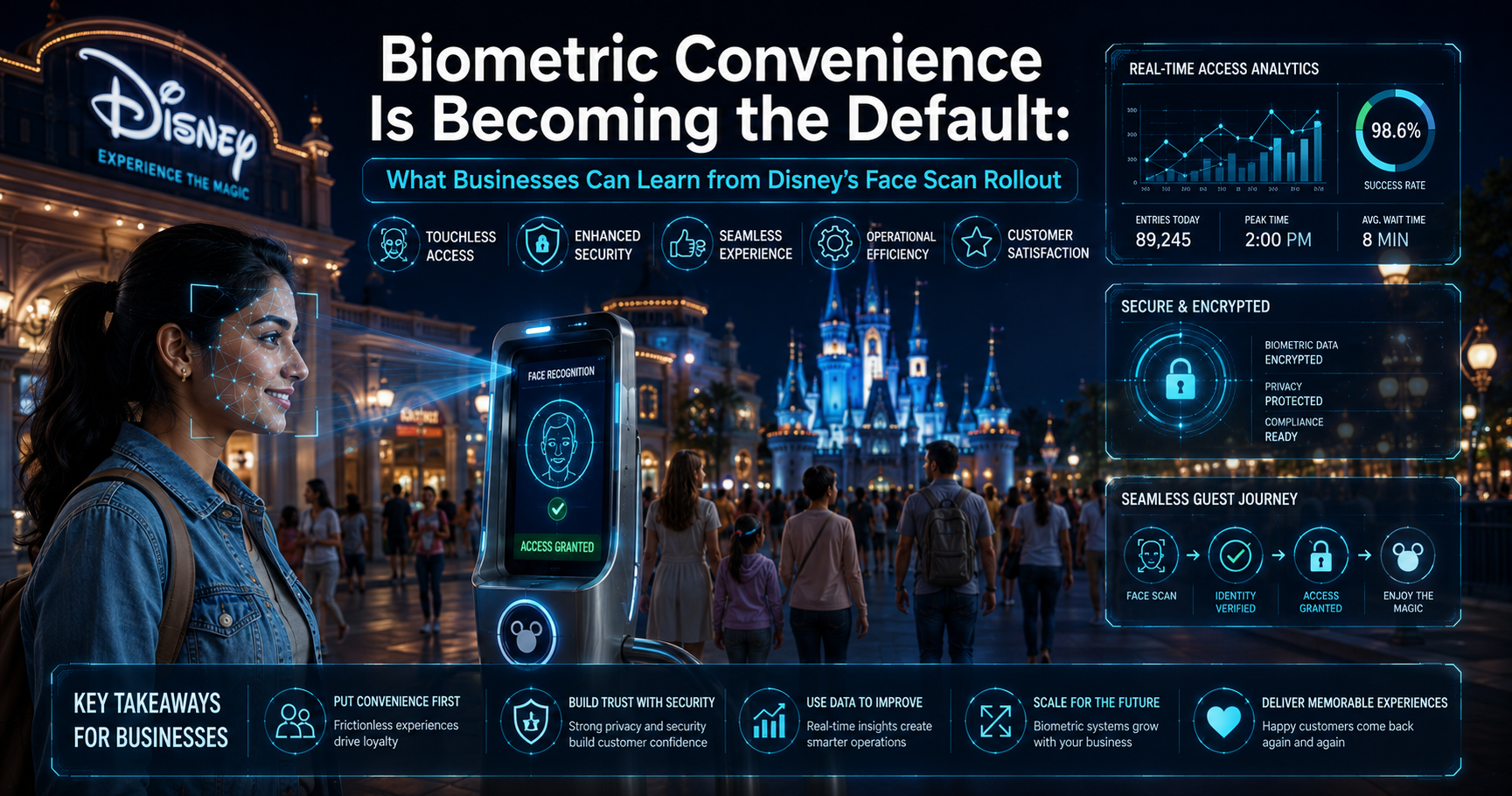
Today, some of the world’s biggest consumer brands are actively exploring how facial recognition and biometric systems can improve convenience, reduce friction, and enhance operational efficiency.
A recent industry report discussing Disney’s face scan rollout highlighted an important shift happening globally:
Biometric convenience is becoming the default, not the exception.
This signals a major transformation in how organizations think about identity, access, customer experiences, and operational automation.
The Era of Frictionless Experiences Has Arrived
Modern users expect:
instant access,
minimal waiting,
and seamless digital experiences.
Traditional systems involving:
physical tickets,
ID cards,
manual verification,
passwords,
and repeated authentication
are increasingly viewed as slow and inconvenient.
Facial recognition changes this experience completely.
Instead of:
stopping at checkpoints,
showing IDs,
swiping cards,
or manually verifying credentials,
users can simply walk naturally while AI systems identify and authenticate them automatically.
This creates:
faster movement,
smoother operations,
and significantly better user experiences.
Why Organizations Are Moving Toward Biometric Convenience
The demand for biometric systems is growing because organizations are facing operational challenges such as:
Long queues
Manual verification delays
Attendance fraud
Access management complexity
Security risks
Workforce inefficiencies
Customer experience expectations
AI-powered facial recognition systems help solve these issues simultaneously.
Organizations can:
automate identity verification,
reduce operational friction,
improve security,
and gain real-time visibility.
This combination of convenience and intelligence is driving global adoption.
Facial Recognition Is Expanding Beyond Security
One of the biggest industry shifts is that facial recognition is no longer only a security technology.
It is becoming an operational intelligence platform.
Modern organizations are now using facial recognition for:
Smart retail experiences
Hospitality automation
Event management
Industrial workforce monitoring
The technology is evolving from surveillance into intelligent automation infrastructure.
The Workplace Is Becoming Contactless
The pandemic accelerated demand for touchless systems, but the long-term transformation is much larger.
Organizations increasingly want:
and reduced dependency on physical hardware.
Traditional biometric devices often create operational limitations:
maintenance overhead,
physical touch requirements,
queue management,
and proxy attendance risks.
AI-based face recognition systems eliminate many of these challenges by using existing camera infrastructure and intelligent automation.
MemoFaceAI: AI Intelligence Over Existing CCTV Infrastructure
At MemoFaceAI, we believe businesses should not have to replace their entire infrastructure to adopt AI-powered identity systems.
MemoFaceAI transforms existing CCTV infrastructure into intelligent AI-powered operational platforms capable of:
This allows organizations to modernize operations while leveraging existing camera systems.
AI Attendance Is Becoming the New Standard
One of the fastest-growing applications of biometric convenience is AI-powered attendance management.
Traditional attendance systems often suffer from:
hardware failures,
manual interventions,
and operational inefficiencies.
AI attendance systems allow employees to:
walk naturally,
mark attendance automatically,
and avoid physical touchpoints.
This creates:
faster workforce movement,
improved compliance,
better attendance accuracy,
and enhanced operational visibility.
Existing CCTV Cameras Are Becoming Smart Sensors
Modern AI systems no longer treat CCTV cameras as simple recording devices.
Instead, cameras are becoming:
operational sensors,
identity intelligence systems,
and behavioral analytics platforms.
AI video analytics can now:
identify faces,
detect anomalies,
analyze movement,
generate alerts,
and provide operational insights in real time.
This transforms surveillance infrastructure into business intelligence infrastructure.
Convenience + Security = The Future of Identity
One of the key reasons facial recognition adoption is accelerating is because it improves both:
user convenience,
and organizational security.
Traditionally, improving security often increased operational friction.
AI-powered biometric systems are changing that equation.
Organizations can now:
strengthen identity verification,
reduce unauthorized access,
and improve experiences simultaneously.
This is one of the biggest reasons enterprises are rapidly investing in AI identity platforms.
Privacy & Responsible Biometric Deployment
As biometric adoption increases, privacy and ethical AI usage become critically important.
Organizations implementing facial recognition systems must ensure:
transparent policies,
secure biometric storage,
controlled access permissions,
encryption,
and compliance with local regulations.
Responsible AI deployment will become one of the most important factors influencing public trust and long-term adoption.
MemoFaceAI supports privacy-focused deployment models, including secure on-premise architectures where organizations maintain full control over their data.
The Future of Intelligent Infrastructure
The future workplace, campus, and smart facility will increasingly rely on:
and automated operational monitoring.
Identity systems will become:
invisible,
intelligent,
and seamlessly integrated into everyday operations.
People will increasingly move through environments without repeatedly stopping for verification.
The infrastructure itself will understand identity context automatically.
Final Thoughts
The growing adoption of biometric convenience by major global organizations reflects a much larger transformation happening across industries.
Facial recognition is evolving from a specialized security tool into a core layer of operational intelligence and customer experience automation.
Organizations are increasingly looking for systems that:
reduce friction,
automate operations,
improve security,
and create smarter environments.
Platforms like MemoFaceAI are helping businesses accelerate this transition by transforming existing CCTV infrastructure into intelligent AI-powered attendance, identity, and workforce management systems.
The future of biometric technology is no longer about scanning faces.
It is about creating seamless, intelligent, and frictionless experiences.