A few months ago, I was sitting in the HR department of a manufacturing plant of an auto mobile company to show case CCTV based face recognition cum workforce visibility system . HR executive told me that their attendance system had been working for years, and on paper, everything looked fine. But
"Our attendance machine isn't broken. It records fingerprints accurately. But every month we have employees standing in queues during shift changes. Sometimes the machine doesn't read dirty fingers. During winters, dry skin causes more failures. Production gets delayed by ten or fifteen minutes every shift. We don't want another machine—we want a better way." Can CCTV based solution fix this?
That conversation stayed with me.
For nearly two decades, fingerprint attendance systems have been the standard solution across factories, offices, schools, hospitals, and warehouses. They solved many problems that manual registers and RFID cards couldn't.
But workplaces have changed.
Organizations are larger.
Shift changes are faster.
Employees expect contactless experiences.
AI has matured.
Today, the question is no longer "Should we automate attendance?"
The real question is:
"Is fingerprint attendance still the best option, or is AI face recognition the future?"
A Short History of Attendance Systems
Attendance management has evolved significantly over the years.
We started with paper registers.
Then came punch cards.
RFID cards became popular.
Fingerprint biometric systems replaced cards because they reduced card sharing.
Now, AI-powered face recognition is changing attendance once again.
Every generation solved one problem while introducing another.
How Fingerprint Attendance Works
Fingerprint systems capture the unique ridge patterns of a person's finger.
During registration, the fingerprint is converted into a biometric template.
During attendance, the employee places their finger on the scanner.
The system compares the live scan with the stored template.
If they match, attendance is recorded.
It is reliable, proven, and still widely used across industries.
How AI Face Recognition Works
Face recognition follows a different approach.
Instead of asking employees to touch a device, the system analyses facial features captured through a camera.
Modern AI systems create mathematical face embeddings rather than storing ordinary photographs.
Every time a person walks past the camera, the live facial features are compared with the stored embeddings.
If the confidence score is within the accepted threshold, attendance is marked automatically.
The employee simply walks naturally.
No cards.
No fingerprint scan.
No waiting.
My Experience from the Field
Over the years, I have implemented attendance solutions in schools, factories, corporate offices, hospitals, clubs, and educational institutions.
One thing became very clear.
Every organization initially asks,
"Which technology is better?"
But after a few discussions, the real concern changes to,
"Which technology fits our environment?"
That is the right question.
Technology should adapt to your workplace—not the other way around.
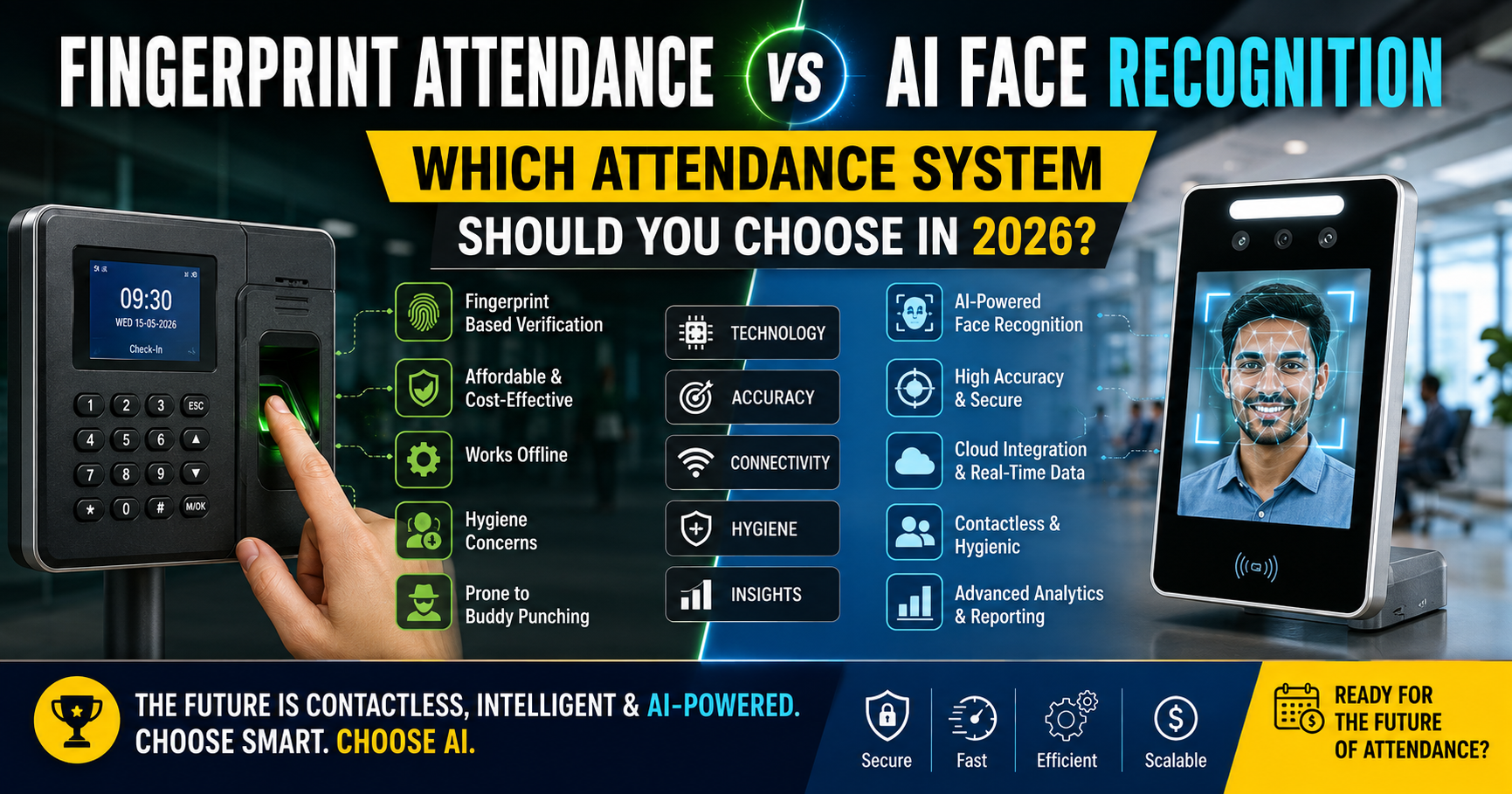
Comparing Fingerprint and AI Face Recognition
| Feature | Fingerprint Attendance | AI Face Recognition |
|---|---|---|
| Contactless | No | Yes |
| Touch Required | Yes | No |
| Queue Formation | Common during peak shifts | Minimal |
| Existing CCTV Can Be Used | No | Yes (in many deployments) |
| Card Required | No | No |
| PIN Required | No | No |
| Works While Walking | No | Yes |
| Hygiene Friendly | Limited | Excellent |
| Suitable for Large Crowds | Moderate | High |
| Automatic Attendance | No | Yes |
When Fingerprint Systems Work Well
Fingerprint attendance is still an excellent choice when:
- Employee count is relatively small.
- One or two attendance points are sufficient.
- Budget is limited.
- Employees do not mind touching the scanner.
- Entry traffic is evenly distributed.
Many organizations continue using fingerprint systems successfully.
Where Fingerprint Systems Face Challenges
Every technology has practical limitations.
In our deployments, we have commonly seen challenges such as:
- Employees forming queues during shift changes.
- Dust, grease, or moisture affecting fingerprint readability in industrial environments.
- Dry skin during winter causing repeated scans.
- Higher wear and tear due to frequent physical contact.
- Difficulty scaling when hundreds of employees arrive within a few minutes.
These are operational challenges rather than failures of the technology itself.
Why AI Face Recognition Is Becoming Popular
AI attendance systems address many operational bottlenecks by allowing attendance to happen naturally as people move.
Instead of stopping at a device, employees simply enter the workplace.
The system performs identification in the background.
For organizations processing hundreds or thousands of people every day, this significantly improves the overall experience.
What About Privacy?
This is one of the first questions customers ask.
Modern face recognition systems should:
- Store encrypted facial embeddings rather than raw images wherever possible.
- Encrypt all communication.
- Apply role-based access controls.
- Maintain audit logs.
- Follow the organization's data retention policies.
Privacy is not only about technology—it is also about governance.
Which Industries Benefit Most from AI Face Recognition?
From our experience, AI face recognition delivers the greatest value in environments such as:
- Manufacturing plants
- Schools and universities
- Coaching institutes
- Hospitals
- Corporate campuses
- Warehouses
- Logistics hubs
- Large office complexes
These are places where speed, accuracy, and minimal disruption matter.
So, Which One Should You Choose?
If your organization has fewer employees and your current fingerprint system is meeting operational needs, there may be no immediate reason to replace it.
However, if you are experiencing long queues, rapid organizational growth, or looking to use your existing CCTV infrastructure for automated attendance, AI face recognition is worth evaluating.
The decision should be based on your operational requirements—not on trends.
A Final Thought
Over the last twenty years, I have seen attendance technology evolve from paper registers to RFID cards, fingerprint scanners, and now AI-powered face recognition.
Each innovation has solved a different challenge.
The future of attendance is not about replacing people with technology.
It is about removing friction from everyday work while improving the quality of attendance data that organizations rely on.
Whether you choose fingerprint attendance or AI face recognition, the objective should always remain the same: build a system that employees trust, HR teams depend on, and management can confidently use for decision-making.
That philosophy continues to guide everything we build at MemoFaceAI.
About the Author
Loveneesh Bansal is the Founder of MemoFaceAI and has over two decades of experience designing and deploying RFID, smart card, biometric, and AI-powered workforce management solutions for schools, manufacturing companies, hospitals, enterprises, and educational institutions.