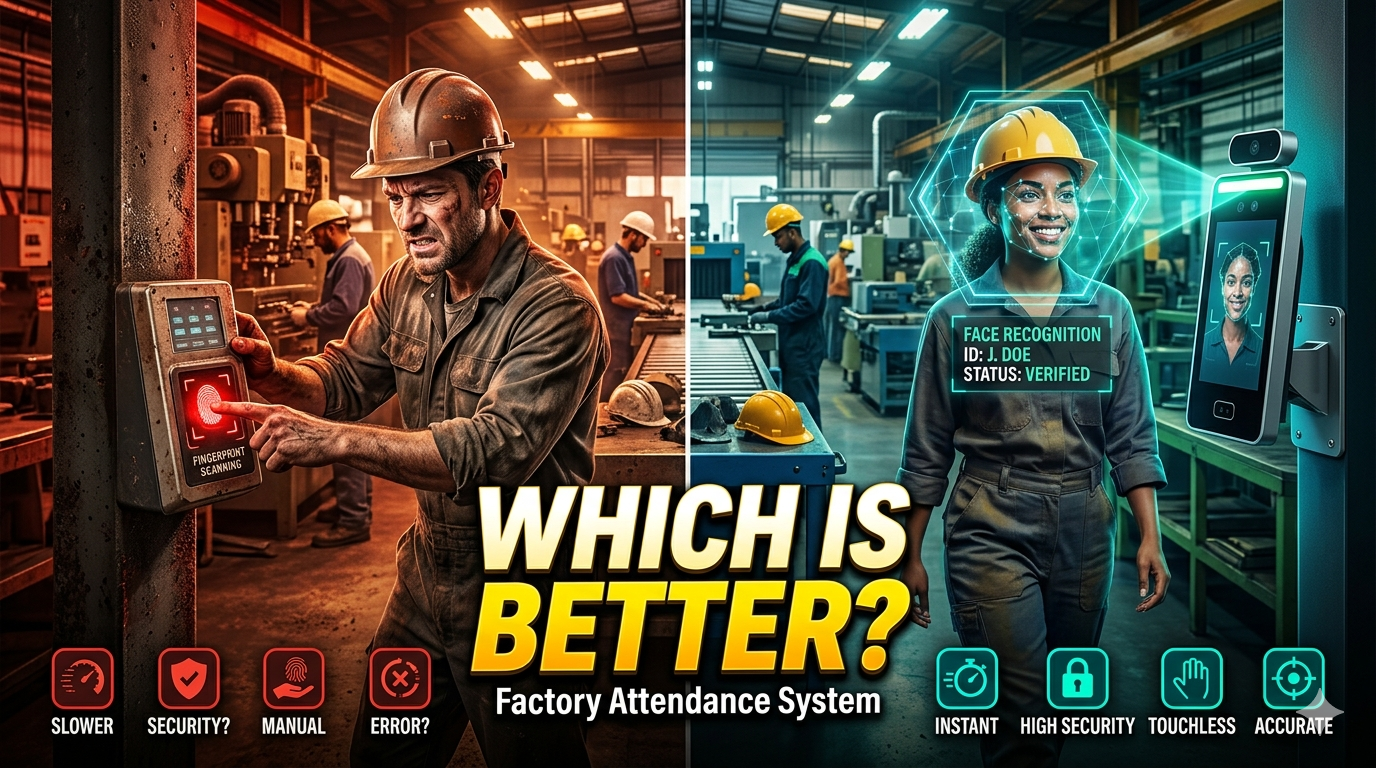
The reason is simple:
modern factories need faster, contactless, anti-proxy, and scalable attendance technology.
In this article, we’ll compare:
- Fingerprint vs face recognition attendance
- Which is better for factories
- Proxy attendance prevention
- AI attendance systems
- CCTV-based attendance
- Payroll integration
- Industrial use cases
- ROI and operational benefits
If you are evaluating attendance systems for a manufacturing facility, this guide will help you make the right decision.
Why Factory Attendance Systems Matter
Factory attendance is not just about marking entry and exit.
Attendance systems directly affect:
- payroll accuracy
- overtime calculation
- labor compliance
- shift management
- workforce productivity
- gate security
Even small attendance errors can create:
- payroll leakage
- compliance issues
- productivity losses
- fake overtime claims
That’s why choosing the right attendance technology is critical.
What is Fingerprint Attendance?
Fingerprint attendance systems use biometric fingerprint scanners to identify employees.
Employees place their finger on the scanner to:
- check in
- check out
- mark attendance
These systems became popular because they reduced manual attendance manipulation.
However, factories today face several challenges with fingerprint technology.
Common Problems with Fingerprint Attendance in Factories
1. Worn-Out Fingerprints
Factory workers often:
- handle chemicals
- perform manual labor
- work with machinery
Over time, fingerprints become unclear or damaged.
This causes:
- failed punches
- attendance delays
- frustration among workers
2. Proxy Attendance & Buddy Punching
Despite biometric verification, proxy attendance can still happen.
Common issues include:
- silicone fingerprint misuse
- forced attendance marking
- unauthorized fingerprint access
This creates payroll fraud risks.
What is Proxy Attendance?
Proxy attendance means:
One employee marking attendance for another employee.
In factories, this can lead to:
- fake overtime
- salary leakage
- inaccurate labor records
Stopping proxy attendance is one of the biggest reasons factories are adopting AI face recognition systems.
3. Hygiene Problems
Fingerprint devices require physical touch.
In industrial environments:
- dust
- oil
- grease
- sweat
can affect scanner performance and hygiene.
This became a major concern after COVID-19.
4. Slow Entry During Shift Changes
Factories with:
- hundreds of workers
- multiple shifts
- peak-hour entry
often face long queues at biometric machines.
This causes:
- shift delays
- crowding
- productivity loss
5. Hardware Maintenance
Fingerprint scanners require:
- regular cleaning
- maintenance
- sensor replacement
Industrial conditions can reduce device lifespan.
What is AI Face Recognition Attendance?
AI face recognition attendance systems use:
- artificial intelligence
- AI cameras
- CCTV integration
- facial recognition algorithms
to automatically identify employees and record attendance.
Employees simply walk through gates or entry points while the system:
- detects faces
- verifies identity
- marks attendance automatically
No touch is required.
How AI Face Recognition Attendance Works
Step 1 — Face Detection
AI cameras detect faces in real time.
Step 2 — Face Recognition
The software matches faces with registered employee data.
Step 3 — Attendance Logging
Attendance is marked automatically.
Step 4 — Dashboard Update
Attendance data syncs to cloud dashboards and payroll systems.
Why Factories Are Switching to Face Recognition
Modern manufacturing companies need:
- automation
- speed
- contactless systems
- real-time monitoring
- anti-proxy attendance
AI face recognition solves these problems efficiently.
Face Recognition vs Fingerprint Attendance Comparison
| Feature | Fingerprint Attendance | AI Face Recognition |
|---|---|---|
| Contactless | No | Yes |
| Proxy Prevention | Medium | Strong |
| Speed | Medium | Fast |
| Multiple Person Detection | No | Yes |
| Works with CCTV | No | Yes |
| Hygiene Friendly | No | Yes |
| Shift Crowd Handling | Limited | Excellent |
| Real-Time Monitoring | Basic | Advanced |
| Payroll Integration | Limited | Advanced |
| Analytics & Reports | Basic | Advanced |
| Maintenance | Higher | Lower |
Proxy Attendance Prevention: Which is Better?
Fingerprint Systems
Fingerprint devices can reduce basic proxy attendance, but they still have vulnerabilities.
Problems include:
- fake fingerprint attempts
- manual manipulation
- forced punching
AI Face Recognition Systems
Modern AI attendance systems use:
- facial mapping
- anti-spoof detection
- liveness detection
- real-time analytics
to prevent fake attendance.
This makes face recognition significantly stronger for anti-proxy attendance.
CCTV Face Recognition Attendance for Factories
Many factories already have CCTV infrastructure.
Modern AI attendance software can integrate directly with:
- IP cameras
- CCTV systems
- industrial surveillance systems
This helps factories:
- reduce hardware costs
- improve monitoring
- automate gate attendance
Gate Attendance Automation Using AI
AI-powered gate attendance systems automatically:
- identify workers
- log entry/exit
- track shift timing
- generate attendance reports
This eliminates manual attendance dependency.
Benefits of Face Recognition Attendance in Manufacturing
1. Faster Shift Entry
Employees can walk naturally through entry points.
No stopping required.
This reduces:
- queues
- delays
- crowd congestion
2. Better Attendance Accuracy
AI systems provide:
- real-time verification
- automatic tracking
- centralized attendance records
3. Improved Payroll Accuracy
Attendance integrates directly with payroll software.
This helps automate:
- salary calculation
- overtime
- late marks
- shift compliance
4. Multi-Location Monitoring
Large manufacturers can monitor:
- multiple plants
- warehouses
- factories
through centralized dashboards.
5. Better Workforce Analytics
Management gets:
- absentee reports
- overtime trends
- department analytics
- shift productivity insights
Offline Face Attendance for Factories
Internet connectivity may not always be stable in industrial environments.
Modern AI attendance systems support:
- offline attendance
- local data storage
- delayed cloud sync
This ensures attendance continues even during network outages.
Security Advantages of Face Recognition Systems
AI attendance systems also improve factory security.
They help:
- identify unauthorized access
- track contractor movement
- monitor restricted zones
- maintain audit logs
This creates an additional security layer.
Which Attendance System is More Scalable?
Fingerprint Systems
Scaling requires:
- more devices
- more maintenance
- more touchpoints
AI Face Recognition Systems
AI systems scale more efficiently because:
- one camera can monitor multiple employees
- cloud dashboards centralize data
- CCTV infrastructure can be reused
This makes face recognition more suitable for large factories.
Cost Comparison: Fingerprint vs Face Recognition
Initially, fingerprint systems may appear cheaper.
However, long-term costs include:
- maintenance
- device replacement
- downtime
- payroll losses
- attendance fraud
AI face recognition systems often provide:
- higher ROI
- lower fraud losses
- better automation
over time.
Best Industries for AI Face Recognition Attendance
AI attendance works especially well in:
- manufacturing plants
- warehouses
- logistics hubs
- construction sites
- pharmaceutical factories
- food processing units
Future of Factory Attendance Systems
Factory attendance is moving toward:
- AI automation
- contactless verification
- workforce analytics
- predictive labor intelligence
- integrated payroll automation
Traditional biometric systems are gradually being replaced by intelligent AI platforms.
Frequently Asked Questions (FAQs)
Which is better for factory attendance: fingerprint or face recognition?
AI face recognition is generally better because it is faster, contactless, and more secure against proxy attendance.
Can face recognition prevent proxy attendance?
Yes. Advanced AI systems use liveness detection and anti-spoofing technology to prevent fake attendance.
Why do fingerprint scanners fail in factories?
Factory workers often have damaged or worn fingerprints due to industrial work conditions.
Can CCTV cameras mark attendance?
Yes. AI attendance software can integrate with CCTV cameras for automated attendance tracking.
Is face recognition attendance expensive?
Modern AI systems often provide better long-term ROI due to reduced fraud and automation benefits.
Can face attendance systems work offline?
Yes. Many systems support offline attendance and later cloud synchronization.
Is AI attendance suitable for large factories?
Yes. AI attendance systems are highly scalable and ideal for multi-shift industrial environments.
Final Verdict: Which is Better?
For modern factories, AI face recognition attendance systems are becoming the preferred choice over fingerprint biometric devices.
Why?
Because they provide:
- stronger anti-proxy protection
- contactless operation
- faster attendance processing
- real-time analytics
- CCTV integration
- payroll automation
- better scalability
While fingerprint systems still work in some environments, manufacturing companies looking for long-term automation and workforce intelligence are increasingly moving toward AI-powered face recognition attendance platforms.