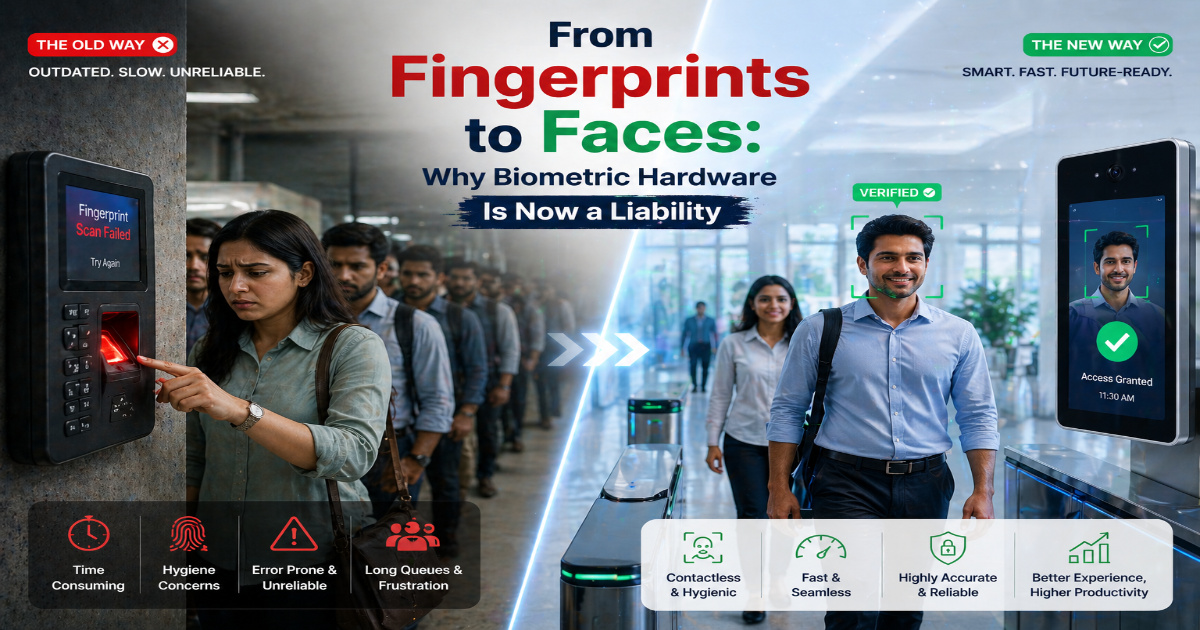
The fingerprint attendance machine had a good run. For over a decade, it was the default answer to buddy-punching, manual registers, and payroll disputes. But four converging forces have turned it from a solution into a liability: post-pandemic hygiene consciousness, rising hardware maintenance costs, the arrival of affordable face recognition AI, and a new generation of workers who find the technology invasive and slow.
The Hygiene Problem That COVID Made Permanent
Before March 2020, the fact that every employee touched the same sensor every day was considered an acceptable operational norm. After the pandemic, organisations across India discovered that employees were actively avoiding the fingerprint terminal — propping doors open, asking colleagues to mark attendance for them, or simply standing aside and waiting for peak rush to pass.
In a survey of 800 employees across 12 organisations conducted in late 2024, 61% said they were "uncomfortable" or "very uncomfortable" touching shared biometric sensors. Only 34% said the sensors were cleaned regularly enough to feel safe. The hygiene problem didn't disappear when COVID did — it became a permanent feature of employee sentiment.
The Hidden Maintenance Cost Nobody Accounts For
A fingerprint scanner costs INR3,000–8,000 at purchase. That's the number that goes into the budget. What doesn't go into the budget: sensor degradation over time (accuracy drops significantly after 18–24 months of high-volume use), software licensing renewals, IT support calls for failed enrollments, and re-enrollment when employees' fingerprints change due to age, injury, or manual labour.
True 3-Year Cost: Fingerprint vs. Face Recognition (100 employees)
The Accuracy Gap That's Costing You Money Right Now
Modern AI-based face recognition systems running on a standard Android tablet achieve 99.4%+ first-attempt recognition accuracy under typical office and factory lighting conditions. Fingerprint scanners operating in their third year of high-usage service average 71–78% first-attempt accuracy — with degradation accelerating for workers in manufacturing, construction, or food service where hands are frequently wet, dirty, or calloused.
Every failed scan is a friction event. It delays the employee, creates a queue at the entry point, and generates an exception record that someone in HR has to resolve manually. In a factory with 200 workers clocking in over a 30-minute window, even a 10% failed-scan rate generates 20 manual interventions per shift — every single day.
The Privacy Shift: Why Employees Are Starting to Object
India's Digital Personal Data Protection Act 2023 has created new employer obligations around the storage and processing of biometric data — including fingerprints. Fingerprint templates stored on-device or in local servers carry different compliance risk than face recognition data processed in real-time and not persistently stored. Legal teams in large organisations are increasingly flagging legacy fingerprint systems for review.
Beyond legal risk, there's an employee relations dimension. Younger workers in particular are questioning whether employers need to retain physical biometric data — and the answer, with modern face attendance systems, is that they don't.
When to Switch — and When to Wait
If your fingerprint system is less than 18 months old and performing well, you have time. If it's over 3 years old, running at below 90% first-attempt accuracy, or generating more than 5% daily exceptions, the economics of switching are almost certainly in your favour. The migration timeline for a 100–300 person organisation is typically 3–5 days from hardware arrival to full rollout.
Still Have Questions?
Here
are answers to the most common queries about AI-based attendance systems,
biometric alternatives, workforce tracking, facial recognition attendance, and
CCTV attendance monitoring.
FAQ
Why are fingerprint systems becoming outdated?
They require physical contact and cannot track movement.
What is replacing fingerprint attendance?
AI-based face recognition systems.
Is face recognition more accurate?
Yes. It provides better real-world tracking.
Does it require physical interaction?
No. It is contactless.
Is it suitable for modern workplaces?
Yes. Especially dynamic environments.
See how face attendance performs in your environment
Our 15-day pilot puts working hardware in your space with zero commitment. See the accuracy numbers with your own workforce.
Start Your Pilot ->