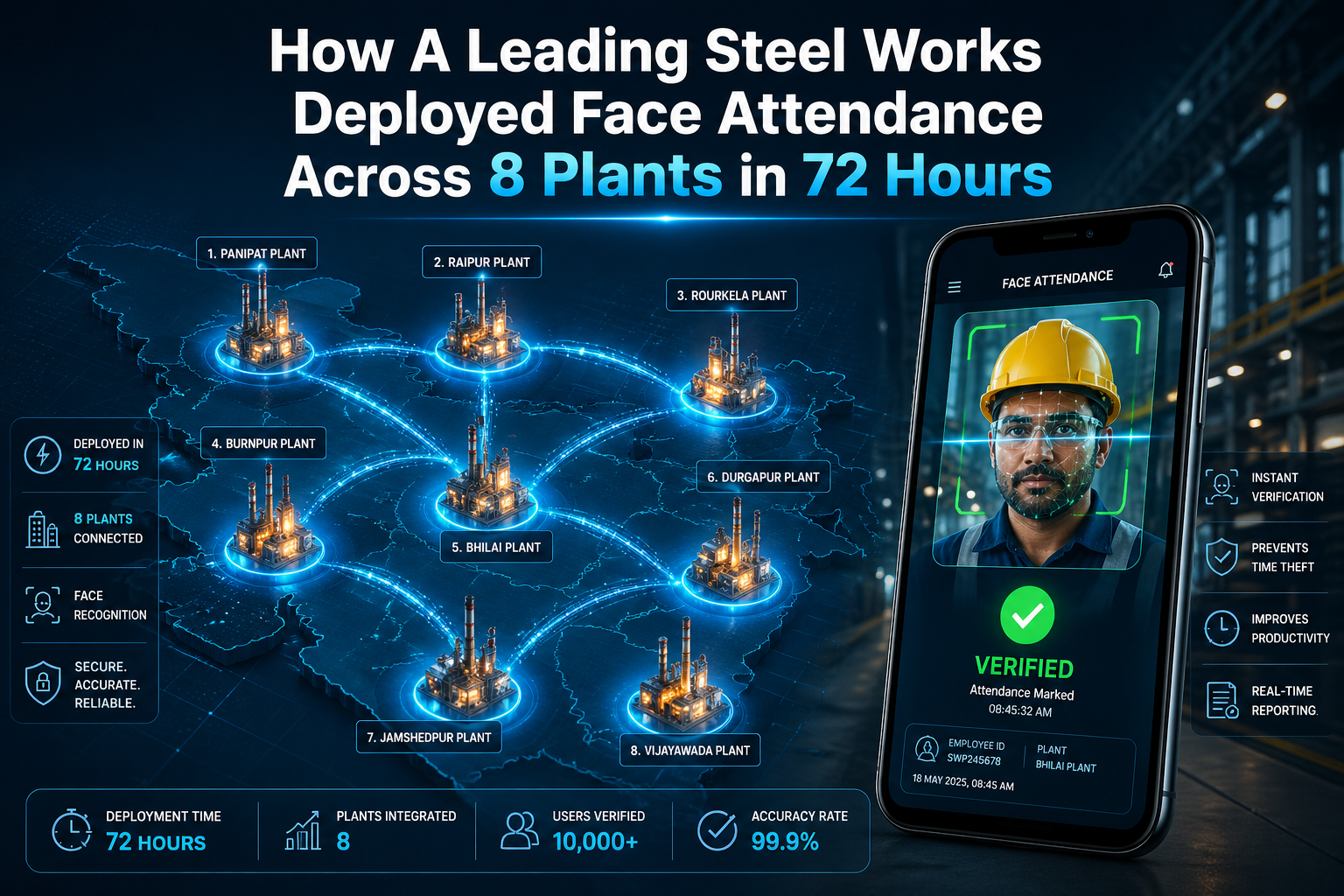
This Steel Works is a mid-size steel processing operation with plants in Haryana, Rajasthan, and Madhya Pradesh. In January 2026, they came to us with a problem that's surprisingly common in Indian manufacturing: an attendance system that had been "good enough" for years, suddenly wasn't — because their PE firm's new management had asked a simple question: "Show me your real overtime data." They couldn't.
The Problem: Data That Existed But Couldn't Be Used
This Steel Works had fingerprint scanners at all eight plants — 44 devices in total, some over five years old. Attendance was being recorded. But the data lived in eight separate, non-connected systems, in different formats, maintained by eight different plant security teams with no common reporting structure.
The HR head in Gurugram could see today's headcount for Plant 1. She could not see Plant 5's overtime data without calling the plant manager and waiting for a manually compiled Excel file. The consolidated monthly report — required for payroll processing across all plants — took 11 days to produce, involved four people, and contained, by the team's own estimate, "meaningful errors" in about 8% of records.
Steel Works — Before Deployment
The Deployment Plan: Why 72 Hours Was the Right Target
The decision to target 72-hour deployment came from a practical constraint: the PE firm's quarterly board meeting was in 75 days, and the CEO needed 60+ days of clean data to show the board. That meant deployment had to happen fast — not over weeks of phased rollout.
The plan had four components. First, we mapped all 8 plants by entry-point count and worker volume to determine device requirements and placement — this was done remotely using plant floor layouts provided by the facilities team, and took 4 hours. Second, devices were pre-configured and enrolled with the worker database before shipment — 1,400 worker faces were enrolled using photos from existing HR records, meaning zero on-site enrollment was required. Third, we trained one "super user" at each plant over a 45-minute video call — no travel, no in-person sessions. Fourth, devices were shipped to all plants simultaneously with a same-day courier arrangement, arriving within a 6-hour window.
Hours 1–24: Hardware In, Systems Live
Devices arrived at all eight plants within 8 hours of the deployment start. Installation at each plant was handled by the local facilities team following a 12-step physical setup guide — no IT specialist required. The AI recognition system went live at each plant as devices came online, with real-time data flowing to the central dashboard immediately.
By hour 18, six of eight plants were fully operational. Plants 6 and 7 had connectivity issues with their local network — a pre-existing infrastructure problem unrelated to the deployment. These plants were brought online using the system's cellular backup capability by hour 26.
Hours 24–72: Testing, Calibration, First Report
Hours 24–48 were used for supervised operation — the super user at each plant monitored for exceptions, with our support team on a shared WhatsApp group responding to queries in real time. We processed 4,200+ clock-in events across the network during this period. The average first-attempt recognition rate was 97.3% across all plants from day one — significantly better than the 73% average they'd been running on the old fingerprint system.
By hour 72, the first consolidated report across all eight plants was generated automatically — showing real-time headcount, plant-wise attendance rates, overtime flags, and comparison against the previous day's data. The HR head called it "the first time in 6 years I've seen all eight plants on one screen."
Steel Works — After 60 Days
What Made It Work: Three Decisions That Matter
Remote pre-enrollment was the single biggest accelerator. By loading the worker database into devices before shipping, we eliminated the most time-consuming part of any biometric deployment — getting 1,400 people to individually register their biometrics. HR record photos, even imperfect smartphone photos, were sufficient for initial enrollment with a high-accuracy model.
The single-platform architecture meant that once Plant 1 came online, every subsequent plant's data was automatically visible in the same dashboard. There was no integration work, no data migration, no IT project — just devices connecting to an already-running system.
Training one super user per plant — rather than attempting to train all supervisors — created accountability without complexity. Each super user knew they were the go-to person for their plant, and the 45-minute training was genuinely sufficient because the interface was designed for non-technical users from the ground up.
Still Have Questions?
Here
are answers to the most common queries about AI-based attendance systems,
biometric alternatives, workforce tracking, facial recognition attendance, and
CCTV attendance monitoring.
FAQ
How was the system deployed in 72 hours?
Using existing CCTV infrastructure and fast configuration.
Can AI attendance scale across multiple plants?
Yes. It supports multi-location deployment.
Does it work in industrial environments?
Yes. It is designed for factories and plants.
Can it handle shift-based workforce?
Yes. It tracks multiple shifts accurately.
Does it improve operational efficiency?
Yes. It reduces time leakage and improves discipline.
Ready for a multi-site deployment?
Tell us how many locations and we'll scope a deployment plan — including timeline, device requirements, and expected ROI — within 24 hours.
Get Your Deployment Plan ->