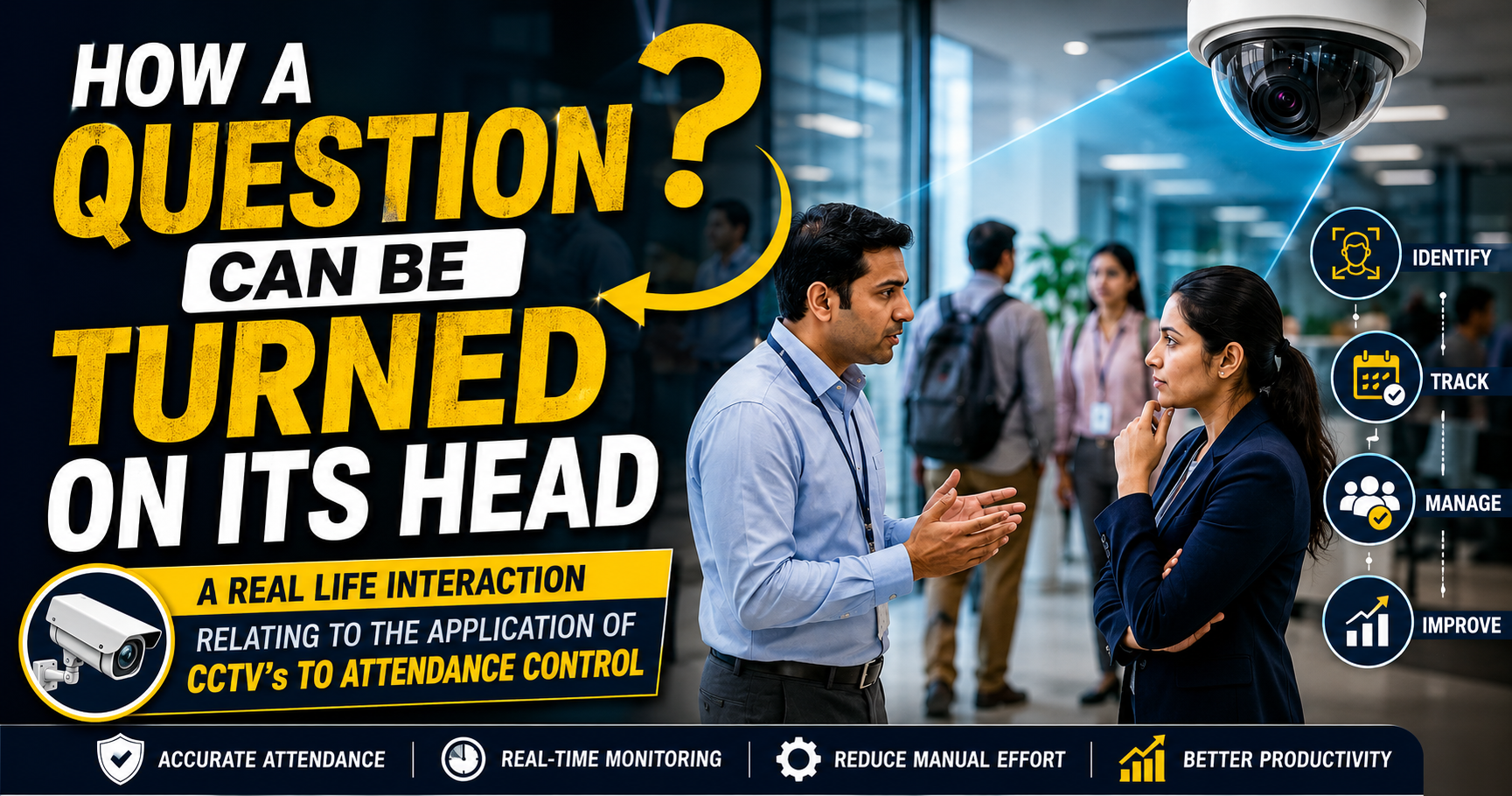
Last week, I received a demo request through our
website MemoFaceAI.com.
The HR Manager of a well-known IT company had
visited our website and noticed something that caught her attention. Our
website mentioned the features of one of our AI aided "Attendance Through
CCTV" solutions.
She was curious and scheduled a demonstration.
When we started the meeting, I expected the
discussion to revolve around AI, facial recognition, dashboards, and
integrations.
However, The HR Manager smiled and said,
"Loveneesh, we already have an attendance
system. Our problem isn't marking attendance. Our problem starts after
attendance is marked."
That one sentence completely changed the direction
of the meeting.
Instead, the first few minutes were all about the
problems they were facing.
"Our Employees Don't Follow Fixed
Timings."
She explained that their company doesn't follow the
traditional 9 AM to 6 PM culture.
Employees came early, after lunch, and some worked
late because they supported overseas customers.
Some even worked from home on certain days.
Their policy was simple –it followed “flexi timings”,
a fairly old concept first started in France many decades ago.
Complete 40 working hours in a week.
The most major problem was that most attendance
software was designed around fixed shifts.
As a result, every month HR spent hours manually
correcting attendance before payroll could be processed.
Employees worked extra hours, some were compensated
on weekends, some switched shifts, and some even forgot to punch.
Ultimately, it all had to be analysed and corrected
manually --- a process involving cross checking with managers, acrimonious
discussions with employees, and some guesswork too!
While saying this, she laughed and said,
"People think attendance is automated. Only HR
knows how much manual work still happens behind the scenes."
The Second Problem – Buddy Punching
The company was using biometric attendance.
Like most organizations, they also faced situations
where fingerprints didn't match.
Sometimes because of dry fingers, worn fingerprints,
and also because the device simply refused to recognize the employee at times.
To avoid delays, they issued RFID cards as a
backup.
But that created other challenges.
Cards could be forgotten, shared, exchanged.
Attendance was marked, but was the employee
actually present?
That question often remained unanswered.
Then She Mentioned Something Every HR Team member Understood.
She said,
"An employee enters the office, marks
attendance, then goes outside three or four times during the day. Later, if we
question the working hours, it becomes a discussion instead of a fact."
That statement told me something valuable.
Attendance only tells you when someone entered.
It doesn't always tell you how the day actually
unfolded.
HR is then forced to investigate with Managers,
Security as well as Employees involved.
Time is wasted on something that should have been
automatic.
I then realised that perhaps the correct solution
to the problem was not simply workforce visibility framed under customized
protocols, but an AI assisted workforce Intelligence platform.
So, I asked the team,
"You already have CCTV cameras installed
across your office. Why should they only be used for security?"
What if the same cameras could also:
Capture attendance automatically
Eliminate buddy punching
Reduce dependency on biometric devices
Integrate directly with your HRMS
Provide accurate entry and exit records
Give HR real-time workforce visibility
The room became very quiet.
The discussion immediately shifted from attendance
machines to business outcomes.
Gone was the talk around recognition accuracies,
algorithms and AI models.
Instead, the questions became:
Can you integrate with our in-house HRMS?
What infrastructure will be required?
Can our existing CCTV cameras be used?
How long will implementation take?
What will be the commercial model?
That is when I realized something important.
Organizations
are no longer looking for another attendance device.
They are looking
for a solution that removes manual work from HR.
A Week Later...
Over the following week, our discussions moved
beyond the product demo.
We talked about APIs, employee data, camera
infrastructure, deployment architecture, and commercial models.
The conversation wasn't about buying software.
It was about solving a business problem that HR had
been struggling with for years.
And that's exactly how enterprise technology
decisions are made.
Not because a product has the most features.
But because it solves a real problem.
My Learning in this meeting reinforced one belief.
AI served best not by replacing people but by replacing repetitive manual work.
If an HR team spends hours every month correcting attendance, resolving disputes, and reconciling records before payroll, then attendance is no longer just an HR process—it's a business productivity challenge.
Maybe the future of attendance isn't another biometric device.
Maybe it's about making better use of the infrastructure organizations already have.
Sometimes, the best innovation isn't installing something new.
It's making something you already own much smarter.
— Loveneesh Bansal
Founder & CEO