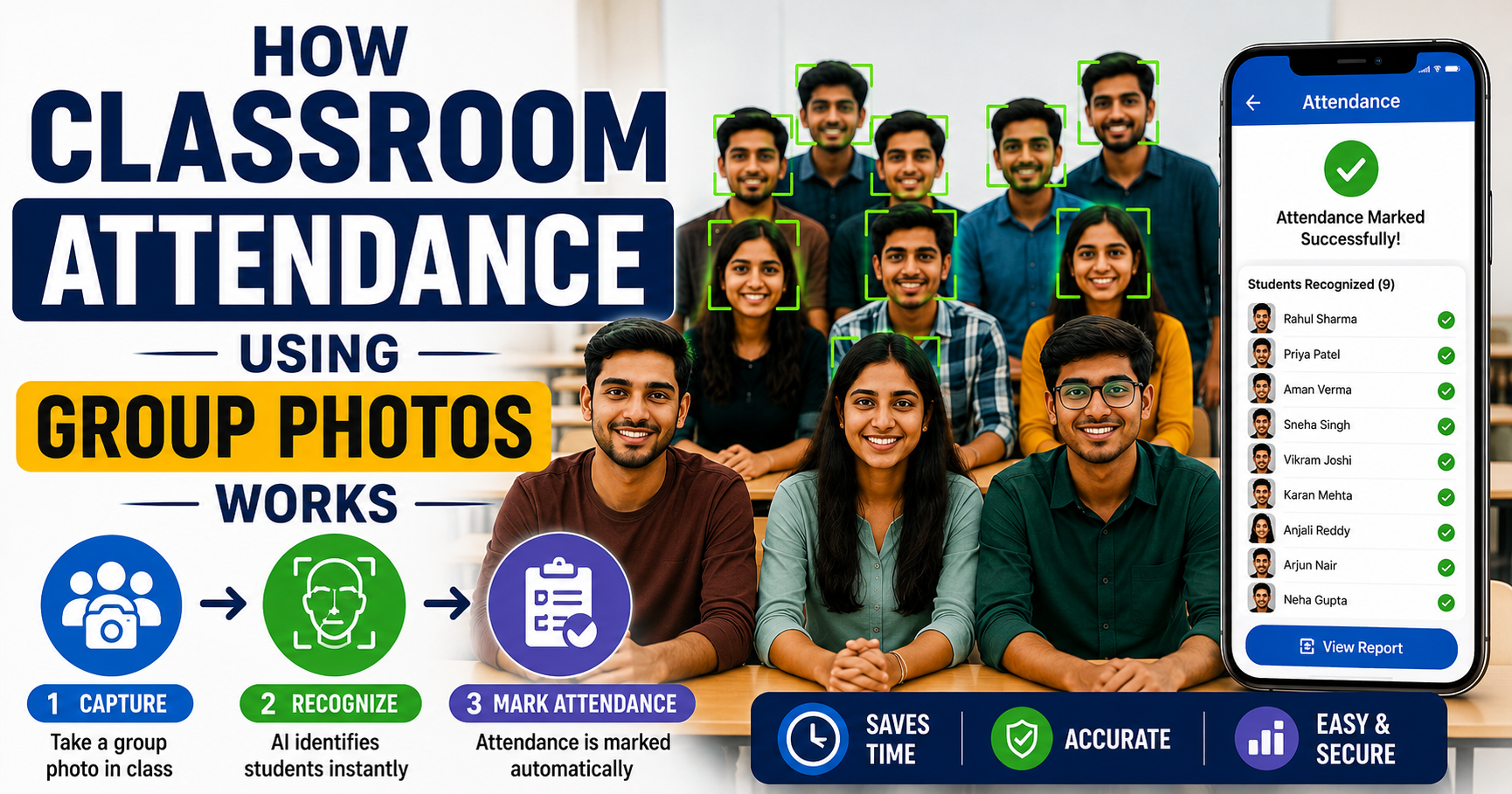
Every School Has the Same Problem
Over the last few months, I have met principals, school directors, university administrators and coaching institutes across India to demonstrate MemoFaceAI.
Although every institution is different, one challenge keeps coming up in every discussion.
Attendance consumes valuable teaching time.
Teachers walk into a classroom, call out names one by one, mark attendance manually or through an application, and only then begin teaching. In large classrooms, this process can easily take five to ten minutes.
Now multiply that by every classroom, every lecture and every working day.
Schools are not just losing time—they are losing productive teaching hours.
This is the problem we wanted to solve.
A Question Almost Every Principal Asks Me
During demonstrations, I often hear this question:
"Can attendance really be taken from just one group photograph?"
The answer is yes, but there is much more happening behind the scenes than simply clicking a picture.
The goal is not just to recognize faces.
The goal is to help teachers complete attendance within seconds while maintaining accuracy and keeping the process simple enough that every teacher is comfortable using it.
How Group Photo Attendance Actually Works
The entire process is surprisingly simple.
Step 1 – The Teacher Opens the MemoFaceAI App
There is no expensive attendance machine.
No biometric device.
No classroom camera installation.
The teacher simply opens the MemoFaceAI application on a mobile phone or tablet.
Step 2 – One Group Photograph
Instead of asking students to stand in a queue or scanning faces individually, the teacher captures a single photograph of the classroom.
The image contains all students present in the class.
The process usually takes only a few seconds.
Step 3 – AI Identifies Registered Students
The photograph is securely processed.
The system detects individual faces and compares them with the registered student database.
Only enrolled students are considered during attendance processing.
Step 4 – Teacher Reviews Before Submission
One feature we deliberately included is teacher verification.
Technology should assist teachers—not replace their judgement.
If a student has been identified incorrectly or someone is partially visible, the teacher can review the attendance before final submission.
This gives institutions additional confidence in the process.
Step 5 – Attendance Is Updated Automatically
Once approved, attendance is recorded automatically.
If the institution has an ERP or Student Information System, attendance can also be synchronized through integration, eliminating duplicate data entry.
Why We Chose Group Photos Instead of Traditional Attendance
Many people assume attendance technology should require dedicated hardware.
We disagree.
Schools already have smartphones.
Teachers already know how to use them.
Our objective was to build software that works with devices institutions already own instead of asking them to invest in additional classroom hardware.
That makes implementation faster, simpler and significantly more economical.
What Makes This Different From Face Recognition Machines?
Traditional attendance devices usually require students to walk to a fixed location one at a time.
That approach works well for entry gates.
It is not practical inside classrooms.
With group-photo attendance:
- Students remain seated.
- Teachers do not interrupt the class.
- Attendance happens where learning happens.
- No queues are created.
- No additional classroom infrastructure is required.
Common Questions We Receive During Demonstrations
What if a classroom has 70 or 80 students?
The system is designed to identify multiple students from a single classroom photograph.
The important requirement is that students should be reasonably visible in the captured image.
Does every classroom need a CCTV camera?
No.
This is probably the biggest misconception.
MemoFaceAI Classroom Attendance works using a mobile phone or tablet.
Schools do not need to install CCTV cameras in every classroom.
What happens if a student changes appearance?
Like any attendance system, periodic updates help maintain accuracy.
Students can easily update their face registration whenever required.
Is internet required?
Depending on the deployment model, attendance can be synchronized through the cloud or deployed according to the institution's infrastructure requirements.
The Real Benefit Is Not Faster Attendance
Many vendors advertise faster attendance.
That is only one advantage.
The real benefit is giving teachers more time to teach.
Imagine a school with:
- 100 classrooms
- 6 lectures every day
- 5 minutes saved per lecture
That translates into hundreds of teaching hours recovered over an academic year.
Those hours can be used for learning instead of administrative work.
What Schools Should Consider Before Choosing Any AI Attendance System
Before selecting any solution, I encourage institutions to ask these questions:
- Does it require expensive new hardware?
- Can teachers learn it quickly?
- Can attendance integrate with the existing ERP?
- How easy is it to scale across multiple campuses?
- What happens if student strength doubles next year?
- Is there a review mechanism before attendance is finalized?
Technology should simplify operations—not create another system that teachers have to manage.
Our Philosophy
When we started building MemoFaceAI, our goal was never to create another attendance machine.
Our objective was much simpler.
Help teachers spend less time taking attendance and more time teaching.
Every feature we develop is measured against that principle.
If a feature increases complexity, we rethink it.
If it saves time without compromising accuracy, we keep improving it.
Final Thoughts
Artificial Intelligence is changing how institutions manage attendance, but technology alone is not enough.
A successful attendance system must fit naturally into the daily routine of teachers and students.
Group-photo attendance is not about replacing people.
It is about removing repetitive administrative work so educators can focus on education.
As more schools embrace digital transformation, I believe classroom attendance should become almost invisible—completed in seconds, integrated with institutional systems, and simple enough that teachers never have to think about it.
That is the future we are building with MemoFaceAI.
About the Author
Loveneesh Bansal is the Founder & CEO of Metaguard Mobitech Pvt. Ltd. With over two decades of experience in attendance systems, access control, smart campus solutions, and enterprise software, he works with schools, universities, hospitals, and businesses to simplify attendance and workforce management through AI-powered technology.