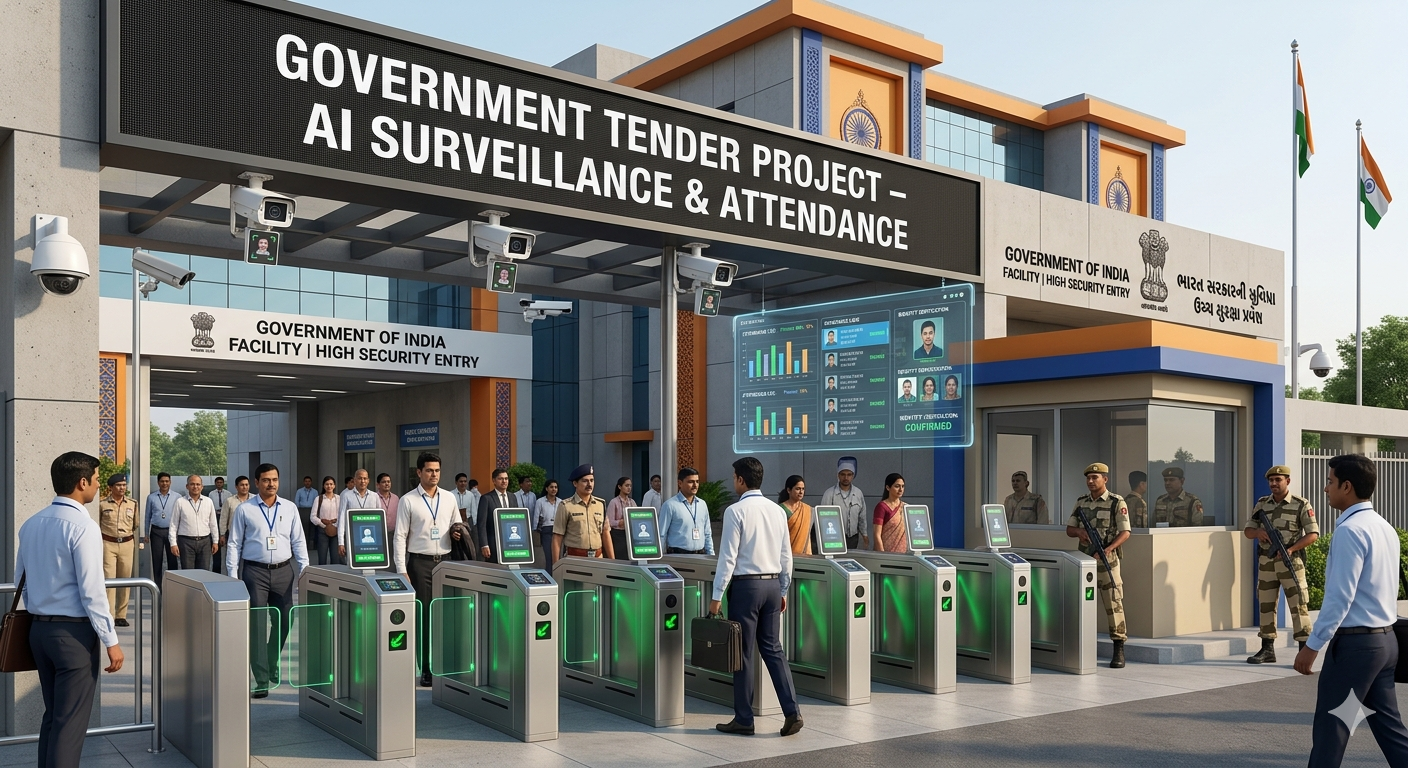
📊 Surge in Government Tenders for Facial Recognition Systems
Across central and state departments, tenders are increasingly focused on:
- Facial recognition attendance systems
- Entry/exit gate monitoring
- AI-based CCTV surveillance
- Integrated access control + attendance
Recent tender data shows:
- Multiple tenders for facial recognition systems at entry/exit gates across states like Rajasthan and Chhattisgarh
- Ongoing bids for AI-based attendance systems integrated with CCTV infrastructure
- Projects involving installation, commissioning, and AMC of facial recognition attendance systems
In some cases, individual tenders range from ₹5 lakh to ₹12 lakh+, indicating strong budget allocation toward this technology
👉 This is a clear signal:
Facial recognition is no longer experimental—it is becoming a standard requirement.
🚪 Why Entry/Exit Gates Are the Focus
Traditionally, attendance systems focused only on check-in points.
But government tenders now emphasize:
👉 Full movement tracking at entry and exit gates
Why this matters:
- Prevents proxy attendance
- Tracks actual time spent inside premises
- Enables real-time verification
- Strengthens security + attendance in one system
In fact, several government RFPs explicitly mention CCTV-based facial recognition integrated with entry/exit monitoring to enable seamless attendance capture
🏛️ Government Use Cases Driving This Trend
1. Workforce Attendance & Transparency
Government programs are deploying AI attendance to prevent fraud and ensure genuine beneficiaries.
For example:
- Facial recognition is being introduced in employment schemes to eliminate fake attendance and wage leakages
2. Security at High-Sensitivity Locations
AI-enabled CCTV with facial recognition is being deployed at:
- Entry/exit points of public infrastructure
- Heritage and high-security zones
- Transport hubs
These systems help in:
- Identifying individuals in real time
- Monitoring movement patterns
- Preventing unauthorized access
3. Smart Surveillance + Attendance Integration
Modern deployments are not standalone systems.
They combine:
- CCTV cameras
- Facial recognition AI
- Access control systems
- Central monitoring dashboards
This creates a single intelligent layer for both:
👉 Security + Attendance + Analytics
🔄 From Biometric Devices to AI Surveillance
Government adoption is also highlighting a major shift:
|
Traditional Systems |
AI-Based Entry/Exit Systems |
|
Manual interaction required |
Fully passive |
|
Limited to entry point |
Covers entire movement |
|
Easy to manipulate |
Highly secure |
|
Separate systems |
Integrated platform |
This evolution is critical for large-scale environments where:
- Thousands of employees or citizens are involved
- Manual systems fail to scale
- Fraud and inefficiencies are common
💰 The Real Driver: Cost Savings & Accountability
Beyond technology, the biggest reason for adoption is financial impact.
AI-based attendance systems help government bodies:
- Eliminate ghost employees
- Reduce payroll leakages
- Improve workforce discipline
- Optimize operational costs
Even a 5–10% efficiency improvement in large government departments can translate into crores in savings annually.
🧠 What This Means for Enterprises
Government adoption is often a leading indicator of broader market trends.
This shift signals that:
👉 AI-based CCTV attendance will soon become the default standard across industries
Private sectors—especially:
- Manufacturing
- Hospitals
- Infrastructure companies
- Large enterprises
are already following this model to:
- Track workforce movement
- Reduce inefficiencies
- Improve compliance
🚀 The Opportunity: From Attendance to Intelligence
The next phase of this evolution goes beyond attendance.
AI systems deployed at entry/exit gates can enable:
- Real-time workforce visibility
- Movement analytics
- Productivity insights
- Predictive behavior analysis
This transforms attendance systems into:
👉 Workforce Intelligence Platforms
🔍 MemoFaceAI Perspective
At MemoFaceAI (by Metaguard Mobitech Pvt Ltd), this trend aligns closely with what we are seeing across enterprise deployments:
- Organizations want CCTV-based attendance, not device-based systems
- Entry/exit intelligence is becoming more important than punch logs
- Clients are focusing on ROI, not just attendance tracking
Government tenders validate this direction.
They confirm that the future lies in:
👉 AI + CCTV + Entry/Exit Intelligence
🧾 Final Thoughts
The rise in government tenders for facial recognition systems at entry and exit gates is more than a procurement trend—it is a policy-level shift toward intelligent infrastructure.
As adoption scales, organizations that embrace this model early will benefit from:
- Higher efficiency
- Better compliance
- Significant cost savings
In the coming years, attendance will no longer be a standalone function.
It will become a core part of security, analytics, and financial control systems.
Still Have Questions?
Here
are answers to the most common queries about AI-based attendance systems,
biometric alternatives, workforce tracking, facial recognition attendance, and
CCTV attendance monitoring.
FAQ
Why is the government adopting AI attendance systems?
For improved security and accurate tracking.
Where are AI systems being used?
Entry/exit gates, offices, and public facilities.
Does this indicate industry shift?
Yes. AI adoption is increasing rapidly.
Are AI attendance systems scalable?
Yes. Suitable for large deployments.
Can private companies adopt similar systems?
Yes. The same technology applies.