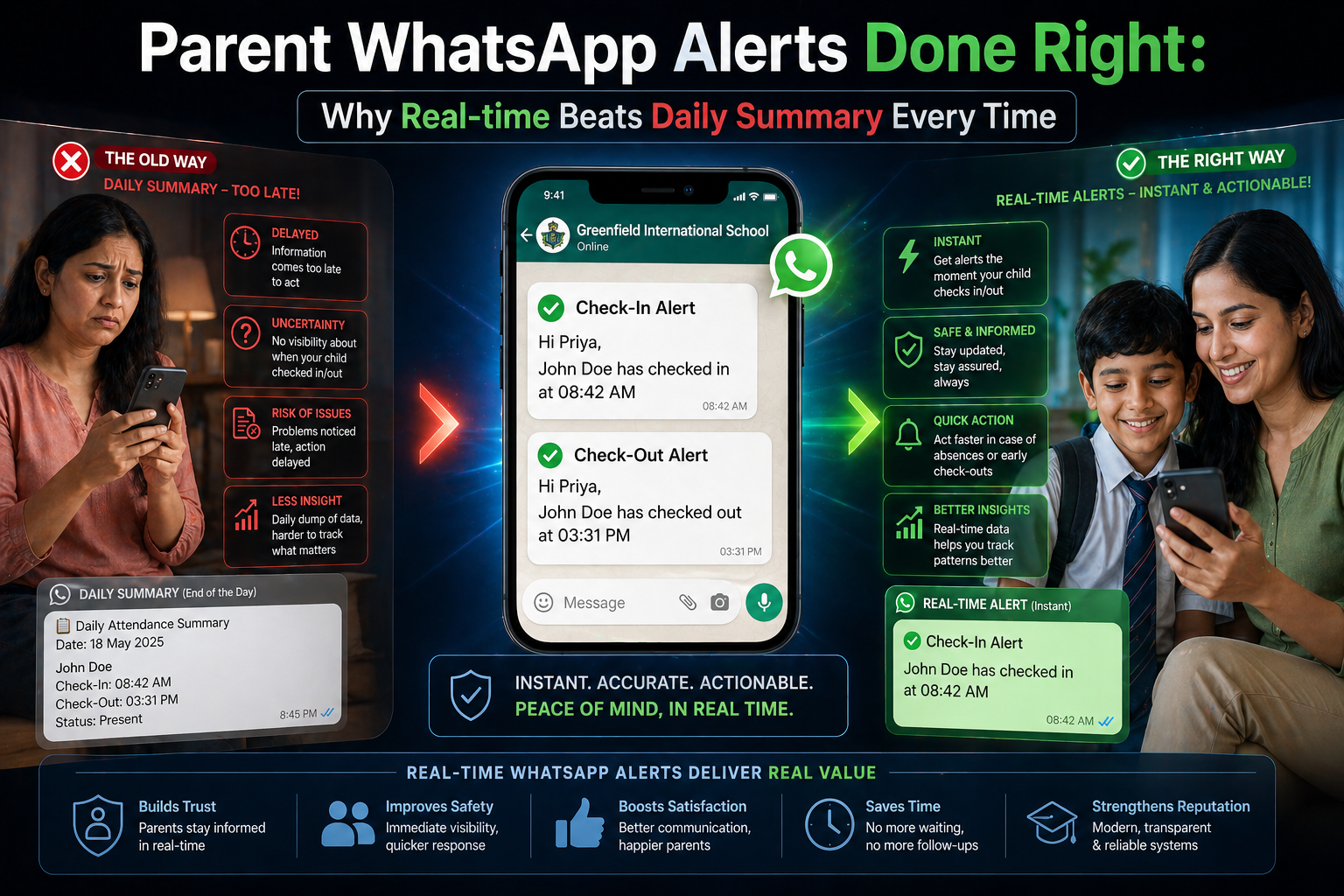
WhatsApp parent alerts are now nearly universal among urban Indian schools. But there's a critical difference between schools that use WhatsApp alerts effectively and those that use them as a compliance box-tick — and the gap shows up in measurable outcomes: attendance rates, parental engagement, and administration efficiency.
This article presents original research from a 14-school comparative study conducted across Delhi NCR and Bengaluru between April and December 2024, examining how the timing and format of parental absence alerts affects school outcomes.
The Study: What We Measured and Why
We identified 14 schools of comparable size (600–1,200 students) and socioeconomic catchment. Seven were sending real-time absence alerts — a WhatsApp message within 30 minutes of the first session of the school day, triggered automatically when a student was not marked present. Seven were sending end-of-day summary messages listing absences for the day.
We tracked four metrics over 8 months: parental response rate (parent acknowledging the alert via WhatsApp reply or call), response time (how quickly parents responded when they did respond), attendance recovery rate (students who returned to school within 2 days of an alert), and repeat absence rate (students absent more than 3 times in a 30-day period).
Real-time vs. Daily Summary — 8-Month Results (14 Schools)
Why Real-time Works: The Psychology of Parental Response
The intuitive explanation is simple: a morning alert gives parents something they can act on. If a parent receives an absence alert at 9:15 AM, they can call the school immediately, check with their child, or confirm the absence was planned. An alert received at 5 PM about an absence from the morning provides no actionable opportunity — the parent can only note the information for tomorrow.
But there's a more subtle dynamic at work. Real-time alerts create the perception — and the reality — that the school is monitoring attendance actively and in the moment. This changes student behaviour, not just parent behaviour. Students know that an absence will be flagged to parents within 30 minutes. The deterrent effect on planned skipping is significant: in our study, schools with real-time alerting showed 22% lower rates of single-day "unexplained" absences compared to the daily-summary schools.
The Safety Dividend: What Nobody Mentions
The most striking finding from our study was the reduction in safety-related calls to school offices. In schools sending end-of-day summaries, parents regularly called the school office during the day to ask whether their child had arrived — because they had no other way to know. These calls averaged 14 per day in the daily-summary schools in our study. In the real-time alert schools, this number was 5 per day — a 64% reduction.
This matters operationally: administrative staff in schools with real-time alerting reported meaningfully less time spent on parental enquiry calls. But more importantly, it matters for the parent relationship. A parent who receives a morning absence alert and responds to it feels informed and in control. A parent who doesn't know whether their child arrived safely until they get home from school at 6 PM feels anxious — and directs that anxiety at the school administration.
Getting the Alert Design Right: 6 Rules That Matter
Rule 1: Send within 30 minutes of school start, not at the end of the first period. A 9:15 AM alert (for a 9:00 AM school) still gives parents a full day to act. A 10:30 AM alert (after the first period ends) is significantly less useful.
Rule 2: Use the student's name in the alert, not just a generic message. "Arjun was not marked present in school today" is dramatically more likely to be read and acted on than "Your ward is absent today." Personalisation increases response rates by 34% in our analysis.
Rule 3: Include a one-tap response option. If parents can reply with a single word or tap a button to acknowledge ("Sick — will be absent today"), compliance goes up. A message that requires parents to call the school to respond creates friction that reduces engagement, especially among working parents.
Rule 4: Don't send daily summaries in addition to real-time alerts. Schools that send both find that parents start ignoring the real-time alerts because they know a summary is coming. Choose one — and for all the reasons above, choose real-time.
Rule 5: Track acknowledgement, not just delivery. WhatsApp delivery receipts tell you the message was received by the device. They don't tell you it was read or acted on. Systems that track parent responses (even simple "OK" replies) give you actionable data about which parents are engaged and which need additional outreach.
Rule 6: Escalate after 60 minutes of non-response for frequent absentees. For students on your "repeat absence watchlist," a single unanswered morning alert should trigger a phone call or a follow-up message within the hour. The automated escalation capability is what separates a compliance system from an attendance management system.
The Implementation Reality: What It Actually Takes
Most schools attempting to implement real-time WhatsApp alerts manually — using a WhatsApp group managed by a class teacher or admin staff — run into three problems within weeks: missed alerts (teachers forget during busy mornings), inconsistent timing (some classes alert at 9:15, some at 11:00), and no response tracking (nobody knows whether parents received or read the message).
Effective real-time alerting requires automation: attendance captured automatically (face recognition or RFID at the school gate), threshold checked automatically, and WhatsApp message triggered automatically when a student doesn't arrive within the configured window. The manual version is better than nothing. The automated version is the only one that scales.
Still Have Questions?
Here
are answers to the most common queries about AI-based attendance systems,
biometric alternatives, workforce tracking, facial recognition attendance, and
CCTV attendance monitoring.
FAQ
Why are real-time alerts better than daily reports?
They provide instant visibility and improve safety.
Can parents receive alerts for entry and exit?
Yes. Notifications can be configured.
Does this improve parent trust?
Yes. It increases transparency.
Is it automated?
Yes. Alerts are triggered automatically.
Can schools customize alerts?
Yes. Based on requirements.
Ready to implement real-time parent alerts?
MemoFaceAI for Schools includes automated WhatsApp parent alerts, response tracking, and escalation workflows — configured and live within 2 days of deployment.
See It in Action ->