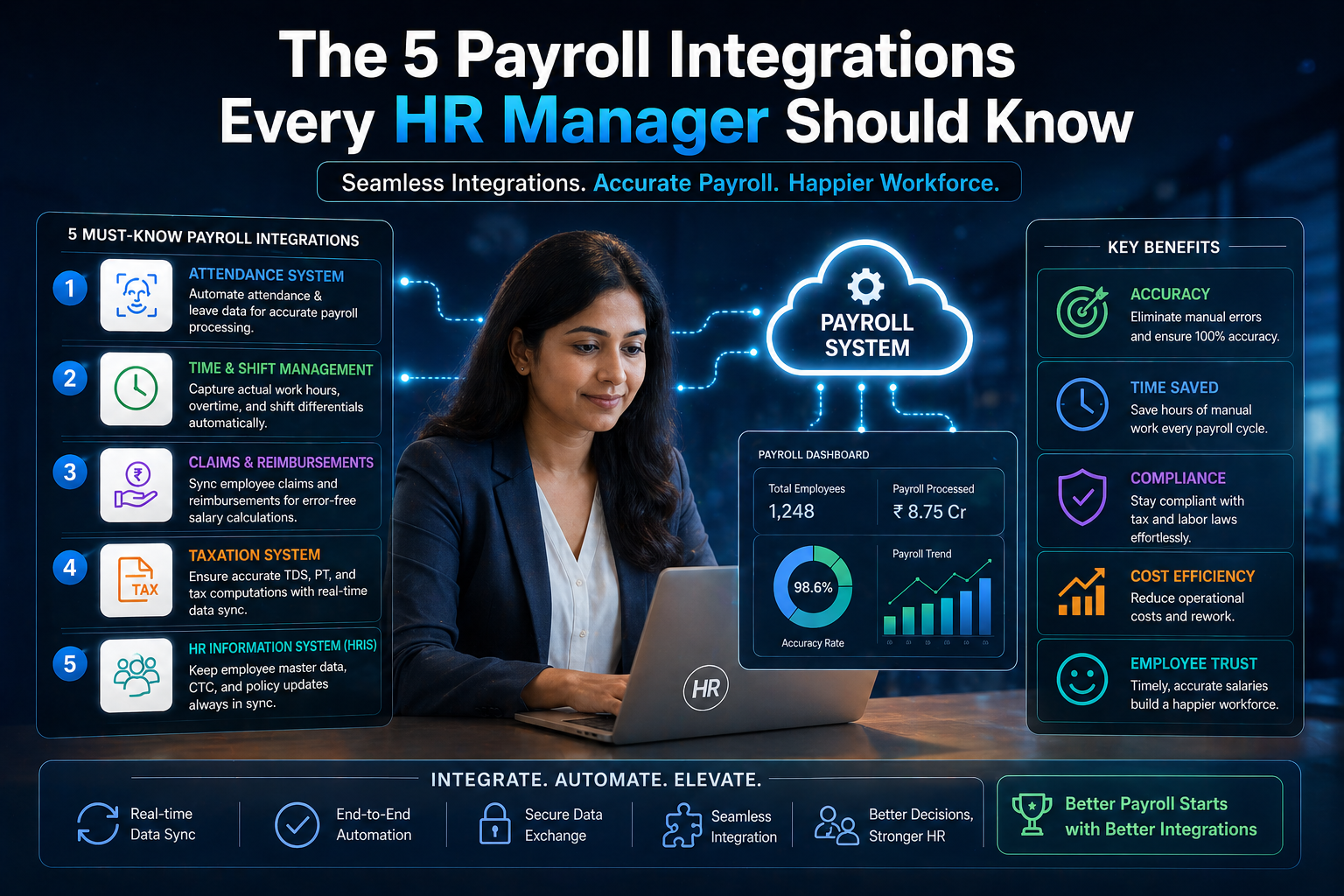
An attendance system that requires manual data export, transformation, and import into payroll software is not a solution — it's a different problem. The HR manager who spends two days at month-end reconciling attendance and payroll data hasn't saved any time over the manual register. They've just moved the work. Here are the five integrations that eliminate this problem entirely — and what to look for in each.
Integration 1: Direct Payroll Software Sync (The Most Important One)
This is the core integration: attendance data flowing automatically and continuously into your payroll software, with no manual steps. The critical requirements are daily sync (not weekly or monthly), bidirectional flow (payroll should be able to push leave approvals back into the attendance system), and exception flagging (records that don't reconcile automatically should be surfaced for human review, not silently processed with a default value).
Compatible payroll platforms for India include GreytHR, Keka, Zoho Payroll, RazorpayX Payroll, and QuickBooks Payroll. The integration mechanism varies — API, SFTP file exchange, or native connector. API-based integration is strongly preferred because it enables real-time sync and reduces the risk of file format errors.
Integration 2: Leave Management System Sync
The most common source of payroll disputes in India is the disconnect between HR-approved leave records and attendance system records. An employee applies for casual leave, HR approves it in the HRMS, but the attendance system still shows an unexcused absence — and payroll deducts the day. This is entirely preventable with a two-way leave management sync.
The sync should work in both directions: when a leave is approved in HR software, the attendance record is automatically updated. When an absence appears in the attendance system without a corresponding approved leave, an alert fires to the employee's manager for resolution within a configurable time window.
Leave Dispute Reduction — With vs. Without Integration
Integration 3: Shift Management and Scheduling Tools
For organisations running multiple shifts, the attendance system needs to know what shift each employee was assigned to in order to correctly calculate attendance, overtime, and late marks. Without this integration, either the attendance system has no shift context (and marks any 2 PM arrival as late, regardless of whether the employee was on a night shift) or shift data has to be manually maintained in two separate systems.
Good shift integration ensures that the attendance system automatically receives shift assignments for each employee each day, and that late-mark rules and overtime calculations are applied relative to the correct shift window — not a fixed company-wide clock-in time.
Integration 4: Contractor and Third-Party Workforce Management
In many Indian industries — manufacturing, construction, hospitality — a significant portion of the workforce is on contract or managed through a third party. Attendance data for these workers needs to flow to the contractor's billing system (for validating contractor invoices) while also being available in your own reporting. This dual-flow integration is frequently missing from basic attendance implementations.
Integration 5: ERP and Project Management Systems
For project-based organisations (IT services, consulting, construction), attendance data connected to project management tools enables automatic project time tracking, billing validation, and resource utilisation reporting. An employee's presence at a project site, confirmed by attendance check-in, can automatically trigger project timesheet entries — eliminating the daily manual timesheet that most professional services employees hate filling in.
A Note on Integration Complexity
Not every organisation needs all five integrations on day one. The priority order for most companies: payroll sync first, leave management second, then shift management if applicable. Contractor and ERP integrations are valuable but can wait for phase two once the core payroll-attendance loop is running cleanly.
Still Have Questions?
Here
are answers to the most common queries about AI-based attendance systems,
biometric alternatives, workforce tracking, facial recognition attendance, and
CCTV attendance monitoring.
FAQ
Why are payroll integrations important?
They automate salary calculations and reduce errors.
Can attendance systems integrate with payroll?
Yes. Modern systems support integration.
What is the biggest benefit of integration?
Accuracy and efficiency.
Does integration reduce manual work?
Yes. It eliminates manual data entry.
Is it suitable for SMEs?
Yes. It benefits organizations of all sizes.
Which integrations are right for your organisation?
Our solutions team will map your current tech stack and identify the integrations that will deliver the most value — in a free 30-minute call.
Book an Integration Review ->