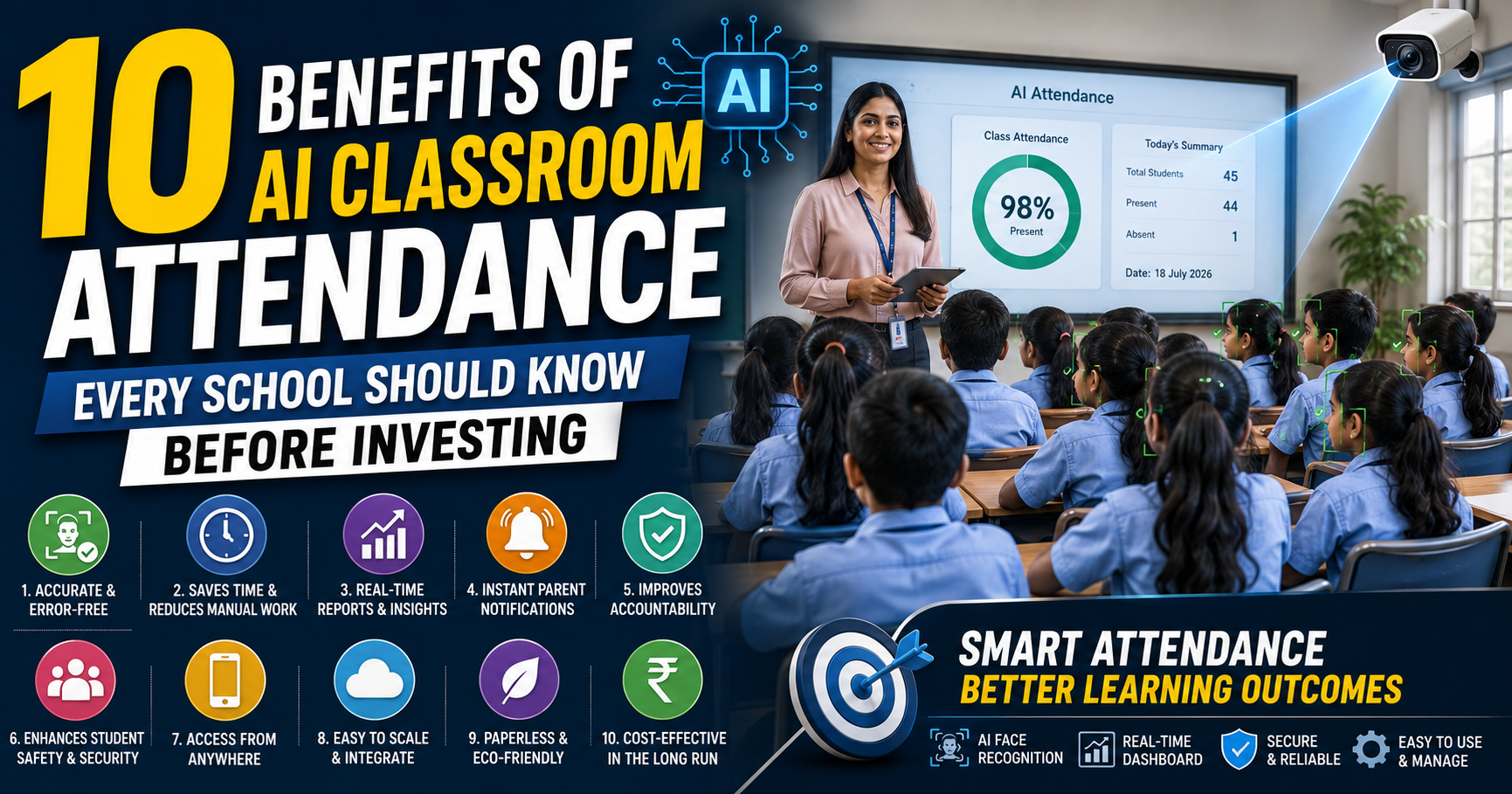
Before We Talk About AI, Let Me Ask You One Question
During almost every school demonstration, I ask the principal a simple question.
"How long does it take your teachers to complete attendance in every class?"
Some answer three minutes.
Some say five.
In larger classrooms, the answer is often closer to ten minutes.
At first, nobody thinks this is a problem.
Then we do the maths.
A school with 80 classrooms and six lectures every day can easily lose hundreds of teaching hours every academic year simply because teachers are busy marking attendance instead of teaching.
That is the real reason schools are exploring AI-powered attendance.
It isn't because AI is fashionable.
It's because schools want teachers to spend more time teaching and less time on repetitive administrative work.
Why I Wrote This Guide
Over the past few years, I have met school principals, trustees, university administrators, coaching institutes and HR teams who were all asking similar questions.
What exactly is AI attendance?
Is it better than biometric machines?
Do we need CCTV cameras?
Will teachers accept it?
Is it accurate?
Is it expensive?
How difficult is implementation?
Instead of answering these questions one customer at a time, I decided to put everything together in one practical guide.
If you're evaluating attendance technology for your institution, this article will help you make an informed decision.
What Is an AI Classroom Attendance System?
An AI Classroom Attendance System is software that automatically identifies students and records attendance using facial recognition technology.
Unlike traditional systems, students do not need to:
stand in queues,
scan RFID cards,
touch fingerprint machines,
or manually confirm attendance.
Instead, attendance can be captured using a teacher's mobile phone, tablet, or, depending on the deployment, existing CCTV cameras.
The objective is simple.
Remove repetitive work without disrupting the classroom.
The Evolution of Attendance
One of the biggest mistakes schools make is comparing AI only with biometric devices.
Attendance has actually evolved through several generations.
Generation 1 – Paper Registers
This method has been used for decades.
Advantages:
No technology investment.
Simple process.
Challenges:
Time consuming.
Human errors.
Difficult reporting.
Easy to manipulate.
No real-time visibility.
Generation 2 – RFID Cards
Schools introduced RFID cards to automate attendance at entry gates.
This improved entry monitoring but introduced new challenges.
Cards can be:
forgotten,
exchanged,
damaged,
or misused.
Most importantly, a card confirms the presence of the card—not necessarily the student.
Generation 3 – Biometric Attendance
Fingerprint and facial terminals improved identity verification.
However, classroom attendance remained difficult because students still needed to visit a fixed device.
This created queues and interrupted the learning process.
Generation 4 – AI Classroom Attendance
Instead of bringing students to the attendance machine, AI brings attendance to the classroom.
That is the biggest difference.
How AI Attendance Actually Works
This is where many articles become too technical.
I'll explain it the same way I explain it during demonstrations.
Step 1
Each student is enrolled once.
Step 2
The teacher opens the MemoFaceAI application.
Step 3
One classroom photograph is captured.
Step 4
The AI identifies registered students.
Step 5
The teacher reviews the attendance.
Step 6
Attendance automatically synchronizes with the ERP.
That's it.
No queues.
No fingerprint devices.
No attendance registers.
Five Myths About AI Attendance
Myth 1
Every classroom needs CCTV.
Reality:
Not necessarily.
Many schools successfully use ordinary Android phones.
Myth 2
Teachers need extensive technical training.
Reality:
If a teacher can use WhatsApp or take a photograph, they can use an AI attendance application.
Myth 3
AI replaces teachers.
Reality:
AI removes repetitive work.
Teachers remain in complete control.
Myth 4
AI attendance is only for large schools.
Reality:
Small schools also benefit because administrative work is reduced.
Myth 5
Implementation takes months.
Reality:
Most deployments are completed far more quickly than schools expect, depending on enrollment, ERP integration, and rollout planning.
Questions Every School Should Ask Before Buying
Instead of choosing a vendor based on brochures, ask:
Does the solution require new hardware?
Can it work on existing mobile phones?
Can attendance be reviewed before submission?
Does it integrate with our ERP?
What happens if student strength doubles?
How is student data protected?
How much teacher training is required?
What support is included after deployment?
These questions will tell you far more than a feature checklist.
My Advice to School Leaders
After working with attendance systems for many years, I've realised something important.
Schools rarely fail because they choose the wrong technology.
They struggle because they choose technology that teachers don't enjoy using.
If teachers avoid the system, the project fails.
If teachers adopt it naturally, the technology becomes almost invisible.
That should be the goal.
Looking Ahead
Artificial Intelligence will continue to improve.
Face recognition will become faster.
Analytics will become smarter.
Attendance systems will eventually provide insights into attendance patterns, absenteeism trends, and operational efficiency.
But the most successful solutions will always remain simple enough for teachers to use without changing how they teach.
Final Thoughts
When people ask me whether AI classroom attendance is the future, my answer is always the same.
AI is not the future. Simplicity is.
Schools don't invest in attendance software because they want Artificial Intelligence.
They invest because they want teachers to teach, administrators to make informed decisions, parents to receive timely information, and students to spend more time learning than waiting in attendance queues.
If technology helps achieve those goals without adding complexity, it has done its job.
That is the philosophy behind MemoFaceAI.
About the Author
Loveneesh Bansal is the Founder & CEO of Metaguard Mobitech Pvt. Ltd. For more than two decades, he has worked on attendance systems, access control, smart campus solutions, and enterprise software. Through MemoFaceAI, he collaborates with schools, universities, hospitals, and enterprises to simplify attendance and operational workflows using AI-powered technology.