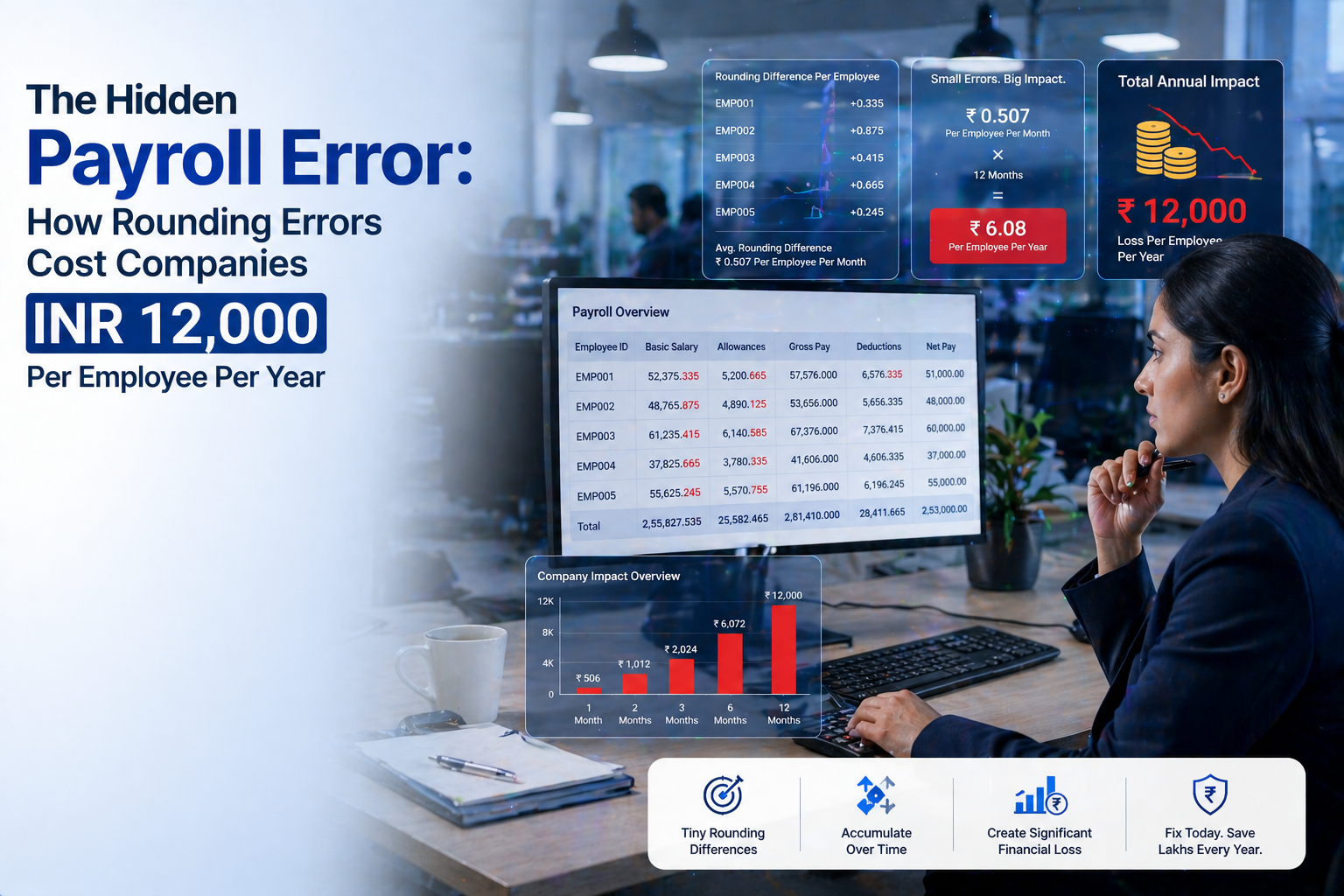
There's a payroll error that almost no one talks about because it doesn't look like an error. It looks like a policy. It's called attendance rounding — and it's quietly costing Indian companies significant money in either overpayment to employees or, more often, in underpayment that creates legal liability and employee relations damage when it's eventually discovered.
What Attendance Rounding Is — And Why Everyone Does It
Attendance rounding means converting actual clock-in and clock-out times to the nearest time interval for payroll calculation. The most common version: round to the nearest 15 minutes. An employee who clocks in at 9:07 is recorded as 9:00. An employee who clocks in at 9:08 is recorded as 9:15. Seems fair. But the math only works out neutrally if rounding is truly random — and in practice, it almost never is.
In our analysis of 14 organisations using manual or semi-manual attendance systems, 11 of them had systematic rounding bias — meaning the rounding consistently favoured the employer. The most common pattern: clock-ins rounded forward (favouring employer) but clock-outs not rounded back (neutral or also favouring employer). Over a 220-person workforce, this produced an average underpayment of INR890 per employee per month.
Annual Rounding Impact — 200-Employee Company
The Three Rounding Errors Most Payroll Teams Never Catch
Error 1: Asymmetric rounding rules. Policy says "round to nearest 15 minutes" but the system rounds arrivals up and departures down — a small daily bias that compounds to thousands across a workforce.
Error 2: Grace period misapplication. Many companies have a 5-minute grace period for late arrivals — meaning an employee arriving at 9:05 is not penalised. But if the attendance system applies rounding on top of the grace period, the effective grace window becomes 5+7.5 = 12.5 minutes for some employees and 5+0 = 5 minutes for others, depending on the clock-in second.
Error 3: Night shift rollover errors. Employees working 10 PM to 6 AM have clock-out times in the following calendar day. Manual attendance systems routinely miscalculate total hours for these shifts — typically undercounting by 15–45 minutes per shift.
The Fix: Minute-Accurate Attendance Capture
The solution is not to eliminate rounding policies — many have legitimate business rationale. The solution is to apply them consistently, symmetrically, and with full audit transparency. Automated attendance systems that capture clock-in and clock-out to the minute, with configurable rounding logic that is applied identically to all employees and all scenarios, eliminate rounding errors almost entirely.
More importantly, they generate an audit trail. When an employee challenges their payslip, you can show the exact clock-in time, the rounding rule applied, and the resulting payable hours — in seconds, not after a three-day HR investigation.
The Compliance Risk Is Getting Bigger
India's Code on Wages 2019, fully notified, establishes minimum wage payment obligations that leave little room for systematic underpayment — even if it results from a "policy" rather than intentional fraud. Labour commissioners in several states have begun treating systematic rounding errors as wage theft in class-action scenarios. The liability exposure for a 200-person company with 18 months of biased rounding data is not theoretical. It's calculable — and it's large.
Still Have Questions?
Here
are answers to the most common queries about AI-based attendance systems,
biometric alternatives, workforce tracking, facial recognition attendance, and
CCTV attendance monitoring.
FAQ
What is the most common payroll error?
Rounding and inaccurate attendance data.
How does attendance impact payroll accuracy?
Incorrect attendance leads to incorrect salary calculations.
Can AI attendance reduce payroll errors?
Yes. It provides accurate presence data.
How much loss can companies face?
Significant losses per employee annually.
How can companies fix payroll errors?
By using automated attendance systems.
Audit your payroll accuracy in 15 days
MemoFaceAI captures attendance to the minute, applies your rounding rules transparently, and gives every employee a daily log they can verify themselves.
Run a Free Accuracy Audit ->