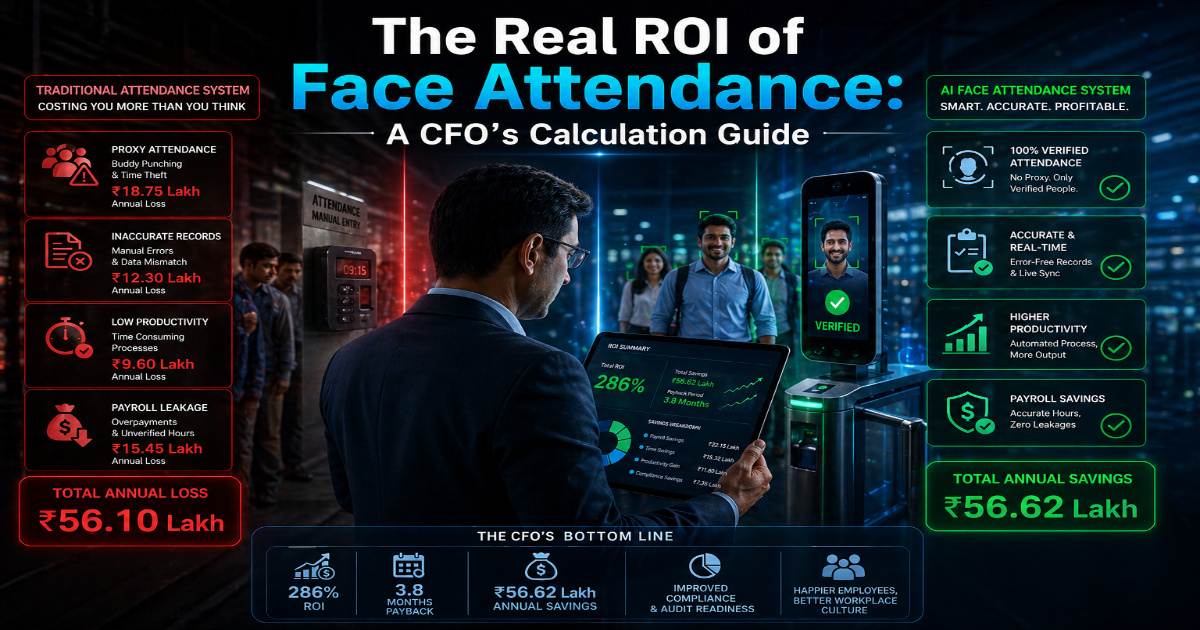
The business case for face attendance software tends to get presented in terms of features: "real-time dashboards," "cloud-based data," "no more proxy attendance." CFOs don't fund features. They fund returns. This guide gives you the numbers framework to calculate — with genuine precision — what face attendance is worth to your specific organisation, and how long it takes to pay back.
The Four Value Drivers (And How to Quantify Each)
Value Driver 1: Payroll accuracy improvement. In organisations moving from manual or semi-manual attendance to automated face capture, payroll error rates typically drop from 5–12% of payroll records to below 0.5%. For a 200-person company with an average monthly salary of INR30,000, a 6% error rate represents INR3.6 lakh in payroll adjustments per month — some overpayments, some underpayments, all requiring HR time to resolve. Conservative calculation: 3% net overpayment × 200 employees × INR30,000 = INR1.8 lakh per month recoverable.
Value Driver 2: Buddy-punching elimination. In organisations where we've conducted pre/post analysis, buddy-punching (one employee clocking in for another) accounts for 2–4% of attendance records on average. This is nearly impossible to detect with fingerprint or card-based systems when employees coordinate. Face recognition systems eliminate it structurally. At 3% rate: 200 employees × 3% × INR30,000 average = INR1.8 lakh per month in recovered wage fraud.
ROI Calculation — 200-Employee Organisation
The Calculation Most People Miss: HR Administrative Time
In a 200-person company running manual or semi-automated attendance, how much HR time goes into attendance-related tasks per month? Based on our audits: attendance data compilation (8–12 hours), exception resolution — employees with missing punches, unresolved leaves (15–20 hours), payroll cross-checking (6–10 hours), dispute resolution (4–8 hours). Total: 33–50 HR person-hours per month. At a fully-loaded HR executive cost of INR400/hour, that's INR13,200–20,000 per month in recoverable HR time — time that can be redirected to higher-value activities.
Overtime Fraud: The Number Nobody Wants to Publish
Overtime fraud — supervisors approving overtime for workers who weren't actually present for those hours, or workers claiming overtime that wasn't worked — is the most sensitive number in any attendance audit. It's also frequently the largest. In manufacturing environments where overtime is common, our analysis consistently finds 15–25% of overtime hours are either exaggerated or unsubstantiated. At average overtime rates, this represents material financial exposure.
Face attendance systems don't directly prevent supervisor approval fraud, but they create an indisputable record of actual presence hours — making it impossible to claim overtime for hours not worked without active system manipulation (which triggers audit flags).
Building Your CFO Presentation in 20 Minutes
Take your total monthly payroll cost. Apply 3% as a conservative buddy-punching rate and 2% as a payroll error rate. That's your minimum recoverable amount per month. Add HR admin hours at fully-loaded cost. Compare against your annual platform cost. In almost every case we've modelled, the payback period is under 60 days for organisations of 100+ employees.
The CFO's final question is always: "What if your assumptions are wrong?" The honest answer: if buddy-punching is only 1% (half our conservative assumption) and payroll errors are only 1%, the payback period extends to roughly 6 months. That's still an excellent return for software with a 5+ year useful life.
Still Have Questions?
Here
are answers to the most common queries about AI-based attendance systems,
biometric alternatives, workforce tracking, facial recognition attendance, and
CCTV attendance monitoring.
FAQ
What is the ROI of AI attendance systems?
ROI comes from reduced payroll leakage and improved productivity.
How quickly can companies recover investment?
Most companies see ROI within a few months.
What costs are reduced?
Hardware, manual effort, and attendance fraud.
Can AI attendance improve profitability?
Yes. By reducing inefficiencies.
Is ROI measurable?
Yes. Through attendance accuracy and cost savings.
Get a custom ROI calculation for your organisation
Share your headcount and average salary, and we'll build a precise ROI model for your CFO — in 24 hours.
Get My ROI Model ->