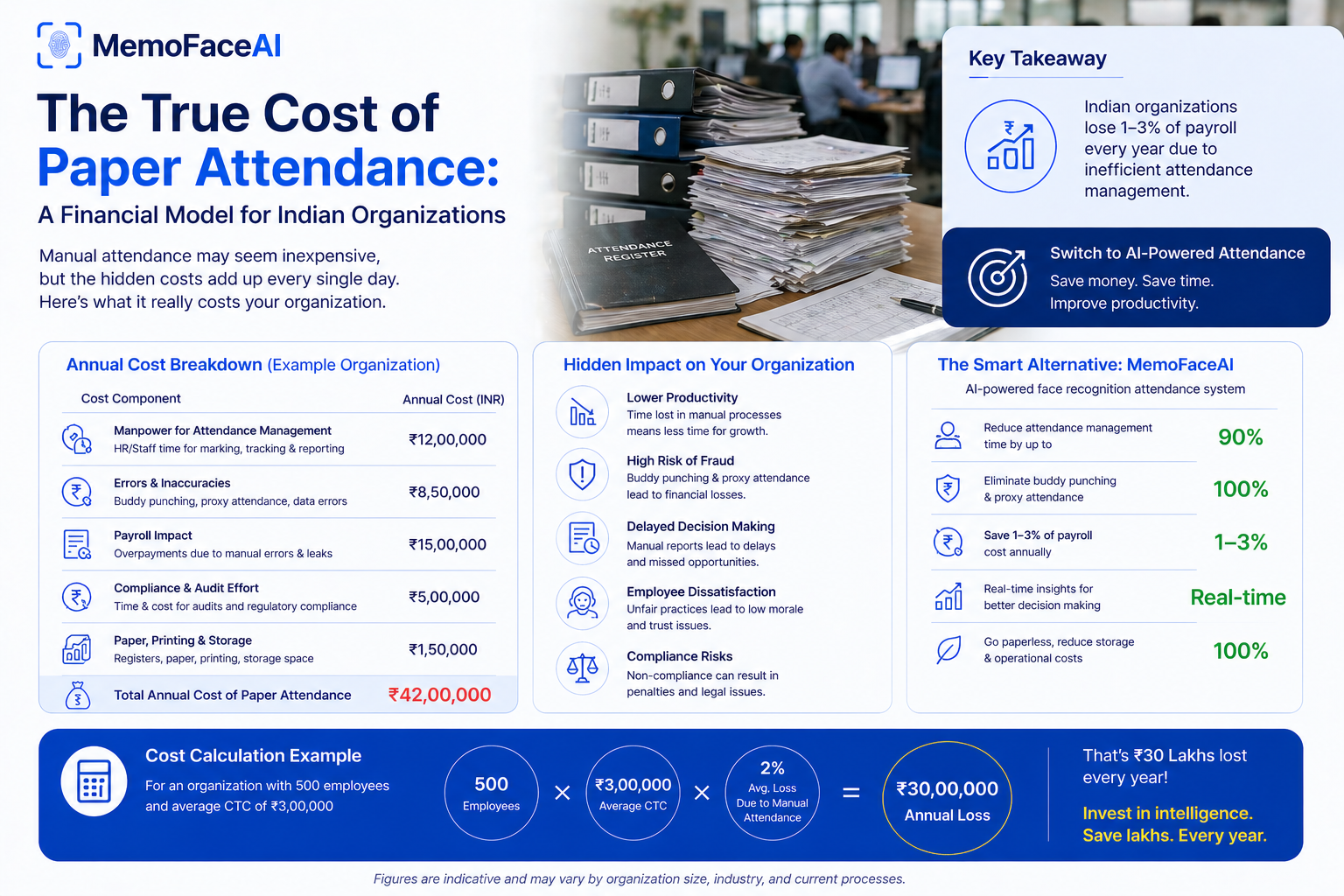
Paper attendance registers have no line item in any budget. They feel free. The paper costs almost nothing. Teacher time is "already being paid." There's no software invoice. This is why the true cost of paper attendance has remained invisible — it's distributed across dozens of cost categories, none of which are labelled "attendance."
The Cost Model: Building the Full Picture
Our financial model covers five cost categories, each requiring different measurement methodologies.
Category 1: Direct time cost — data collection. In a school with 40 classes, each teacher spending 7 minutes on manual roll call at the start of each class period: 40 classes × 7 minutes × 6 periods × 200 school days = 336,000 minutes = 5,600 teacher-hours per year. At an average teacher cost of INR400/hour fully loaded: INR22.4 lakh per year — just for taking roll calls. This is genuinely instructional time converted to administrative overhead.
| Cost Category | Annual Cost (200-person org) |
|---|---|
| Roll call / data collection time | INR3.8L |
| Data entry and digitisation | INR1.6L |
| Report compilation and distribution | INR0.9L |
| Error correction and dispute resolution | INR1.4L |
| Payroll errors caused by attendance errors | INR2.8L |
| Compliance risk (estimated liability) | INR0.9L |
| Total annual cost | INR11.4L |
The Payroll Error Cascade
The largest single cost category is not the time cost of taking attendance — it's the payroll errors that paper attendance causes downstream. Manual data transfer from paper register to Excel to payroll system introduces errors at every step. Our analysis of six organizations that switched from paper to automated attendance found average payroll error rates of 6.8% in paper-based systems — meaning roughly 1 in 15 employees had a payroll error in any given month. Error resolution costs HR time; systematic underpayment creates legal liability; systematic overpayment is direct financial loss.
The Comparison: Paper vs. Automated
The fully automated attendance alternative — face recognition terminal plus software — costs approximately INR2.4 lakh per year for a 200-person organization in India (hardware amortised over 5 years plus software subscription). Against the INR11.4 lakh annual cost of paper attendance, this represents a INR9 lakh annual saving — or a 375% ROI. The payback period on the hardware investment, using only the direct time savings and payroll error reduction, is approximately 90 days.
The Intangible Costs Nobody Models
The financial model above doesn't capture three additional costs that are real but harder to quantify: the absence of predictive analytics (paper attendance can never generate early-warning signals, dropout predictions, or absenteeism trends), the compliance exposure under increasingly digital audit requirements, and the competitive signal — organizations in the same industry that have automated attendance are making better-informed workforce decisions every day. The strategic disadvantage compounds over time.
Still Have Questions?
Here
are answers to the most common queries about AI-based attendance systems,
biometric alternatives, workforce tracking, facial recognition attendance, and
CCTV attendance monitoring.
FAQ
What is the cost of paper-based attendance systems?
Paper attendance leads to manual errors, time loss, and administrative overhead.
Why is paper attendance inefficient?
It lacks automation, accuracy, and real-time visibility.
Can paper attendance impact payroll accuracy?
Yes. Manual errors directly affect salary calculations.
What is the alternative to paper attendance?
AI-based digital attendance systems.
Can digital systems reduce operational cost?
Yes. They eliminate manual work and improve accuracy.