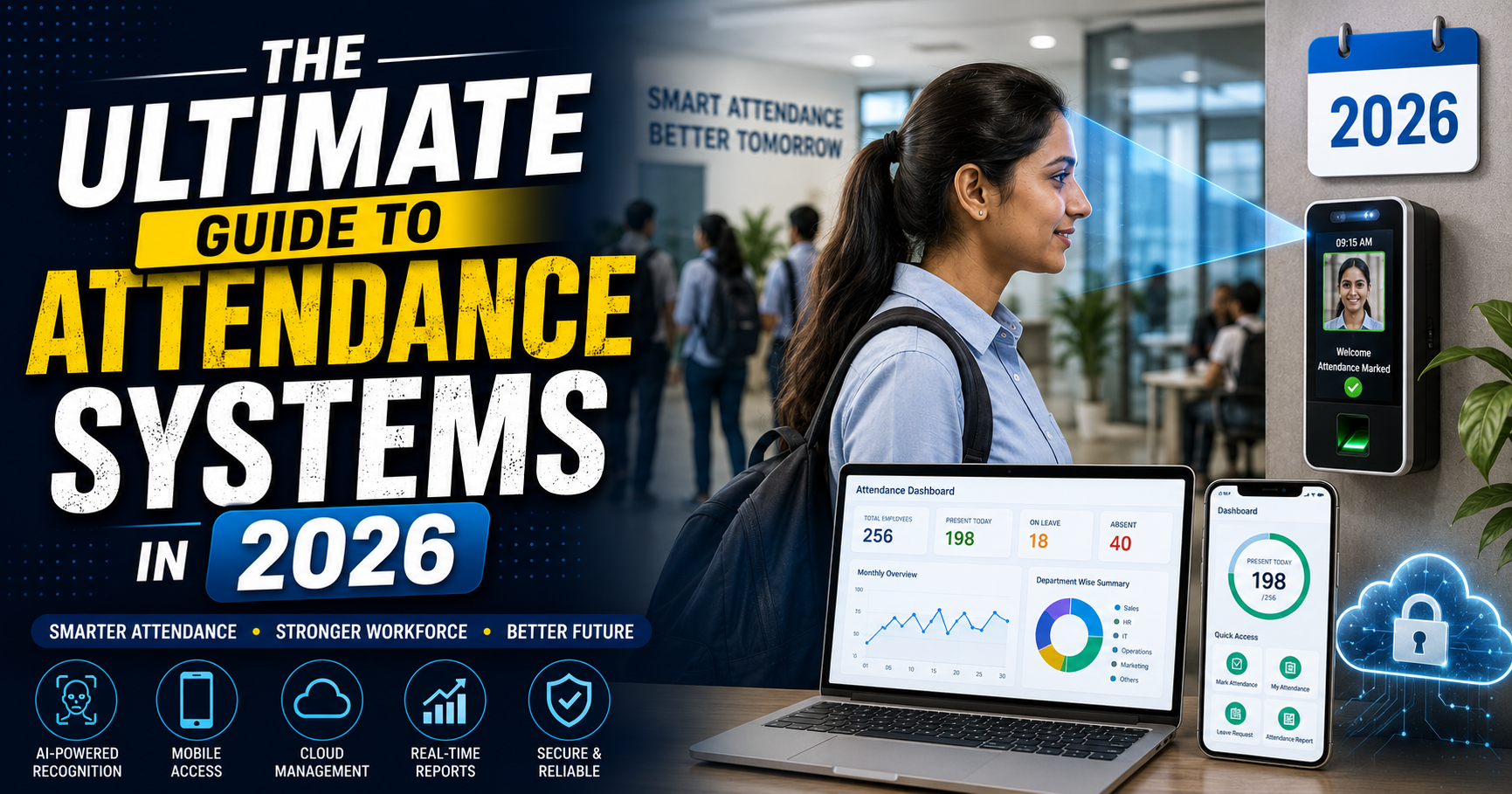
For more than two decades, I have been working in the attendance and access control industry.
During these years, I have met thousands of principals, HR managers, factory owners, university administrators, hospital directors, and business leaders. Interestingly, almost every meeting begins with the same question.
"Which attendance system should we buy?"
At first glance, it sounds like a technology question.
But after a few minutes of discussion, I usually realize they are not looking for an attendance machine.
They are trying to solve a business problem.
- A school wants teachers to spend less time calling out names.
- A factory wants to stop buddy punching.
- A university wants to eliminate proxy attendance.
- A hospital wants to know who is actually on duty during emergencies.
- A corporate HR team wants attendance to flow directly into payroll without manual intervention.
In every case, attendance is only the beginning.
The real objective is efficiency, accountability, security, compliance, and better decision-making.
Over the last twenty years, attendance technology has changed dramatically.
- We have seen paper registers replaced by punch cards.
- Punch cards were replaced by barcode systems.
- Barcode systems gave way to RFID cards.
- Then came fingerprint devices.
Today, artificial intelligence and face recognition are changing the way organizations think about attendance.
Every few years, a new technology enters the market and promises to solve every problem.
Some succeed.
Some disappear.
Some create new challenges while solving old ones.
That is exactly why I decided to write this guide.
This article is not written to convince you that one technology is better than another.
Instead, my goal is much simpler.
I want to help you understand how attendance systems have evolved, where each technology works best, where it fails, and how you can choose the right solution for your organization.
Whether you manage a school, college, university, factory, hospital, retail chain, corporate office, or government department, this guide will help you make a better decision.
Let's begin with a very basic question.
What Is an Attendance System?
Most people think attendance simply means marking someone as Present or Absent.
If you ask ten people what an attendance system does, most will answer,
"It records attendance."
Technically, they are correct.
But in today's world, attendance has become much more than that.
A modern attendance system is a platform that records, verifies, stores, and analyzes the presence of people while integrating with other operational systems such as payroll, ERP, visitor management, access control, compliance reporting, and workforce analytics.
In simple words, attendance is no longer just about knowing who came to work or who attended a class.
It is about understanding what is happening inside an organization.
For example:
A school principal wants to know:
- Which students are frequently absent?
- Which classes have poor attendance?
- Are attendance levels dropping before examinations?
- Which teachers consistently start classes on time?
A factory manager wants answers to completely different questions.
- Which workers are currently on the shop floor?
- Which shift has the highest absenteeism?
- How many contract workers reported today?
- Is production being affected because of manpower shortages?
An HR manager thinks differently.
They want attendance data to automatically calculate salaries, overtime, leave balances, shift allowances, and compliance reports.
Different industries ask different questions.
But they all depend on one thing.
Accurate attendance.
That is why attendance systems have become one of the most important digital foundations of modern organizations.
Why Attendance Matters More Than Ever in 2026
When attendance systems first became popular, their primary objective was simple.
Reduce paperwork.
Today, attendance serves a much larger purpose.
Let us look at how different industries use attendance.
Schools
Many schools still spend the first few minutes of every class taking attendance manually.
Three minutes may not sound like much.
But imagine a school with:
- 80 classrooms
- 7 periods every day
- 220 working days
Thousands of teaching minutes disappear every academic year simply because attendance is being recorded manually.
Now imagine if those minutes could be used for teaching instead.
Attendance is no longer just about maintaining records.
It is about giving teachers more teaching time.
Colleges and Universities
Higher education institutions face a completely different challenge.
Students are adults.
Large classrooms make manual attendance difficult.
Proxy attendance becomes common.
Sometimes attendance registers travel around the classroom while lectures continue.
Sometimes friends answer on behalf of absent students.
Sometimes attendance sheets disappear completely.
Universities need systems that improve accuracy without disrupting academic activities.
Corporate Offices
Attendance is closely linked with payroll.
Even a small attendance error can create salary disputes.
Employees may question overtime calculations.
Managers may dispute working hours.
HR teams spend valuable time resolving attendance-related issues that could have been avoided with accurate digital records.
Manufacturing
Factories depend on workforce availability.
Production planning, shift allocation, contractor management, overtime calculation, and statutory compliance all depend on attendance.
Knowing who entered the factory is no longer enough.
Management wants visibility into workforce movement throughout the day.
Healthcare
Hospitals never stop operating.
Doctors, nurses, technicians, emergency staff, and support teams work around the clock.
Attendance is directly connected to patient care.
Hospital administrators need real-time visibility to ensure adequate staffing across every shift.
Government Organizations
Government departments often manage employees across multiple locations.
Attendance systems help improve transparency, accountability, compliance, and operational efficiency while reducing manual paperwork.
Attendance Is No Longer Just Attendance
This is something I often explain during customer meetings.
People think they are purchasing an attendance system.
In reality, they are investing in information.
Once attendance becomes digital, organizations can answer questions they could never answer before.
For example,
Which branch has the highest absenteeism?
Which departments consistently work overtime?
Which shifts experience maximum delays?
Which classrooms have poor attendance?
Which employees frequently arrive late?
Attendance data becomes management intelligence.
That is where the real value lies.
The Evolution of Attendance Systems
Attendance systems did not become intelligent overnight.
Like every technology, they evolved gradually.
Understanding this evolution helps explain why different organizations continue to use different solutions today.
Generation One – Paper Registers
For decades, paper registers were the only attendance system available.
Teachers called student names.
HR departments maintained large attendance registers.
Factory supervisors manually recorded employee attendance.
The process was simple.
No electricity.
No software.
No internet.
No maintenance.
But it had several limitations.
Manual errors.
Time-consuming processes.
Difficulty generating reports.
No real-time visibility.
Easy manipulation.
Despite these shortcomings, paper registers are still used in many organizations because they require almost no investment.
Generation Two – Punch Cards
Industries introduced punch card systems to automate attendance recording.
Employees inserted cards into punch machines that stamped arrival and departure times.
This reduced manual recording but introduced new challenges.
Cards could be misplaced.
Machines required maintenance.
Attendance data still needed manual processing.
Although punch cards improved efficiency, organizations quickly realized they needed something more reliable.
Generation Three – Barcode and Magnetic Cards
As computers became common, barcode and magnetic card technologies entered the market.
Employees or students scanned their cards to record attendance.
Reporting became faster.
Digital records became easier to maintain.
However, another problem emerged.
Cards could be shared.
Someone could simply hand over their card to another person.
The system confirmed the presence of the card.
Not necessarily the person.
Generation Four – RFID Attendance
RFID technology solved many limitations of barcode systems.
Instead of physically scanning cards, RFID readers detected radio-frequency tags automatically.
Schools widely adopted RFID for gate attendance.
Factories used RFID for workforce entry.
Corporate offices used RFID cards for access control.
The technology was faster and more convenient.
But one limitation remained.
RFID identifies the card.
Not the individual carrying it.
If a student gives their card to a friend, the system has no way of knowing.
Generation Five – Biometric Attendance
Fingerprint attendance changed the industry.
Instead of identifying cards, systems began identifying people.
Buddy punching became significantly more difficult.
Fingerprint systems became the preferred solution for offices and factories.
However, they introduced their own challenges.
Wet fingers.
Dust.
Aging fingerprints.
Physical contact.
Queue formation during peak hours.
Maintenance requirements.
During the COVID-19 pandemic, many organizations also became concerned about touch-based devices.
The search for contactless attendance accelerated.
Generation Six – Face Recognition Attendance
Instead of asking users to touch a device, organizations began using facial recognition.
Employees simply looked at a camera.
Students walked through gates naturally.
Attendance became faster and contactless.
Face recognition significantly improved user experience while reducing maintenance associated with fingerprint devices.
But technology continued to evolve.
Generation Seven – AI-Powered Attendance
Artificial Intelligence is changing attendance in ways we could hardly imagine a few years ago.
Today, attendance can be captured using a classroom group photo, a mobile phone, or existing CCTV infrastructure, depending on the deployment model.
Instead of simply recording who is present, AI can help identify attendance trends, unusual patterns, and operational insights.
Attendance is no longer just a record.
It is becoming a decision-support tool.
And I believe this is only the beginning.
Final Thoughts for This Section
If there is one lesson I have learned over the last two decades, it is this:
Every attendance technology was created to solve a problem.
Paper registers solved documentation.
Punch cards reduced manual effort.
RFID improved speed.
Biometrics improved identity verification.
Face recognition improved convenience.
AI is helping organizations improve intelligence.
No single technology is perfect for every organization.
The right attendance system depends on your environment, your objectives, your users, and the challenges you are trying to solve.
That is exactly what we will explore in the next section, where we compare every major attendance technology—from paper registers to AI-powered face recognition—and help you understand which solution is best suited for your organization.
Final Thoughts
If there is one thing I have learned over the last two decades, it is this:
There is no single attendance system that is perfect for every organization.
The right solution depends on your industry, your operational challenges, your workforce, and the outcome you want to achieve.
A school may benefit from AI-powered classroom attendance using group photos. A manufacturing plant may find RFID cards more practical. A corporate office may prefer face recognition integrated with payroll, while a construction company may need GPS-based mobile attendance for its field workforce.
The mistake many organizations make is selecting a technology because it is popular rather than because it is appropriate for their specific requirements.
My advice is simple: don't buy an attendance system—solve your attendance problem. Start by identifying the challenges you want to address, whether it's proxy attendance, buddy punching, manual errors, payroll disputes, compliance, or administrative overhead. Once those challenges are clear, choosing the right technology becomes much easier.
At Metaguard Mobitech Pvt. Ltd., we have been helping organizations implement attendance and access control solutions for more than two decades. Our expertise covers the complete spectrum of attendance technologies, including RFID, Smart Cards, NFC, QR Code, Biometric, GPS-Based Attendance, Visitor Management, Access Control Systems, and integrated security solutions.
For organizations looking to embrace the next generation of attendance, we developed MemoFaceAI—our specialized AI-powered facial recognition platform. MemoFaceAI focuses on intelligent, contactless attendance using technologies such as Face Recognition, Classroom Attendance through Group Photos, CCTV-Based Attendance, Workforce Visibility, and AI-driven attendance analytics.
Whether you choose AI, RFID, biometric authentication, GPS, or a hybrid approach, the objective should always remain the same: make attendance simpler, more accurate, and more valuable for your organization.
Technology will continue to evolve, but the purpose of attendance will never change—to help organizations manage people more efficiently, make better decisions, and allow teachers, employees, supervisors, and administrators to focus on what they do best instead of spending valuable time on manual attendance processes.
I hope this guide has helped you understand not just the technologies available today, but also how to choose the one that will serve your organization for years to come.
Where Is Your Organization Today?
One of the biggest mistakes organizations make is assuming that the latest technology is always the right choice.
In my experience, that's not true.
Every attendance technology has solved a specific problem in its time. The goal isn't to jump straight to Artificial Intelligence. The goal is to move to the next level when your current system no longer meets your operational needs.
Think of attendance systems as a journey rather than a destination.
Generation 1 – Manual Attendance Registers
If you're still using paper registers, Excel sheets, or manual attendance books, your first priority should be to digitize your attendance process.
Recommended next step: Move to a basic digital attendance system such as QR Code, RFID, or biometric attendance.
Why?
- Eliminate paperwork
- Reduce manual errors
- Generate attendance reports automatically
- Save administrative time
Don't worry about AI yet. Focus on building a reliable digital foundation.
Generation 2 – Card-Based Attendance (RFID, Smart Cards, NFC)
If your organization already uses RFID or smart cards, you've successfully digitized attendance.
Now ask yourself:
- Are cards frequently lost?
- Are students or employees sharing cards?
- Is proxy attendance becoming a problem?
- Do you spend money replacing damaged cards?
If the answer is yes, it may be time to move beyond card-based identification.
Recommended next step: Face Recognition Attendance.
Generation 3 – Fingerprint or Biometric Attendance
Biometric systems solved many problems associated with card sharing.
However, organizations often face new challenges over time.
- Queues during peak hours
- Wet or damaged fingerprints
- Hygiene concerns
- Device maintenance
- Wear and tear
If these challenges affect your daily operations, consider upgrading to a contactless attendance solution.
Recommended next step: AI-powered Face Recognition.
Generation 4 – Face Recognition Attendance
At this stage, you've eliminated most of the limitations of cards and fingerprints.
Attendance is faster, contactless, and more convenient.
However, attendance is still largely focused on recording who is present.
Now ask yourself another question.
Can my attendance system help me make better decisions?
If not, it's time to think beyond attendance.
Generation 5 – AI-Powered Attendance & Workforce Intelligence
This is where attendance becomes more than just attendance.
Artificial Intelligence helps organizations understand patterns rather than simply recording presence.
Examples include:
- Classroom attendance using group photos
- CCTV-based attendance
- Workforce visibility
- Attendance analytics
- Automated payroll integration
- Absenteeism trends
- Shift optimization
- Productivity insights
At this stage, attendance becomes a management tool rather than an administrative task.
Don't Skip Generations
One piece of advice I often give customers is this:
Don't buy the most advanced technology simply because it's available. Buy the technology that solves your current problem.
A small school that is still using paper registers may not need AI-powered attendance on day one.
Its first step should be digitization.
On the other hand, a university struggling with proxy attendance across thousands of students may find that AI-powered facial recognition delivers immediate value.
Similarly, a factory that already uses RFID cards but faces frequent card sharing may benefit more from upgrading to face recognition than replacing its existing RFID infrastructure.
The right technology is not always the newest technology.
The right technology is the one that solves your biggest operational challenge today while giving you room to grow tomorrow.
About the Author
Loveneesh Bansal is the Founder & CEO of Metaguard Mobitech Pvt. Ltd. With more than two decades of experience in attendance, access control, RFID, biometric solutions, and AI-powered facial recognition, he has worked with schools, universities, hospitals, manufacturing companies, corporates, and government organizations to design practical attendance solutions that solve real operational challenges. Through MemoFaceAI, he is helping organizations adopt the next generation of intelligent attendance systems powered by Artificial Intelligence.