A few years ago, I was invited to visit a manufacturing company that had recently automated its attendance process.
The HR Head welcomed us with confidence.
"We've computerized everything now."
Attendance reports were generated automatically.
Payroll was automated.
Monthly summaries looked professional.
Everything seemed perfect.
Then the Finance Manager joined the meeting.
He quietly placed three salary sheets on the table.
"Can you explain why overtime keeps increasing even though production hasn't?"
That single question changed the direction of our discussion.
The attendance system was working.
The software wasn't faulty.
The real problem was something much bigger.
People had learned how to manipulate the process.
That experience taught me an important lesson.
Attendance fraud is rarely caused by technology. It usually happens because people find loopholes in the process.
Over the years, while working with schools, factories, hospitals, warehouses and corporate offices, I have seen different forms of attendance fraud.
Some are simple.
Some are surprisingly sophisticated.
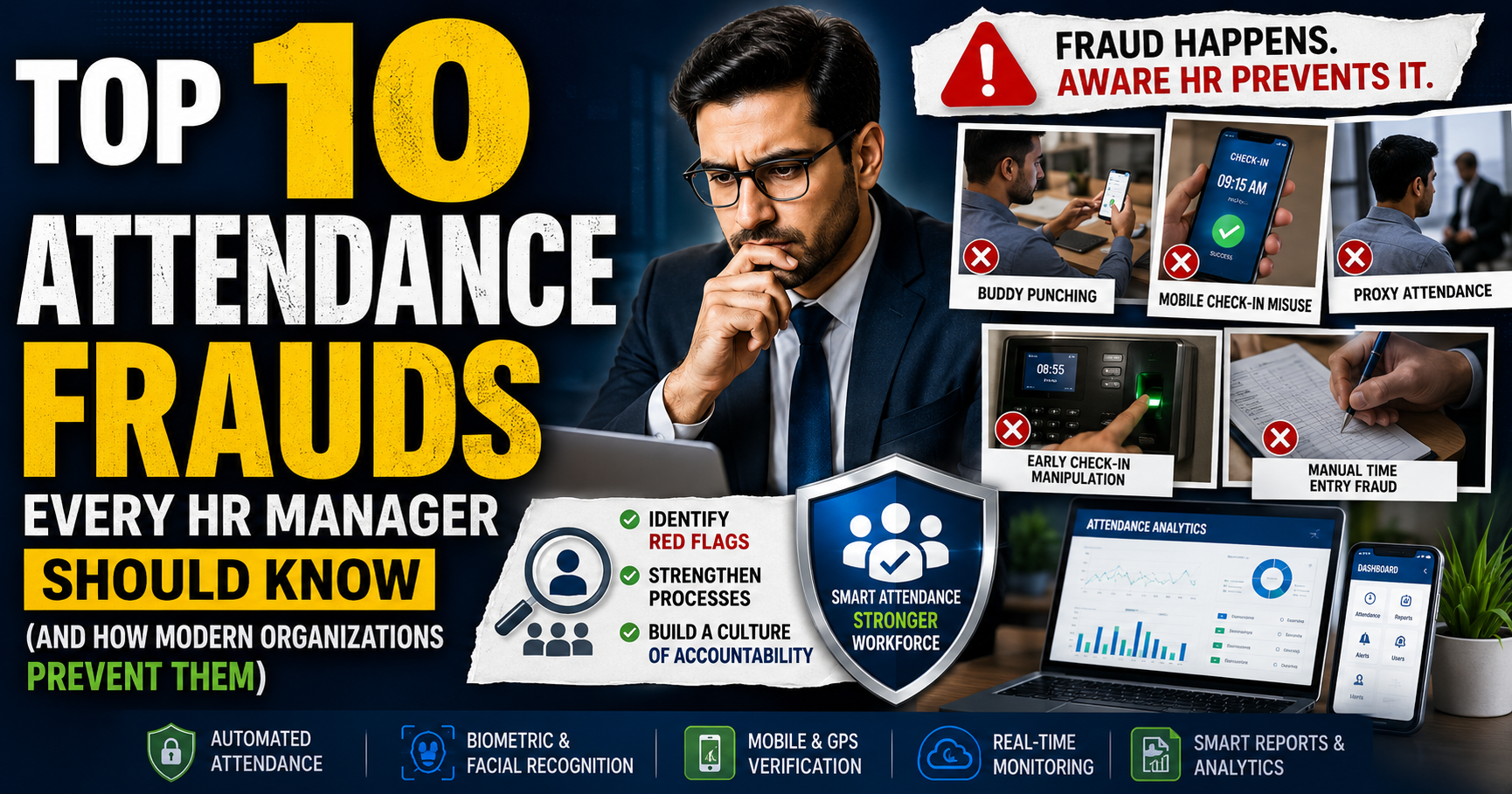
Here are the ten most common ones.
1. Buddy Punching
This is probably the most common attendance fraud in workplaces.
An employee asks a colleague to mark attendance on their behalf.
Years ago, this happened using punch cards.
Today it may involve RFID cards, PINs or poorly designed attendance systems.
The result is the same.
Someone receives salary for time they never worked.
Real-world example
During one implementation, an employee admitted,
"Sir, I was late only by twenty minutes. My friend marked my attendance because otherwise half a day's salary would have been deducted."
One small favour became a regular habit.
2. Proxy Attendance
Educational institutions know this problem very well.
One student answers during roll call.
Another signs the register.
Sometimes attendance is shared using cards or QR codes.
Over time, the institution believes students are attending classes when they are not.
3. RFID Card Sharing
RFID cards solved many operational problems.
Unfortunately, they introduced another.
Employees simply exchange cards.
One person taps two cards.
The system records two employees as present.
The software has no way of knowing who actually entered.
4. PIN or Password Sharing
Some attendance systems still depend on employee IDs and passwords.
Once credentials are shared, attendance loses its credibility.
The system authenticates the password—not the person.
5. Manual Register Manipulation
It may sound outdated, but many organizations still rely on paper attendance registers.
Names can be added later.
Timings can be modified.
Corrections become impossible to audit.
Paper rarely tells the full story.
6. Fake Overtime
This is one of the most expensive forms of attendance fraud.
Employees remain marked as present long after completing their work.
Overtime payments increase.
Payroll expenses rise.
Management often discovers the issue only after several months.
A Conversation I'll Never Forget
One factory manager once told me,
"We installed an attendance system to reduce costs. Somehow our overtime increased instead."
Technology alone cannot prevent process abuse.
7. Ghost Employees
Ghost employees exist in payroll systems but not in reality.
Sometimes they are former employees whose records were never removed.
Sometimes they are entirely fictitious.
Every salary cycle quietly transfers money that should never have been paid.
Fortunately, proper attendance validation can significantly reduce this risk.
8. Mobile Attendance Manipulation
Mobile attendance is convenient.
However, if organizations rely only on GPS location without stronger verification, there is a possibility of misuse through location spoofing or credential sharing.
Modern attendance solutions often combine multiple verification methods to improve reliability.
9. Early Check-In, Late Arrival
This is more common than many organizations realize.
An employee checks in at the gate.
Instead of reporting to work immediately, they spend time elsewhere before starting their shift.
The attendance record looks correct.
Productive working time tells a different story.
10. Multiple Shift Manipulation
Organizations running round-the-clock operations sometimes struggle with employees attempting to manipulate shift timings, especially where attendance and scheduling systems are not tightly integrated.
Proper shift validation helps reduce these issues.
Why Attendance Fraud Matters
Attendance fraud is often dismissed as a minor administrative issue.
It isn't.
Its impact extends across the organization.
- Payroll accuracy
- Compliance
- Productivity
- Workforce planning
- Project costing
- Customer commitments
- Financial reporting
When attendance data becomes unreliable, every business decision based on that data becomes less reliable.
Can Technology Eliminate Attendance Fraud?
Technology helps.
Processes matter even more.
The most effective organizations combine:
- Clear attendance policies
- Employee awareness
- Regular audits
- Automated reporting
- Secure authentication
- AI-assisted verification where appropriate
No single technology can solve every problem.
But the right combination can significantly reduce opportunities for misuse.
What We Have Learned
During our journey from RFID systems to biometric devices and now AI-powered attendance, one observation has remained consistent.
Employees generally do not set out to commit fraud.
Most loopholes exist because the system allows them.
When attendance becomes effortless for genuine employees and difficult to manipulate, organizations naturally see cleaner payroll data and stronger operational discipline.
Final Thoughts
Attendance systems should do more than record arrival and departure times.
They should help organizations build confidence in the data used for payroll, compliance and workforce management.
Every fraud discussed in this article has one thing in common.
It becomes possible when there is a gap between who the system believes is present and who is actually present.
Closing that gap should be the objective of every modern attendance strategy.
Technology will continue to evolve.
Human behaviour will too.
The organizations that succeed will be those that continuously improve both.
About the Author
Loveneesh Bansal is the Founder of MemoFaceAI and has spent over two decades implementing attendance, RFID, biometric and AI-powered workforce management solutions across manufacturing plants, schools, hospitals, educational institutions and enterprise organizations throughout India.