A few years ago, while visiting one of our manufacturing clients, I reached the factory gate just before the morning shift started. Employees were entering one after another, some carrying lunch boxes, others chatting before work.
One supervisor smiled and said, "Everything is automated now."
A few minutes later, another employee walked in casually.
The supervisor looked surprised and said. I checked you are already in. How this is possible. Who punched your attendance.
"My friend punched my attendance."
That one incident meant inaccurate attendance, incorrect payroll, and overtime calculations based on false data.
That was the day I realized that attendance fraud doesn't always involve sophisticated hacking. Sometimes it is simply two friends helping each other.
This practice has a name.
Buddy Punching.
What is Buddy Punching?
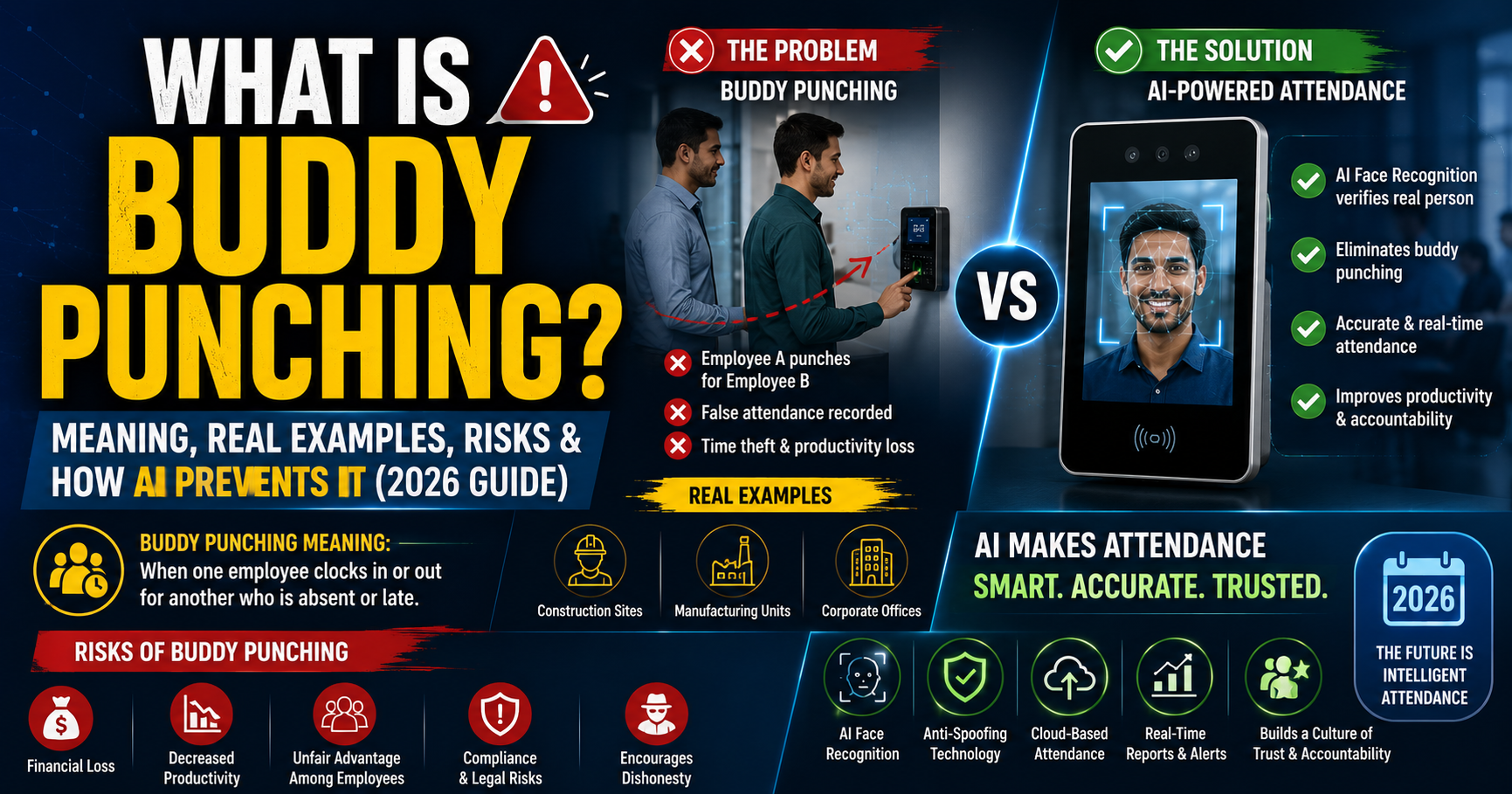
Buddy punching is an attendance fraud where one employee records attendance on behalf of another employee who is absent or arrives late.
Instead of the actual employee checking in, a colleague marks attendance using a fingerprint machine, RFID card, PIN, mobile application, or any system that can be operated by someone else.
Although it may seem like a small favour between coworkers, it directly impacts attendance records, payroll, productivity, compliance, and organizational trust.
Why is it Called Buddy Punching?
Years ago, attendance systems used mechanical punch clocks.
Employees inserted a paper time card into the machine, which stamped the arrival or departure time.
If someone was running late, a friend—or "buddy"—would punch the card for them.
The name remained, even though modern organizations now use biometric devices, RFID cards, QR codes, and mobile attendance apps.
Is Buddy Punching the Same as Proxy Attendance?
People often use these terms interchangeably, but there is a slight difference.
Buddy Punching is commonly used in corporate offices, factories, warehouses, and manufacturing environments.
Proxy Attendance is the more familiar term in schools, colleges, universities, and coaching institutes.
Both describe the same underlying problem: someone else records attendance for another person.
Why Does Buddy Punching Happen?
During our interactions with HR managers and administrators, we noticed that buddy punching usually happens because of one or more of these reasons:
Employees arriving late.
Friends covering for each other.
Shift changes.
Weak attendance policies.
Attendance systems that rely on cards, passwords, or PINs.
Lack of monitoring at entry points.
Sometimes employees don't even consider it fraud.
They simply think they are helping a colleague.
Unfortunately, the impact on payroll and compliance can be significant.
Common Ways Employees Commit Buddy Punching
Over the years, we have seen several methods.
RFID Card Sharing
An employee hands over their access card to a colleague.
The colleague taps both cards before entering.
Both employees appear present.
Fingerprint Workarounds
Although fingerprints are much harder to misuse, organizations occasionally encounter attempts to bypass biometric devices through unauthorized methods or poor operational practices.
Mobile Attendance Sharing
Some attendance applications rely only on GPS.
If location verification is weak, employees may attempt to misuse the system.
Manual Attendance Registers
Traditional attendance registers remain one of the easiest systems to manipulate.
PIN or Password-Based Attendance
If attendance depends only on credentials, those credentials can be shared.
Why Buddy Punching is a Serious Business Problem
Many organizations underestimate its impact.
The real cost extends far beyond one missed attendance entry.
Payroll Losses
Incorrect attendance leads directly to incorrect salary calculations.
Overtime Fraud
Employees may receive overtime payments they never earned.
Reduced Productivity
Managers believe sufficient staff are present when they are not.
Compliance Risks
In regulated industries, inaccurate attendance records may create audit challenges.
Loss of Trust
Once attendance data becomes unreliable, every report generated from it becomes questionable.
How Traditional Attendance Systems Perform
| System | Can Someone Else Mark Attendance? |
|---|---|
| Paper Register | Yes |
| RFID Card | Yes |
| PIN Based | Yes |
| QR Code | Yes |
| GPS Only | Possible |
| Face Recognition | Highly Resistant when deployed correctly |
Can Face Recognition Eliminate Buddy Punching?
Face recognition significantly reduces the possibility of buddy punching because attendance is linked to the individual's facial features rather than something they carry or know.
Modern AI systems compare facial embeddings instead of relying solely on cards or passwords.
When implemented with proper camera placement, lighting, and operational controls, organizations can achieve a much higher level of confidence in attendance records.
Where AI Makes the Difference
With AI-powered face recognition:
Employees do not need to carry cards.
Passwords cannot be shared.
Attendance can be verified using existing CCTV infrastructure.
Recognition happens automatically without interrupting employee movement.
Attendance data becomes available in real time.
A Lesson I Learned
Over the last two decades, I have worked with organizations implementing smart cards, RFID, biometric systems, and now AI-powered attendance.
Technology has evolved dramatically.
But one thing has remained constant.
People will always look for shortcuts if the process allows them.
The best attendance system is not the one with the most features.
It is the one that creates trustworthy data without making life difficult for genuine employees.
Final Thoughts
Buddy punching may begin as a small favour between colleagues, but over time it can become an expensive habit for an organization.
As businesses move towards automation, trusted attendance data becomes the foundation for payroll, compliance, workforce planning, and operational decisions.
Whether you call it buddy punching, proxy attendance, or attendance fraud, the objective remains the same: ensure that attendance reflects reality.
At MemoFaceAI, that philosophy guides everything we build. Our focus is not just to record attendance but to help organizations create reliable, transparent, and trustworthy workforce records using practical AI technology.
About the Author
Loveneesh Bansal is the Founder of MemoFaceAI and has spent more than two decades working on RFID, smart card, biometric, and AI-enabled workforce management solutions across schools, manufacturing units, corporate offices, hospitals, clubs, and enterprise organizations.