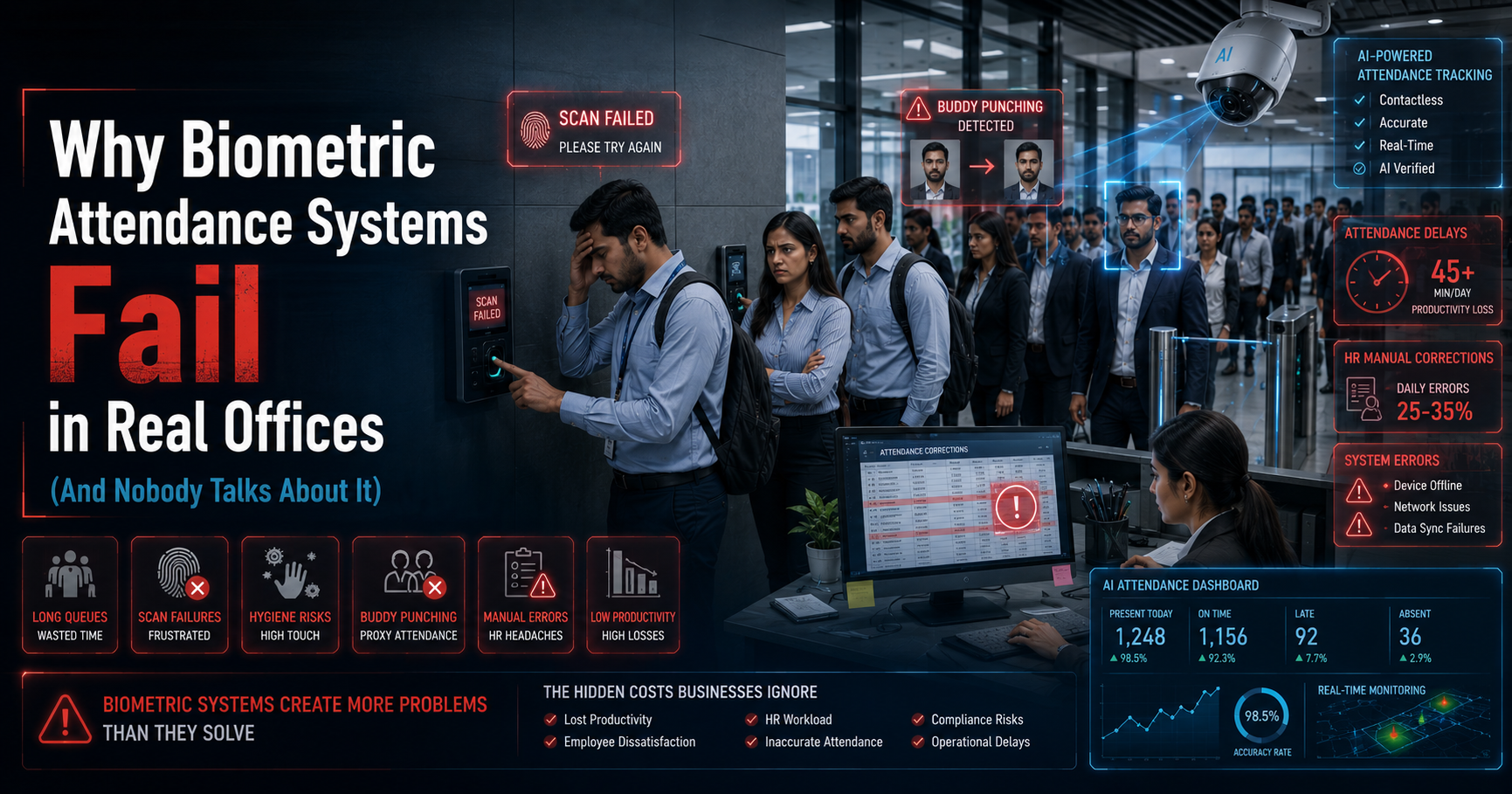
Why Biometric Attendance Systems Fail in Real Offices (And Nobody Talks About It)
🚨 The Harsh Reality: Punch ≠ Presence
Most companies believe:
“If an employee punches in, they are present.”
But in real-world offices, this assumption breaks down instantly.
Employees don’t behave in a controlled, linear way:
- They go out multiple times a day
- They re-enter without tracking
- They follow others through access doors
👉 The result?
You are not tracking attendance. You are tracking only an event.
⚠️ Problem #1: The Tailgating Loophole (Most Ignored)
One employee punches.
The door opens.
Three others walk in behind him.
This is called tailgating, and biometric systems cannot stop it unless:
- You install turnstiles (expensive)
- You enforce guards (manual dependency)
In most offices, neither happens.
👉 So your system records 1 entry instead of 4 people.
🔁 Problem #2: No Tracking After Entry
Biometric systems only capture:
- Entry time
- Exit time (sometimes)
But what about:
- Multiple exits during the day?
- Lunch breaks extending to 1 hour → 2 hours?
- Frequent smoke/tea breaks?
👉 These are completely invisible.
🧩 Problem #3: Real Behavior vs System Assumption
Let’s compare:
| System Assumption | Reality |
|---|---|
| One entry per day | 5–10 movements per day |
| Employees follow rules | Employees optimize convenience |
| Punch = working | Punch = just entry |
This mismatch is where companies lose productivity, discipline, and visibility.
💸 Hidden Cost: Time Theft (You Don’t See It, But You Pay For It)
Let’s do simple math:
- 100 employees
- Avg 30 minutes untracked time/day
- = 50 hours lost daily
- = ~1,100+ hours/month
👉 That’s equivalent to 5–7 employees’ full salaries wasted.
And most companies don’t even realize it.
😬 Problem #4: False Sense of Security
Biometric systems give reports, so management feels:
“Everything is under control.”
But those reports:
- Don’t reflect actual presence
- Don’t show movement
- Don’t highlight misuse
👉 It’s structured data… but incomplete truth.
🏢 Why Companies Still Use Biometric Systems
If it has so many flaws, why is it still everywhere?
1. Habit
“Sab use kar rahe hain”
2. Initial Cost Perception
Seems cheaper than advanced solutions
3. Lack of Awareness
Most decision-makers don’t know alternatives exist
🔍 The Core Problem
Biometric systems are built on:
👉 Control at a single point (gate)
But modern workplaces require:
👉 Visibility across the entire day
🚀 What Needs to Change
Instead of asking:
“Did the employee punch?”
You should be asking:
- How many times did they exit?
- How long were they actually inside?
- What is their real presence duration?
👉 This shift is from attendance → behavior tracking
💡 The New Approach (Preview)
Forward-thinking companies are now moving to:
- AI-based CCTV tracking
- Entry + exit intelligence
- Real-time movement visibility
👉 Without changing existing infrastructure
(We’ll break this down in the next blog)
🎯 Final Thought
Biometric systems were designed for a simpler time.
But today’s workplaces are dynamic, flexible, and unpredictable.
👉 If your system cannot track reality,
it is not a system — it is a formality.
📞 CTA (Lead Conversion)
Want to check if your current system is leaking productivity?
👉 Get a Free Attendance Audit Report
👉 See real gaps in your current setup
👉 No hardware change required