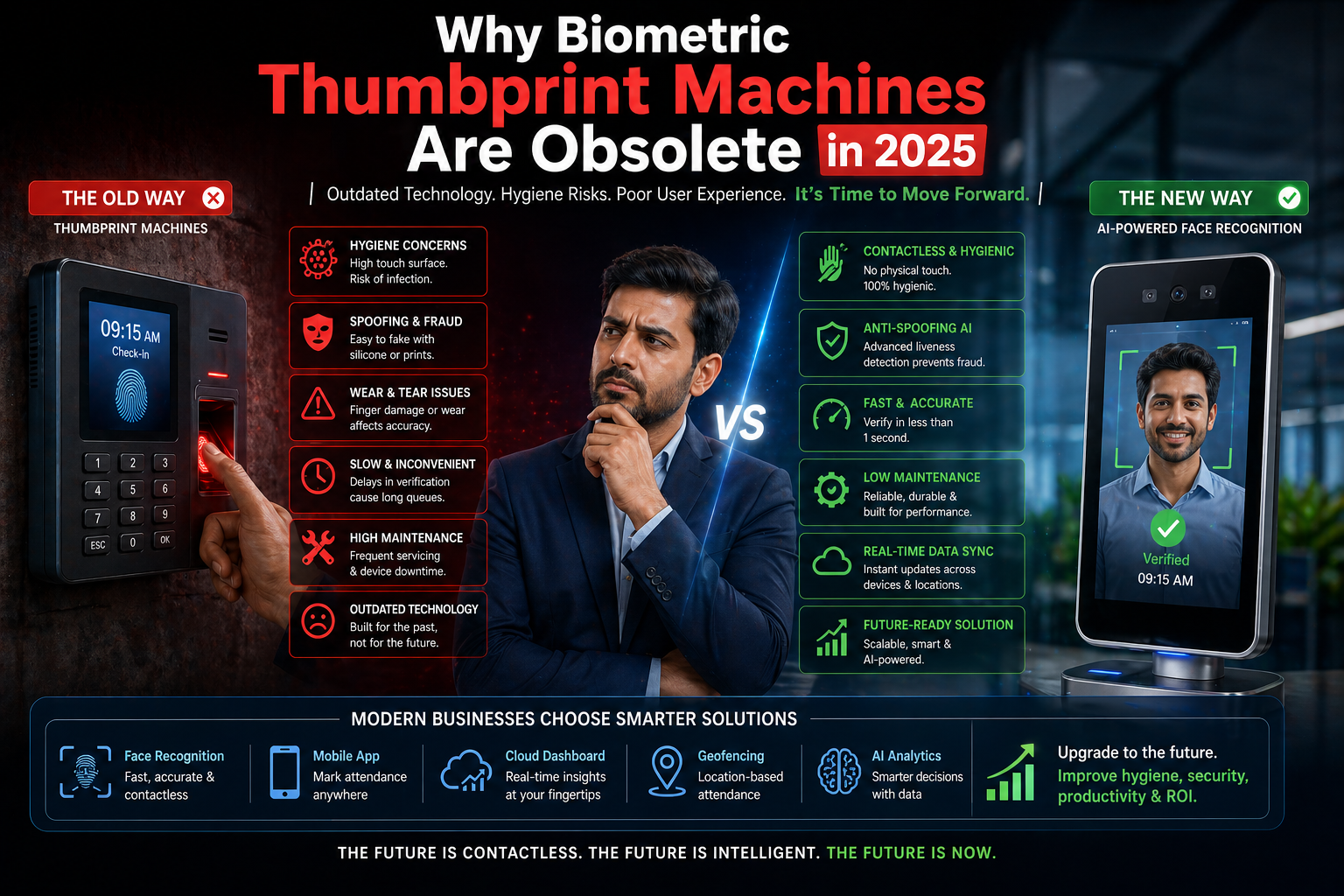
That's a strong statement. Let me back it up with specifics, because there are real reasons — price, familiarity, perceived simplicity — why organisations continue to install thumbprint machines. This article addresses each of them directly.
The Price Parity Has Already Arrived
The most common objection to face recognition attendance is cost: "Thumbprint machines are cheaper." In 2019, that was true. A thumbprint scanner cost INR3,000–5,000. Face recognition hardware cost INR15,000–30,000. The price gap justified the technology gap for many budgets.
In 2025, that gap has closed almost entirely. Capable AI face recognition running on a standard Android tablet — the hardware you can buy from any electronics store — costs INR12,000–18,000. The software that powers it has become dramatically cheaper as AI inference costs have dropped. The total landed cost of a face attendance terminal is now within INR5,000–8,000 of a fingerprint scanner, before factoring in maintenance and operational differences.
Cost Comparison 2025: Fingerprint vs. Face (Single Terminal)
Accuracy Isn't a Nice-to-Have — It's Money
A fingerprint scanner that's working perfectly delivers ~95% first-attempt recognition. After 2–3 years of heavy use, that drops to 70–80%. For employees who do physical labour, it can be significantly worse. Every failed scan is a manual intervention — an HR record that needs to be corrected, or an employee who gets marked absent because the scanner couldn't read their fingerprint at shift start.
AI face recognition systems maintain 99%+ accuracy indefinitely. The model doesn't degrade with use. Lighting changes, slight appearance changes (haircuts, glasses, masks below the nose), and aging are handled gracefully by modern models trained on diverse Indian face datasets.
The Contactless Requirement Is Now Permanent
Post-pandemic, many organisations implemented "contactless wherever possible" policies. These policies haven't been reversed. In fact, they've been codified — in hospital infection control protocols, in food industry hygiene standards, and in the general employment contracts of many large employers. A fingerprint scanner is fundamentally incompatible with contactless operation. A face recognition terminal is fundamentally contactless.
The "Simplicity" Argument for Fingerprint Is Backwards
The argument that fingerprint scanners are "simpler" persists because they have been around longer and IT teams know how to troubleshoot them. This is path dependency, not genuine simplicity. Modern face recognition systems are configured via a mobile app or web dashboard, require no specialist IT for maintenance, and run on hardware that any smartphone-literate person can operate. The complexity argument was true in 2018. It's not true in 2025.
When Should You Wait?
If your fingerprint system is less than 18 months old, working at above 92% accuracy, and you have no specific pain points driving the conversation, you have time. Plan to transition when your hardware reaches the end of its useful life rather than doing it earlier than necessary. If your system is over 3 years old or under 85% first-attempt accuracy: the economic case for switching now is strong.
Still Have Questions?
Here
are answers to the most common queries about AI-based attendance systems,
biometric alternatives, workforce tracking, facial recognition attendance, and
CCTV attendance monitoring.
FAQ
Why are biometric machines becoming obsolete?
They rely on manual input and fail in dynamic environments.
What are the alternatives to biometric systems?
AI-based CCTV attendance tracking.
Can biometrics track real movement?
No. They only capture punches.
Are biometric systems secure?
They have limitations and can be bypassed.
Why are companies shifting to AI attendance?
For accuracy, automation, and better visibility.
Thinking about switching?
We'll audit your current attendance accuracy for free — show you your real scan success rate and exception volume — before you make any commitment.
Get a Free Accuracy Audit ->