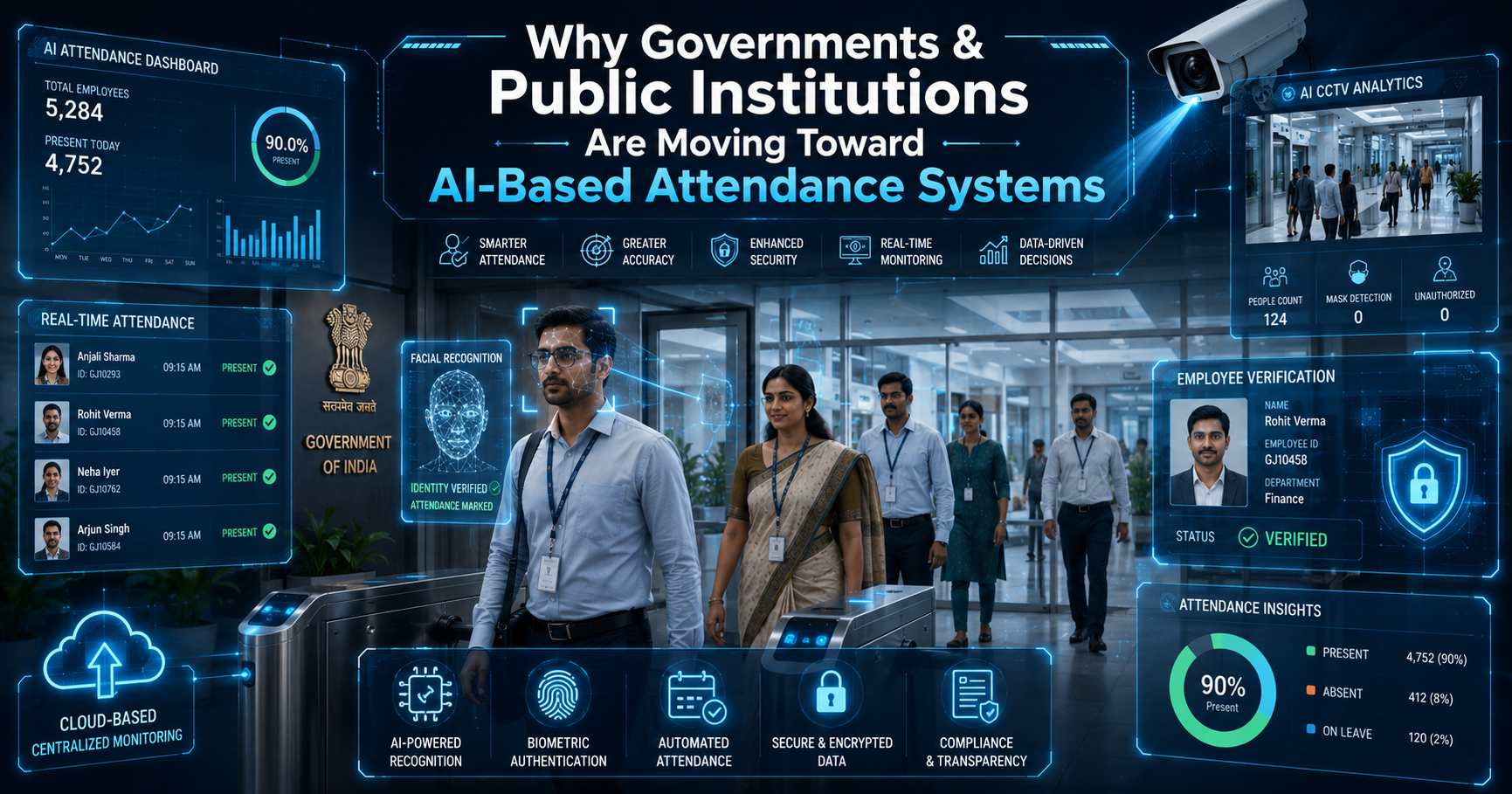
Now, public institutions across the world are increasingly exploring biometric and AI-powered attendance systems to improve accountability, transparency, and operational efficiency.
A recent report highlighted how a BJP corporator in Mumbai urged the municipal administration to introduce biometric attendance systems for BMC meetings in order to improve attendance tracking and accountability among elected representatives. (Fortune)
This reflects a much larger global trend where organizations are moving from manual attendance methods toward intelligent AI-powered workforce monitoring systems.
The Growing Need for Attendance Transparency
Large organizations and public institutions often face operational challenges such as:
Delayed attendance reporting
Manual errors
Lack of real-time visibility
Administrative inefficiencies
Attendance manipulation
Compliance monitoring issues
In public systems, attendance transparency becomes even more important because operational accountability directly impacts governance and citizen services.
This is one of the major reasons governments, enterprises, educational institutions, and industries are increasingly adopting biometric and AI attendance technologies.
Traditional Attendance Systems Have Limitations
Conventional attendance systems such as:
swipe cards,
often create multiple operational challenges.
These may include:
hardware dependency,
physical touch requirements,
maintenance overhead,
attendance queues,
and proxy misuse.
In large-scale environments, managing attendance manually becomes increasingly difficult and inefficient.
AI Attendance Systems Are Changing Workforce Management
Modern AI-powered attendance systems use:
and intelligent automation
to create contactless and highly scalable attendance solutions.
Instead of requiring individuals to manually mark attendance, AI systems can automatically identify and log attendance events using cameras and facial intelligence.
This enables:
touchless attendance,
faster entry,
centralized monitoring,
and real-time workforce visibility.
Why Face Recognition Attendance Is Growing Rapidly
AI-based facial recognition attendance systems provide several operational advantages:
Contactless Experience
No physical touch or biometric device interaction is required.
Reduced Proxy Attendance
AI verifies actual facial identity instead of cards or manual registers.
Faster Attendance Processing
Large groups can be processed quickly without queues.
Real-Time Monitoring
Attendance visibility becomes instant and centralized.
Better Administrative Control
Organizations can generate automated reports and analytics.
This is especially useful in:
government institutions,
hospitals,
schools,
universities,
manufacturing plants,
and enterprise campuses.
Existing CCTV Infrastructure Can Now Be Used
One of the biggest transformations in attendance technology is that organizations no longer need separate hardware systems everywhere.
Modern AI platforms can leverage existing CCTV infrastructure to automate attendance and workforce monitoring.
This significantly reduces:
deployment costs,
hardware investments,
and infrastructure complexity.
Instead of deploying multiple standalone biometric devices, organizations can use existing camera networks combined with AI intelligence.
MemoFaceAI: AI Attendance & Workforce Intelligence Over Existing CCTV Infrastructure
MemoFaceAI helps organizations transform existing CCTV infrastructure into intelligent AI-powered attendance and workforce management systems.
Rather than relying solely on standalone biometric devices, MemoFaceAI enables organizations to automate attendance through AI-based face recognition integrated with existing cameras.
Key Features of MemoFaceAI
AI Face Attendance
Automatic attendance marking using CCTV cameras.
Real-Time Workforce Monitoring
Track employee or staff presence centrally.
Multi-Location Attendance Intelligence
Manage attendance across multiple offices or campuses.
Unauthorized Access Alerts
Identify unknown individuals entering restricted areas.
Attendance Analytics
Generate workforce movement and attendance insights.
Contactless Operations
Completely touchless attendance experience.
Integration Support
Can integrate with HRMS, payroll, visitor management, and access control systems.
Smart Governance Through AI Systems
Governments and public institutions are increasingly focusing on:
digitization,
operational transparency,
automation,
and smart governance.
AI-powered attendance systems support these objectives by:
improving accountability,
reducing manual intervention,
enhancing reporting accuracy,
and enabling centralized workforce visibility.
This is particularly important in environments where attendance and operational discipline directly affect public services.
AI Attendance Is Expanding Beyond Offices
Modern AI attendance systems are now being deployed in:
municipal institutions,
educational campuses,
healthcare facilities,
manufacturing plants,
smart offices,
logistics operations,
industrial facilities,
and public sector organizations.
Attendance systems are no longer just HR tools.
They are evolving into operational intelligence platforms capable of supporting workforce analytics, compliance monitoring, and organizational efficiency.
Privacy & Responsible AI Deployment
As biometric and AI attendance systems become more common, privacy and ethical AI deployment become critically important.
Organizations implementing AI attendance solutions must ensure:
secure biometric storage,
encryption,
role-based access,
and compliance with local regulations.
Responsible AI deployment will play a major role in public trust and long-term adoption.
MemoFaceAI supports privacy-focused deployment approaches, including secure on-premise infrastructure where organizations maintain full control over their data.
The Future of Attendance Is Intelligent
The future of attendance management will increasingly combine:
and real-time operational monitoring.
Organizations are moving toward systems capable of:
understanding presence,
automating reporting,
reducing manual effort,
and improving operational decision-making.
AI attendance systems represent one of the most practical and rapidly growing applications of artificial intelligence in workforce management.
Final Thoughts
The increasing push toward biometric and AI-based attendance systems reflects a global shift toward intelligent operational infrastructure.
Public institutions, enterprises, and educational organizations are looking for systems that:
improve transparency,
reduce attendance fraud,
automate operations,
and create better workforce visibility.
Platforms like MemoFaceAI are helping organizations accelerate this transition by transforming existing CCTV infrastructure into intelligent AI-powered attendance and workforce intelligence systems.
The future of attendance is no longer manual.
It is automated, intelligent, and AI-driven.