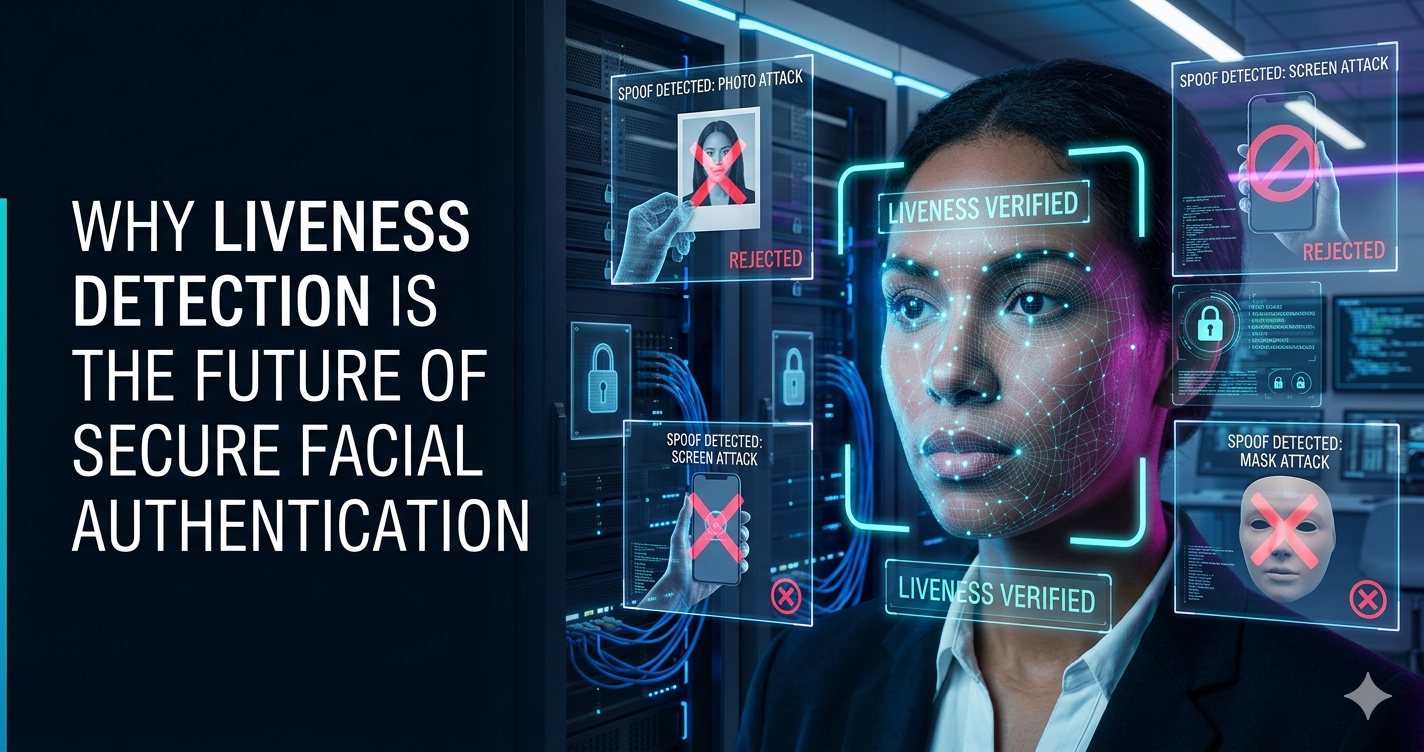
But there is a growing problem.
What happens when someone uses:
- a printed photo,
- a replayed video,
- a deepfake,
- or an AI-generated face
to fool the system?
This is exactly why modern biometric systems must go beyond simple face matching.
At MemofaceAI, we strongly believe that:
“Face recognition without liveness detection is incomplete security.”
The Rising Threat of Fake Biometric Authentication
Recent reports and cybersecurity studies show that attackers are increasingly using:
- deepfake videos,
- synthetic identities,
- replay attacks,
- 3D masks,
- and virtual camera injections
to bypass biometric systems.
Traditional face recognition systems only answer:
“Does this face match?”
But they often fail to answer:
“Is this a real live person?”
That difference changes everything.
What is Liveness Detection?
Liveness detection is a security layer that verifies whether the biometric input is coming from a real human being physically present in front of the camera — not from a photo, video, mask, or manipulated feed.
In simple words:
| Technology | Question Answered |
|---|---|
| Face Recognition | “Who is this person?” |
| Liveness Detection | “Is this person real right now?” |
Modern cybersecurity experts now consider liveness detection essential for secure biometric authentication.
Why Basic Face Recognition is No Longer Enough
Older biometric systems were designed in an era before:
- generative AI,
- realistic deepfakes,
- high-resolution smartphone cameras,
- and AI face-swapping tools.
Today, attackers can:
- replay videos on another device,
- inject fake camera streams,
- create synthetic faces,
- or use social media photos to attempt spoofing attacks.
This means organizations using only traditional face recognition are exposed to:
- fake attendance,
- proxy punching,
- unauthorized access,
- identity fraud,
- and compliance risks.
How MemofaceAI Approaches Biometric Security
At MemofaceAI, our philosophy is simple:
“Recognition alone is not enough. Verification must include liveliness.”
That is why our AI-driven architecture focuses heavily on:
- face liveliness validation,
- anti-spoofing detection,
- behavioral verification,
- and intelligent authentication workflows.
Our systems are designed to identify anomalies such as:
- static photos,
- replayed videos,
- artificial screens,
- suspicious motion patterns,
- and non-human interaction behavior.
Types of Spoofing Attacks Modern Systems Must Detect
Modern biometric fraud is no longer limited to printed photographs.
1. Photo Attacks
An attacker shows a printed or mobile-displayed image to the camera.
2. Replay Video Attacks
A recorded video of the genuine user is played back to the authentication system.
3. Deepfake Attacks
AI-generated or face-swapped videos attempt to impersonate legitimate users.
4. 3D Mask Attacks
Advanced attackers use realistic facial masks to bypass weak systems.
5. Virtual Camera Injection
Malicious software injects manipulated video feeds directly into applications.
This is why advanced anti-spoofing is becoming mandatory.
Active vs Passive Liveness Detection
Modern biometric systems use two major approaches.
Active Liveness
The system asks users to:
- blink,
- smile,
- turn the head,
- or perform random movements.
Passive Liveness
The system silently analyzes:
- texture,
- lighting,
- reflections,
- depth,
- micro facial movements,
- and behavioral patterns
without user interaction.
At MemofaceAI, we believe passive intelligence combined with behavioral AI creates a more seamless and secure user experience.
Why This Matters for Businesses
Organizations are increasingly using facial authentication for:
- employee attendance,
- smart access control,
- visitor management,
- digital onboarding,
- cashless systems,
- healthcare authentication,
- education campuses,
- and workforce tracking.
Without liveliness checks, these systems become vulnerable to:
- attendance fraud,
- buddy punching,
- fake visitor identities,
- unauthorized entry,
- and manipulated audit trails.
For enterprises, this is not just a technology issue.
It becomes:
- a compliance issue,
- a trust issue,
- and a business risk.
The Future of AI-Based Authentication
The future of biometric security will not depend on:
- “Can the system recognize a face?”
Instead, it will depend on:
- “Can the system intelligently verify real human presence?”
Industry experts increasingly agree that biometric systems must evolve toward:
- continuous authentication,
- anti-deepfake protection,
- passive liveness,
- and AI-based fraud detection.
This is exactly the direction MemofaceAI is building toward.
Conclusion
Face recognition is powerful.
But in the age of deepfakes and AI-generated identities, recognition alone is no longer enough.
The next generation of biometric systems must be capable of:
- detecting spoofing,
- verifying human presence,
- analyzing behavioral authenticity,
- and continuously validating trust.
At MemofaceAI, liveliness is not an optional feature.
It is a core security principle.