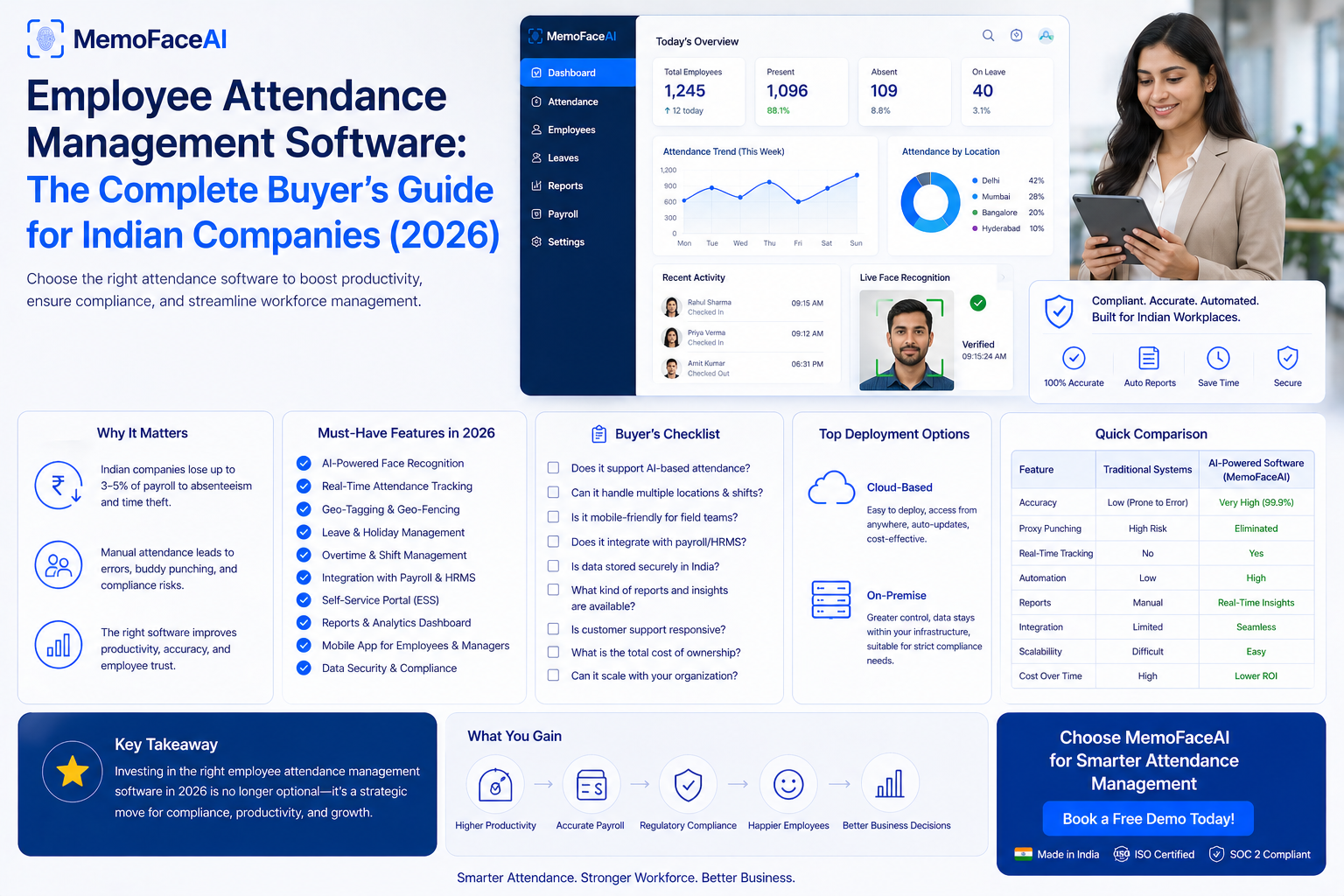
This guide is written for HR heads, CHROs, and operations leaders in Indian organizations evaluating a move from legacy biometric systems to modern AI-powered attendance platforms. We cover what to look for, what to avoid, and how much you should actually pay.
Why Employee Attendance Management Has Become a Business Problem
Attendance used to be about discipline. Today, it is about data — payroll accuracy, compliance reporting, productivity analytics, and workforce forecasting.
But most Indian companies still run on systems designed ten years ago:
- Fingerprint machines that fail with dust, sweat, or cuts on fingers.
- Excel sheets that HR manually reconciles at the end of every month.
- Multiple branches running different systems, with no single view for the head office.
- Proxy attendance via shared RFID cards or buddy punching at the biometric.
The result is a hidden tax on the organization — payroll errors, compliance exposure, HR overtime, and low trust in attendance data.
What to Look for in Modern Employee Attendance Software
Not every employee attendance system is built for today's workforce. Here are the non-negotiable features to evaluate.
1. Face Recognition with 3D Liveness
Fingerprint and RFID can be spoofed. A modern face recognition attendance system uses 3D liveness detection to block photo, video, or mask-based proxy attempts — something no fingerprint device can offer.
2. Mobile-First Architecture
Your employees already carry phones. Insisting on dedicated biometric hardware at every door is outdated and expensive. Look for platforms that work on any Android or iOS device.
3. Geo-Fencing and Location Validation
For field staff, sales teams, and multi-site operations, the software should validate not just who is marking attendance but where. Geo-fencing ensures employees check in only within approved zones.
4. Offline Capability
Factories in industrial zones, construction sites, and retail outlets often have patchy internet. The software must capture attendance offline and sync automatically when connectivity returns.
5. Payroll-Ready Integration
Attendance is worthless if HR still has to spend three days every month cleaning it before running payroll. The system should sync directly with your HRMS or payroll software — or at minimum export clean, payroll-ready data.
6. Multi-Location Dashboard
If you operate across cities, branches, or plants, one dashboard with live visibility across all sites is essential. Anything less creates blind spots.
Face Recognition vs Biometric vs Excel: What Actually Fits Today's Workplace?
| Parameter | Excel / Manual | Fingerprint Biometric | AI Face Recognition |
|---|---|---|---|
| Accuracy | Low | 85–95% | 99.9% |
| Proxy prevention | None | Partial | Strong (3D liveness) |
| Hardware investment | Zero | INR25,000–INR80,000 per device | Zero (uses existing phone) |
| Multi-location view | Manual consolidation | Per-device only | Single unified dashboard |
| Offline support | Yes | Limited | Full, with auto-sync |
| Payroll integration | Manual entry | Export required | Direct sync |
| Maintenance cost | HR overhead | High (devices, AMC) | Low (software only) |
| Setup time | Immediate but messy | 2–4 weeks | 48 hours |
The comparison usually makes the case on its own. The interesting question is not whether to switch, but how fast.
How Much Should Employee Attendance Software Cost in India?
Pricing varies widely because the term "attendance software" covers everything from basic time-tracking to full workforce intelligence platforms. See our full breakdown on attendance software pricing in India for current market rates.
As a rule of thumb:
- Basic time tracking software: low per-user monthly cost, but usually no face recognition, no liveness, and no multi-location view.
- Biometric device purchase: heavy upfront hardware cost plus annual AMC, with ongoing device failures.
- AI face recognition platforms: mid-range per-user monthly pricing, zero hardware, full feature set, with enterprise tiers for 1000+ employees.
For most Indian companies between 50 and 2000 employees, AI face recognition ends up cheaper than biometric devices within the first 18 months, because you skip the hardware altogether.
Want a realistic quote for your company size? Book a 30-minute demo and walk away with a tailored cost estimate — no credit card, no obligation.
Common Mistakes Indian Companies Make While Choosing Attendance Software
Having helped 30+ organizations migrate to modern attendance, we see the same five mistakes repeatedly.
- Buying hardware first, software second. Companies spend lakhs on biometric devices, then realize the software that runs them is rigid and can't integrate with payroll.
- Ignoring proxy attendance in the demo. Always ask the vendor to demonstrate what happens when you hold up a photo or wear a mask. If they dodge the question, move on.
- Not involving payroll. HR buys, payroll suffers. Make sure the finance or payroll team reviews how data flows into salary calculation.
- Over-engineering the pilot. Run a two-week pilot with one department, not a six-month POC. Modern systems go live in 48 hours — if a vendor needs months, their platform is the problem.
- Underestimating change management. Employees need a 15-minute orientation and clear policy communication. Skip this and adoption suffers, however good the software is.
Is Employee Attendance Software Worth the Investment?
For most Indian companies, the answer becomes obvious once you calculate the hidden cost of the current system.
A rough benchmark for a company with 200 employees:
- HR time on reconciliation: 3 working days every month — roughly 36 hours of senior HR time.
- Proxy attendance leakage: conservatively 1–2% of salary bill, which at INR50 lakh monthly payroll is INR50,000–INR1 lakh every month.
- Biometric device AMC and failures: INR50,000–INR1.5 lakh annually across branches.
- Payroll error corrections: difficult to measure, but consistently the second-largest HR support ticket category.
Against this, a modern face recognition attendance platform typically pays back within the first quarter — often within the first month for mid-sized companies.
Compliance and Data Privacy: What Indian HR Leaders Must Know
With the DPDP Act 2023 now in force, employee biometric and face data fall under "sensitive personal data." Any attendance platform you choose must:
- Store data on Indian servers or with clear cross-border transfer consent.
- Provide employees the right to access, correct, and request deletion of their data.
- Maintain written consent records for face enrollment.
- Use encryption at rest and in transit — AES-256 is the current industry standard.
- Offer role-based access controls with full audit logs.
MemoFaceAI is built Indian-first with DPDP compliance baked in, not bolted on.
Frequently Asked Questions
Can face recognition attendance software work for field employees?
Yes. Modern platforms combine face recognition with geo-fencing and live location capture, so field sales teams, delivery staff, and site engineers can mark attendance from authorized locations using their own phones.
What happens if an employee changes their appearance, like growing a beard?
AI models today handle facial changes — beards, glasses, haircuts, weight changes — reliably because they focus on structural features, not surface appearance. In rare cases, a quick re-enrollment takes under 30 seconds.
How is this different from Zoho People or Keka attendance?
Zoho People, Keka, and similar HRMS platforms focus on leave, payroll, and HR workflows, with attendance as a feature. MemoFaceAI focuses specifically on attendance intelligence — with stronger face recognition, liveness, and multi-location capability — and integrates with HRMS platforms via API.
Is it difficult to train employees on a new attendance system?
No. Face recognition attendance is the easiest system to adopt — employees just point the camera and it works. Most companies complete full employee orientation in under 20 minutes via a short video or team huddle.
Can we run a pilot before buying?
Yes. MemoFaceAI offers a 15-day free pilot with up to 20 users, full features, no credit card, and no hardware purchase. This is the recommended way to evaluate any attendance software before commercial commitment.
The Bottom Line
The right employee attendance management software is not the one with the longest feature list — it is the one that eliminates proxy attendance, saves HR time, works across every location, and makes payroll a non-event every month.
For Indian companies between 50 and 5000 employees, AI face recognition platforms like MemoFaceAI have quietly become the standard. Zero hardware, fast deployment, payroll-ready data, and pricing that beats legacy biometric within the first year.
If your HR team still spends the first week of every month fixing attendance data, that's the signal. Book a MemoFaceAI demo and see the difference in 30 minutes.
Still Have Questions?
Here are answers to the most common queries about AI-based attendance systems, biometric alternatives, workforce tracking, facial recognition attendance, and CCTV attendance monitoring.
FAQ
What should companies look for in attendance software?
Accuracy, automation, scalability, and integration with payroll systems.
Is AI attendance better than biometric systems?
Yes. It tracks real presence instead of just punch events.
Can attendance software integrate with payroll?
Yes. Most modern systems support HRMS and payroll integration.
What is the biggest mistake companies make?
Relying on manual or punch-based systems that don’t track real movement.
How can companies improve attendance accuracy?
By adopting AI-based tracking systems.