These inefficiencies rarely appear as large, visible gaps. Instead, they manifest in everyday behaviours: employees stepping out during shifts, proxy attendance, inaccurate overtime claims, or manual corrections in payroll systems. Over months, and across large teams, such leakages can cost companies several lakhs annually.
A growing number of organisations are now turning to a new approach—using artificial intelligence layered on existing CCTV infrastructure—to address this challenge.
From surveillance to operational intelligence
Traditional attendance systems, including biometric devices and RFID cards, require active participation. They record check-ins and check-outs but often fail to capture what happens in between.
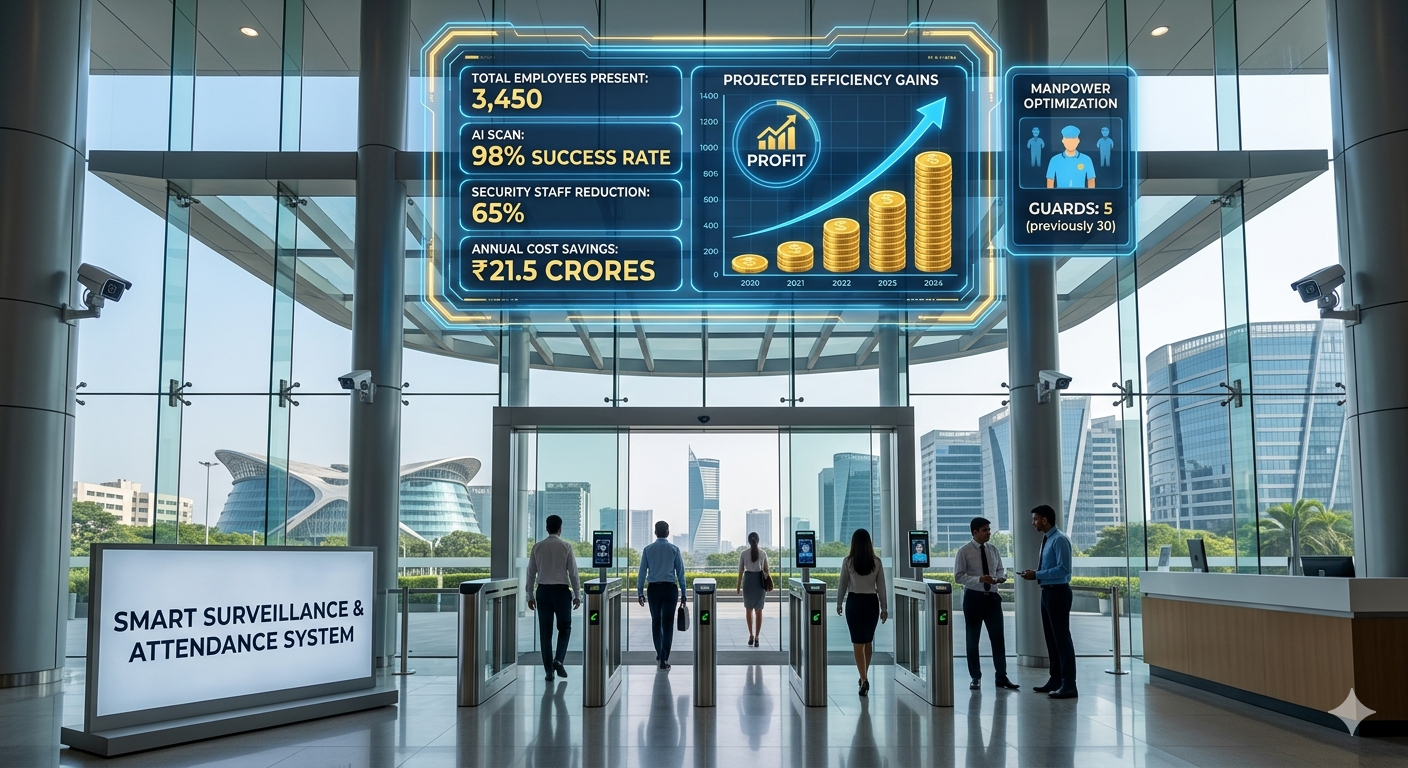
AI-powered CCTV attendance systems take a different approach. By combining facial recognition with computer vision, these systems passively track employee movement across entry and exit points.
Employees do not need to stop to mark attendance. Instead, the system identifies individuals in real time and records their movement patterns throughout the day.
This shift—from manual input to passive tracking—is emerging as a key differentiator.
Where companies are seeing measurable impact
Early adopters across sectors report that the benefits extend beyond automation.
Reduction in proxy attendance:
Since identification is based on facial recognition, the possibility of “buddy punching” is effectively eliminated.
Improved productivity visibility:
Organisations gain insight into mid-shift exits, extended breaks, and movement patterns that were previously untracked.
More accurate payroll processing:
With real-time attendance data integrated into payroll systems, companies report fewer discrepancies and disputes.
Lower infrastructure costs:
Because these systems leverage existing CCTV setups, there is minimal additional hardware investment.
A shift in how attendance is viewed
One mid-sized organisation that implemented an AI-based attendance system observed a significant reduction in unnecessary expenses linked to overtime, late working hours, and associated operational costs such as food and transport.
In this case, improved visibility into actual working hours helped reduce such expenses by nearly 60 percent.
While outcomes vary across industries, the broader trend suggests that attendance is increasingly being treated as a financial control mechanism rather than just an HR function.
Adoption beyond the private sector
The use of AI-driven attendance systems is also expanding within public sector projects and large-scale workforce programmes, where transparency and accountability are critical.
This indicates a wider acceptance of AI-led monitoring as a tool not just for compliance, but for efficiency.
Looking ahead: Beyond attendance
Industry observers note that the next phase of these systems may go beyond attendance tracking.
With advances in AI, organisations could begin to analyse workforce movement patterns, generate productivity insights, and even predict operational bottlenecks.
If this trend continues, attendance systems may evolve into broader workforce intelligence platforms.
A quiet but significant shift
Unlike more visible digital transformations, this shift is happening quietly—often without direct employee interaction.
However, for businesses operating on tight margins, the ability to recover hidden costs and improve workforce discipline can have a measurable impact on profitability.
As Indian companies continue to adopt AI in operational workflows, attendance management may be one of the most immediate areas where returns are both visible and significant.