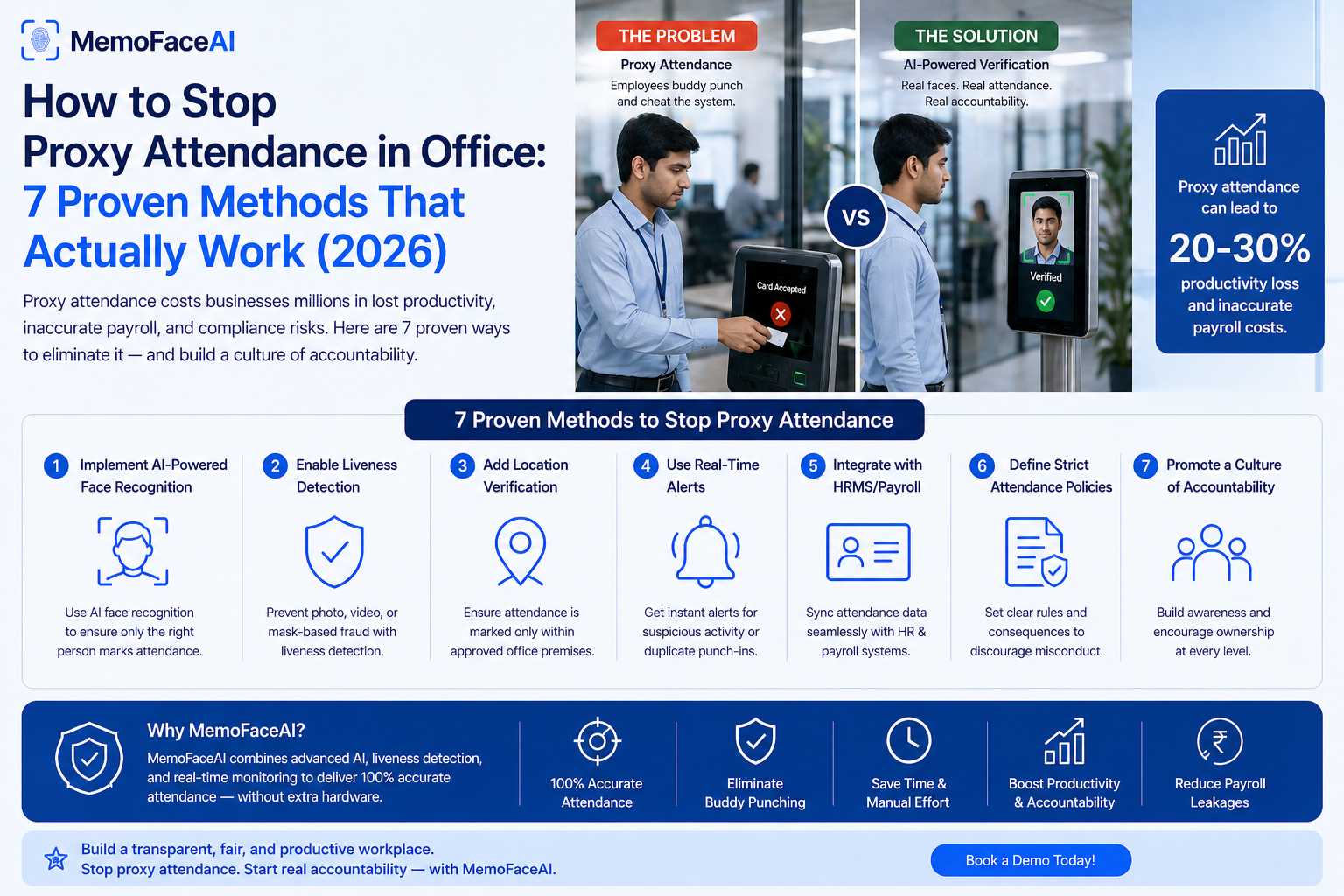
Proxy attendance — also called buddy punching — costs Indian businesses an estimated 1–5% of their salary bill every month. For a company with a INR1 crore monthly payroll, that is between INR1 lakh and INR5 lakh quietly leaking out each month. This guide walks through seven practical methods to stop proxy attendance, ranked by effectiveness.
What Proxy Attendance Actually Looks Like in Indian Offices
Before fixing the problem, it helps to understand its most common forms:
- Buddy punching — one employee marks attendance for another on a shared fingerprint or RFID system.
- Photo attendance — someone holds up a colleague's photo in front of a basic face recognition system.
- Shared login — an employee shares their app credentials or ID card with a friend.
- Ghost employees — fake employees added to payroll, often marked present by an accomplice.
- Location fraud — field staff mark attendance from home instead of the assigned work location.
- Time-manipulation — employees arrive late but get marked on-time through a friend's punch.
Each form has its own fix, and the most effective systems address multiple at once.
Method 1: Switch to AI Face Recognition Attendance
The single most effective way to stop proxy attendance is to switch to an AI-powered face recognition attendance system with 3D liveness detection. Unlike basic face recognition, 3D liveness verifies that a real, living human is in front of the camera — blocking photos, videos, masks, and screen replays.
Why this works better than anything else:
- It is not possible to share your face the way a card or fingerprint can be shared.
- 3D liveness confirms you are physically present, not a printed photo.
- The technology is low-friction — employees just look at their phone and walk in.
- Every attempt (successful or blocked) is logged with a timestamp and location.
Companies deploying face recognition with liveness typically report 95%+ reduction in proxy attendance within the first month.
Method 2: Add Geo-Fencing for Location Validation
Face recognition stops identity fraud. Geo-fencing stops location fraud.
Geo-fencing defines a virtual boundary around approved office locations. An employee can only mark attendance when both their face is verified and their phone is physically within the authorized zone.
This is especially valuable for:
- Field sales teams
- Service engineers and delivery staff
- Construction site workers
- Multi-branch organizations where each branch has specific geo-boundaries
Geo-fencing combined with face recognition is nearly impossible to fake — the employee would need to be physically at the location, with their own face, and their own device.
Method 3: Implement Device Binding
A simple but powerful method: bind each employee's attendance app to one registered device. If someone tries to mark attendance from a different phone, the system flags it.
This closes the loophole where one employee could install the app on a friend's phone and mark their attendance remotely. Device binding is a standard feature in any modern employee attendance system worth considering.
Method 4: Replace Shared RFID Cards with Personal Verification
RFID and proximity cards are among the worst technologies for attendance — they verify the card, not the person. A employee can hand their card to a colleague with a simple "please punch me in, I'll be late."
If you currently use cards, the migration path is clear:
- Start with a pilot on face recognition for one department.
- Issue a formal HR policy stating that attendance must be personal.
- Phase out cards over 30–60 days.
- Keep cards for physical access control only, not attendance.
Serious about stopping proxy in your organization? Run a free 15-day MemoFaceAI pilot and measure the exact leakage reduction in your own data.
Method 5: Enable Real-Time Alerts and Audit Logs
Prevention works best when paired with transparency. Modern attendance platforms should provide:
- Real-time alerts to HR when a proxy attempt is blocked.
- Immutable audit logs of every check-in attempt, successful or not.
- Visual dashboards showing patterns — specific employees, locations, or times with suspicious activity.
- Exportable reports for internal audits and investigations.
When employees know that every attempt is logged and visible to HR, attempted fraud drops sharply even before technical controls fully engage. Visibility itself is a deterrent.
Method 6: Tighten HR Policy and Communicate It Clearly
Technology alone is not enough. A clear HR policy on proxy attendance — shared openly, signed at joining, and reinforced periodically — creates the cultural layer that software supports.
A strong policy should:
- Define what constitutes proxy attendance in specific terms.
- State the consequences clearly (verbal warning, written warning, termination).
- Require acknowledgment at the time of joining.
- Apply equally to both the person marking proxy and the person being covered.
- Include a provision for periodic audits of attendance data.
Most Indian companies underestimate how much of their proxy problem comes from unclear expectations. A two-page policy well-communicated removes a large percentage of casual fraud.
Method 7: Regular Attendance Audits and Pattern Detection
Even with face recognition and liveness, periodic audits add an extra layer of confidence. Modern AI-driven attendance platforms automatically flag unusual patterns, such as:
- Employees consistently clocking in at exactly the same second every day.
- Attendance patterns that match another employee's schedule too precisely.
- Check-ins from new devices or unusual locations.
- Irregular working hours that don't match the team's pattern.
HR teams receive a weekly summary, review flagged cases, and address them quietly. Over time, the fraud detection gets smarter because the AI learns your organization's normal patterns.
Proxy Prevention Methods: Side-by-Side Comparison
| Method | Effectiveness | Cost | Ease of Implementation |
|---|---|---|---|
| AI Face Recognition + 3D Liveness | Very High | Low (software only) | 48 hours |
| Geo-Fencing | High (for field staff) | Included in most AI platforms | Instant |
| Device Binding | High | Included | Instant |
| Fingerprint Biometric | Medium | High (devices + AMC) | 2–4 weeks |
| RFID Cards | Low | Medium | 1–2 weeks |
| HR Policy Only | Low (without tech) | Minimal | Immediate |
| Manual Audits | Low (reactive) | High (HR time) | Ongoing |
The Real Cost of Doing Nothing
Let's put concrete numbers to this. A mid-sized company with 500 employees and an average monthly salary of INR40,000 has a monthly payroll of INR2 crore.
- If proxy attendance runs at just 2%, that is INR4 lakh leaking out every month — INR48 lakh annually.
- HR reconciliation time: three senior staff days every month spent cleaning attendance data.
- Team morale cost: harder to measure, but honest employees resent colleagues who game the system without consequences.
- Audit and compliance exposure: especially for companies with statutory or labour compliance requirements.
Against this, a modern AI face recognition attendance platform typically costs a tiny fraction of the leakage it prevents. The ROI question is rarely close.
Frequently Asked Questions
Can employees use a photo to fool face recognition?
With a basic face recognition system, yes. With a modern system using 3D liveness detection — like MemoFaceAI — no. Liveness verifies that a real, living human is in front of the camera through subtle depth and motion analysis. Photos, videos, and even high-quality masks are reliably blocked.
What if an employee claims the face recognition didn't work?
Legitimate recognition failures happen occasionally — poor lighting, phone covered, major appearance change. A good attendance platform provides a supervisor override with audit trail: the employee requests, the manager approves, and the event is logged. Genuine cases are handled smoothly; fraudulent claims become visible in the data.
How do we handle employees without smartphones?
Two options. First, provide shared tablets at entry points for these employees. Second, most AI attendance platforms work on any Android or iOS device — including low-cost phones. In practice, smartphone penetration in Indian offices is high enough that this is rarely a blocker.
Will employees resist face recognition attendance?
In our experience, honest employees welcome it — because it protects them from being falsely marked absent or late. The small percentage who resist are usually those benefiting from the existing proxy system. Clear communication and a short demo session address most concerns.
How quickly can we deploy this?
For a company of up to 500 employees, full deployment typically takes 48 to 72 hours. Enrollment is batch-uploaded from HR records, training is a 15-minute video, and employees start using it the same day.
The Bottom Line
Stopping proxy attendance is not a technical challenge anymore. The technology exists, it is affordable, and it deploys in days — not months. The real barrier is organizational inertia: companies keep tolerating a 2–5% payroll leakage because the legacy system is "what we have always used."
If you are ready to measure the actual scale of proxy in your organization — and eliminate it — the fastest path is to run a free 15-day pilot with a modern AI face recognition platform.
Stop paying for work that didn't happen. Book a MemoFaceAI demo or start your free pilot today.
Still Have Questions?
Here
are answers to the most common queries about AI-based attendance systems,
biometric alternatives, workforce tracking, facial recognition attendance, and
CCTV attendance monitoring.
FAQ
What is proxy attendance?
Proxy attendance occurs when one employee marks attendance for another.
Why is proxy attendance a problem?
It leads to inaccurate data and payroll losses.
Can biometric systems stop proxy attendance?
Not completely. They can still be bypassed.
What is the best way to stop proxy attendance?
AI-based tracking systems.
Does CCTV attendance eliminate proxy attendance?
Yes. It tracks individuals visually.