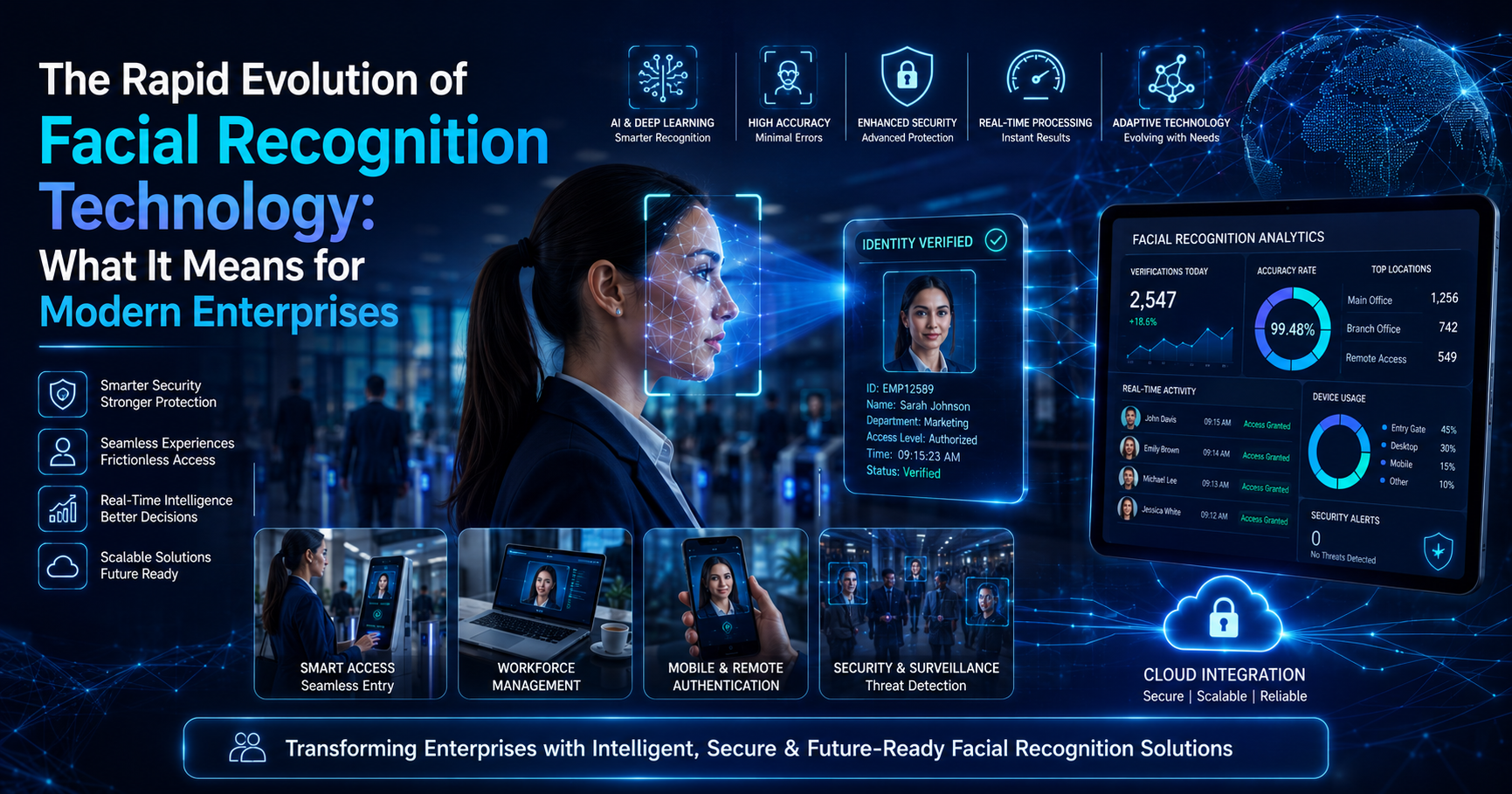
Recent industry reports and global market trends indicate that facial recognition is evolving from experimental deployments into mainstream enterprise adoption. Organizations across industries are increasingly integrating AI-powered facial intelligence into their daily operations to improve security, automation, attendance, access control, and operational visibility. (TechRadar)
As this transformation accelerates, businesses are beginning to realize that facial recognition is not just a security tool — it is becoming an intelligent operational layer for the modern digital workplace.
Why Facial Recognition Technology Is Growing So Fast
Several factors are driving the rapid adoption of facial recognition systems globally:
Growth of AI and computer vision technologies
Increased security requirements
Rising demand for contactless systems
Workforce automation needs
Smart city initiatives
Remote and hybrid workplace models
Operational efficiency demands
Availability of affordable AI infrastructure
Organizations are under pressure to improve security while also reducing manual processes and operational inefficiencies.
Facial recognition technology helps solve both challenges simultaneously.
From Security Tool to Enterprise Infrastructure
Traditionally, facial recognition systems were associated primarily with surveillance and law enforcement.
Today, the technology is expanding far beyond security.
Modern enterprises are now using facial recognition for:
Compliance monitoring
Fraud prevention
Smart retail experiences
Campus management
Industrial safety monitoring
According to recent industry analysis, facial recognition is increasingly becoming “business-critical infrastructure” rather than just a standalone security solution. (TechRadar)
This shift is transforming how organizations think about cameras and identity systems.
The Rise of Contactless Attendance Systems
One of the biggest areas of growth is AI-powered attendance management.
Traditional biometric systems face several operational challenges:
Physical contact
Hygiene concerns
Proxy attendance risks
Device maintenance
Queue management
Hardware dependency
AI-based face recognition attendance systems eliminate many of these limitations.
Employees can walk naturally through entrances while AI systems automatically identify and log attendance events in real time.
This creates:
faster employee movement,
better compliance,
and reduced operational friction.
Existing CCTV Infrastructure Is Becoming Intelligent
A major reason for rapid adoption is that organizations no longer need to replace their existing CCTV systems.
Modern AI platforms can integrate directly with existing camera infrastructure.
This creates a powerful opportunity for businesses:
no large hardware investment,
minimal infrastructure disruption,
and faster implementation.
Instead of installing entirely new systems, organizations can add an AI intelligence layer over existing cameras.
This approach significantly reduces deployment costs while improving operational capabilities.
MemoFaceAI: AI Intelligence Over Existing CCTV Infrastructure
MemoFaceAI is designed around this exact vision.
Rather than forcing organizations to replace their surveillance infrastructure, MemoFaceAI transforms existing CCTV systems into intelligent AI-powered monitoring and workforce management platforms.
Key Capabilities of MemoFaceAI
AI Face Attendance
Automatic employee attendance using existing CCTV cameras.
Unauthorized Access Detection
Identify unknown or restricted individuals entering secured areas.
Workforce Movement Analytics
Track employee movement patterns and workplace utilization.
Visitor Intelligence
Monitor visitor entry, exit, and movement within facilities.
Multi-Camera AI Monitoring
Centralized intelligence across multiple locations and camera feeds.
Real-Time Alerts
Generate instant notifications for suspicious or predefined events.
Searchable Video Intelligence
Quickly locate events using face recognition and AI filters.
Facial Recognition in Smart Workplaces
The workplace of the future will rely heavily on AI-powered identity systems.
In smart offices and industrial environments, facial recognition will increasingly integrate with:
Visitor management systems
Security operations centers
This creates a connected operational ecosystem where identity, movement, security, and productivity are all linked intelligently.
The Growing Importance of Ethical AI & Privacy
As facial recognition adoption increases, concerns around privacy, governance, and responsible AI usage are also growing globally. (The Guardian)
Organizations deploying facial recognition systems must ensure:
Transparent usage policies
Data security
Access controls
Responsible AI governance
Compliance with local regulations
The future of facial recognition will not depend only on technological advancement — it will also depend on trust.
Businesses that deploy AI responsibly will gain long-term operational and reputational advantages.
The Indian Opportunity for AI Facial Recognition
India represents one of the largest growth opportunities for AI-powered facial recognition systems due to:
Rapid urbanization
Smart campus initiatives
Growing enterprise digitization
Workforce automation needs
Large-scale infrastructure projects
Increased security requirements
Industries likely to see rapid adoption include:
manufacturing,
hospitals,
educational institutions,
logistics,
IT parks,
smart offices,
retail,
and industrial operations.
Organizations are actively looking for scalable, cost-effective AI solutions that can improve both security and operational intelligence.
The Future Is Not Just Surveillance — It Is Intelligence
The evolution of facial recognition technology is no longer about simply identifying people.
The next generation of AI systems will focus on:
behavioral understanding,
operational insights,
CCTV cameras are evolving from passive recording devices into active intelligence systems capable of assisting decision-making in real time.
This transformation is reshaping the future of security, attendance, workplace automation, and enterprise operations.
Final Thoughts
Facial recognition technology is rapidly moving into mainstream enterprise infrastructure.
What was once considered futuristic technology is now becoming a practical business tool for improving security, automation, workforce management, and operational visibility.
The organizations that adopt AI-powered facial intelligence early will gain significant advantages in:
efficiency,
compliance,
security,
and operational decision-making.
Platforms like MemoFaceAI are helping businesses accelerate this transition by turning existing CCTV infrastructure into intelligent AI-powered workplace systems.
The future of enterprise monitoring is no longer just about watching.
It is about understanding, analyzing, and acting intelligently in real time.