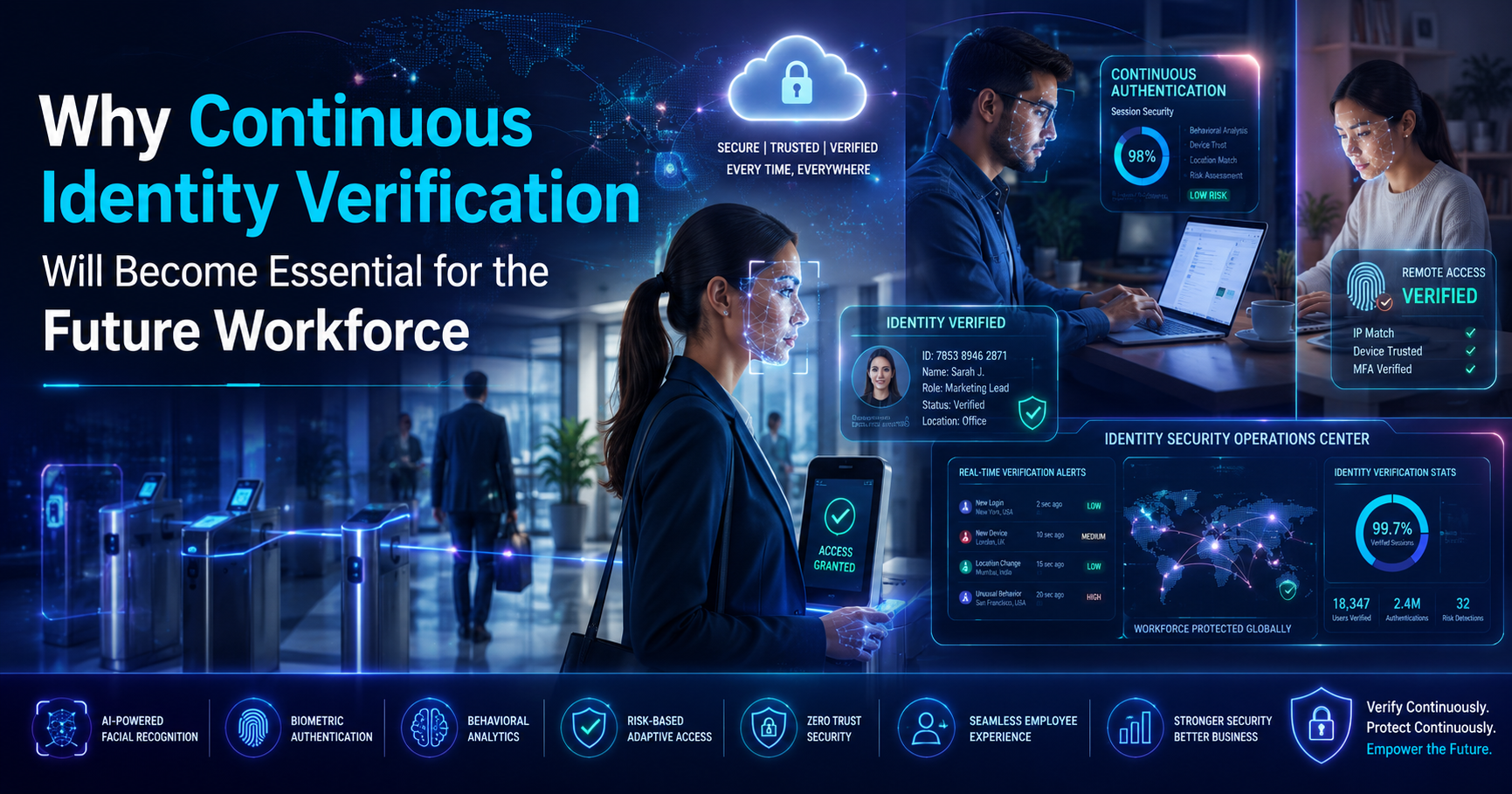
Organizations today are no longer only protecting customer identities — they must now continuously verify employees, contractors, vendors, and privileged users throughout the entire workforce lifecycle.
A recent report by Biometric Update highlighted how companies like Daon are launching continuous identity verification solutions designed to combat workforce fraud, fake hiring, account takeovers, and AI-driven impersonation attacks. (Biometric Update)
This reflects a major global shift in how enterprises approach workforce security, digital trust, and identity management.
The New Era of Workforce Fraud
Traditional employee verification methods were designed for physical workplaces where:
employees worked from office locations,
HR teams conducted in-person verification,
and IT access was tightly controlled.
That model is rapidly changing.
Today’s organizations face entirely new threats:
Fake remote job applicants
AI-generated resumes
Deepfake video interviews
Credential sharing
Insider threats
Account takeover attacks
Unauthorized privileged access
Identity spoofing
As AI-generated fraud becomes more sophisticated, traditional passwords and basic verification methods are becoming insufficient. (Daon)
Identity Verification Is No Longer a One-Time Process
One of the biggest shifts happening globally is the concept of:
Continuous Identity Verification
Instead of verifying identity only during hiring or login, organizations are beginning to verify trust continuously across the employee lifecycle.
This includes:
onboarding,
system access,
attendance,
sensitive transactions,
credential recovery,
remote access,
and privileged operations.
The goal is simple:
Continuously confirm that the person accessing systems is genuinely the authorized individual.
This approach significantly reduces fraud risks in hybrid and remote work environments.
AI Is Changing Both Sides of Security
Artificial Intelligence is creating both:
advanced fraud risks,
and advanced security solutions.
Fraudsters can now use AI to generate:
fake documents,
cloned voices,
deepfake video calls,
synthetic identities,
and highly convincing impersonation attempts.
At the same time, AI-powered identity platforms are using:
to identify suspicious activities in real time. (Biometric Update)
This is creating a global race between AI-driven fraud and AI-driven defense systems.
The Growing Importance of Facial Intelligence
Modern workforce identity systems increasingly rely on AI-powered facial intelligence because face recognition offers:
Frictionless user experience
Strong identity assurance
Reduced credential dependency
Faster workforce onboarding
Unlike passwords or access cards, facial identity is significantly harder to share, duplicate, or misuse.
This makes facial intelligence one of the fastest-growing areas in enterprise security infrastructure.
MemoFaceAI: Continuous Workforce Intelligence Through AI Vision
At MemoFaceAI, we believe the future of workforce security is not limited to login authentication alone.
The future lies in continuous AI-powered workforce intelligence.
MemoFaceAI helps organizations transform existing CCTV infrastructure into intelligent identity and workforce monitoring systems capable of:
Instead of relying only on isolated biometric devices or passwords, organizations can use AI vision systems to continuously validate workforce presence and access patterns.
Why Continuous Identity Matters in Modern Enterprises
The modern workplace is increasingly:
distributed,
hybrid,
cloud-connected,
and remotely managed.
This creates multiple identity risks:
shared credentials,
unattended sessions,
unauthorized remote access,
impersonation attacks,
and insider threats.
Continuous identity systems help organizations:
reduce account takeover risks,
strengthen access security,
automate compliance,
improve workforce accountability,
and increase operational trust.
This is becoming especially important in:
financial institutions,
hospitals,
government organizations,
manufacturing plants,
data centers,
educational campuses,
and enterprise offices.
Existing CCTV Infrastructure Can Become an Identity Layer
One of the biggest opportunities for enterprises is that existing camera infrastructure can now become part of identity security architecture.
Organizations no longer need separate identity hardware everywhere.
AI-powered platforms can use:
existing CCTV cameras,
and AI analytics
to continuously monitor identity confidence across environments.
This significantly improves scalability while reducing operational costs.
Beyond Authentication: The Rise of Behavioral Intelligence
The next evolution of workforce identity will combine:
Instead of only verifying:
“Who is this person?”
future systems will also evaluate:
how they behave,
where they move,
when they access systems,
and whether activity patterns appear normal.
Behavioral biometrics and AI anomaly detection are rapidly becoming key components of enterprise fraud prevention strategies. (Daon)
Privacy & Responsible AI Deployment
As workforce identity systems become more intelligent, organizations must also prioritize:
privacy protection,
secure data handling,
access governance,
and ethical AI practices.
AI identity systems should enhance security without creating unnecessary surveillance concerns.
Responsible deployment models such as:
will become increasingly important for enterprise adoption.
The Future of Workforce Security
The future of workforce security will not rely only on passwords, ID cards, or one-time authentication.
Organizations will increasingly move toward:
continuous identity verification,
AI-powered trust scoring,
intelligent workforce analytics,
and real-time behavioral monitoring.
The workplace itself is becoming an intelligent security environment.
AI vision systems, behavioral biometrics, and identity intelligence platforms will play a critical role in securing the next generation of digital enterprises.
Final Thoughts
Workforce fraud is evolving rapidly in the age of AI.
Deepfake impersonation, fake hiring, account takeovers, and synthetic identities are creating new security challenges for organizations worldwide.
As highlighted by recent developments in the digital identity industry, continuous identity verification is emerging as one of the most important enterprise security trends of the coming decade. (Biometric Update)
Platforms like MemoFaceAI are helping organizations prepare for this future by transforming existing CCTV infrastructure into intelligent AI-powered workforce identity systems.
The future of enterprise security is no longer just about access control.
It is about continuous trust.